Product Description
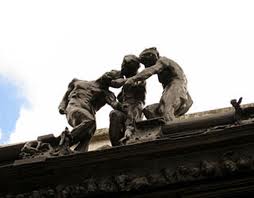
Mayo Martin Johnson / American Post-War bronze sculpture 1960

Mayo Martin Johnson (b. 1904) USA
“Summit Conference” 1960
Patinated bronze with a verdigris patina in the recessed areas and natural bronze highlights, original wooden plinth / base.
Marks: Red painted museum accession marks
For more information see: American Art, ed. Peter Hastings Falk (Madison, Conn.: Sound View Press, 1985) p. 317.
H: 10 ¼” on plinth
Price: $6,000
Mayo Martin Johnson / American Post-War bronze sculpture 1960
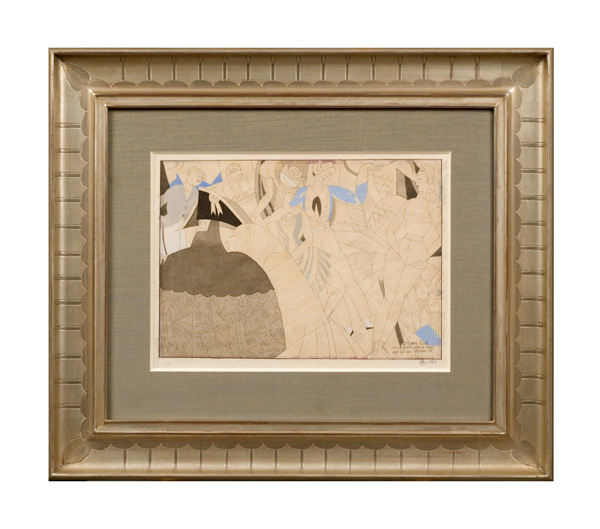
CHARLES MARTIN (1884-1934) France
Feu d’Artifice 1927
Pencil, ink, gouache and watercolor on paper.
Signed: Martin, A L’Ami Koval (dedication on lower right corner)
H: 8” x W: 11 7/16”
Price: $12,500
Charles Martin was a notable French illustrator, graphic artist, posterist, fashion and costume designer. His drawings are charming, amusing and sophisticated. The artist studied at the Montpelier Ecole des Beaux Arts, Academie Julian and Ecole Des Beaux Arts, Paris. Throughout his career, Martin was also a contributor to the French fashion journals Gazette du Bon Ton, Modes et Manieres d’Aujourd’hui, Journal Des Dames et Des Modes, and Vogue. His illustrated books include the hat catalogue “Les Modes en 1912,” the erotic “Mascarades et Amusettes” 1920, and “Sports et Divertissements” 1919, written in collaboration with composer Erik Satie.
ROBERT BREER (1926-2011) USA
Untitled 1950
Oil on canvas, white-gold leaf and lacquer frame
Marks: Untitled, 1950, Robert Breer, 26×32, No. 29 in a circle (paper label)
Provenance: Robert Breer, Private Collection, Chicago
Canvas: H: 25 3/4” x W: 32”
Framed: H: 32 1/4” x W: 39″
“Breer acknowledges his respect for this purist, “cubist” cinema, which uses geometric shapes moving in time and space”
Robert Breer’s career as an artist and animator spans 50 years and his creative explorations have made him an international figure. He began his artistic pursuits as a painter while living in Paris from 1949-59. Using an old Bolex 16mm camera, his first films, such as “Form Phases”, were simple stop-motion studies based on his abstract paintings.
Breer has always been fascinated by the mechanics of film. Perhaps it was his father’s fascination with 3-D work that inspired Breer to tinker with early mechanical cinematic devices. His father was an engineer and designer of the legendary Chrysler Airflow automobile in 1934 and built a 3-D camera to film all the family vacations. After studying engineering at Stanford, Breer changed his focus toward handcrafted arts and began experimenting with flip books. These animations, done on ordinary 4″ by 6″ file cards have become the standard for all of Breer’s work in fim.
Like many of his generation, Breer did early work influenced by the various European modern art movements of the early 20th century, ranging from the abstract forms of the Russian Constructivists and the structuralist formulas of the Bauhaus, to the nonsensical universe of the Dadaists. As a result of his association with the Denise René Gallery, which specialized in geometric art, he saw the abstract films of such pioneers as Hans Richter, Viking Eggeling, Walter Ruttmann and Fernand Léger. Breer acknowledges his respect for this purist, “cubist” cinema, which uses geometric shapes moving in time and space.
In 1955, he helped organize and exhibited in a show in Paris entitled “Le Mouvement” (The Movement), which paved the way for new cinema aesthetics. During this period, Breer also met the poet Allen Ginsberg and introduced him to his film “Recreation” (1956), which made use of frame-by-frame experiments in a non-narrative structure. Although Breer resisted being labeled a beatnik, the film does capture some aspects of beat poetry and music.
When Breer returned to the United States in the late 1950s, the American avant-garde was thriving and films by Kenneth Anger, Stan Brakhage, Peter Kubelka and Maria Menken were creating a new visionary movement. Breer found kindred spirits within the New York experimental scene. As Pop Art emerged as a phenomenon in the 1960s, Breer befriended Claes Oldenburg and others. He worked on the TV show, “David Brinkley’s Journal”, filming pieces on art shows in Europe; at the same time, he made his debut documentary on the sculptor Jean Tinguely in 1961.
GALERIE CARREFOUR 141Boulevard Raspail, Paris
Vérité Collection Wood block print poster “ARTS PRIMITIFS, CARREFOUR, 141 BD RASPAIL, DAN 5803″ c. 1948
Float mounted in a finely contoured oak frame.
Inscribed to: A Monsieur E Mme Breton, Vérité Image dimension:
H: 19 1/2″ x W: 12 3/4″
Framed dimension: H: 26 3/4″ x W: 19 3/4”
Price: $9,000
The Vérité Collection of primitive arts started after World War 1 in 1920. Pierre Vérité, a young artist started buying primitive art before anyone else. Vérité opened a small store selling exclusively tribal art in 1931 in conjunction with the Paris Colonial Exposition. Pierre Vérité regarded “primitive arts” as art, and it is the raw power of these primitive pieces that changed the history of 20th-century European culture. In 1936, he opened the Galerie Carrefour on the Boulevard Raspail, which was a hangout for artists and collectors such as Pablo Picasso, Helena Rubenstein, Nancy Cunard and Andre Breton. Tribal art was one of the key influences on Pablo Picasso and he often dropped into Pierre Vérité’s Galerie Carrefour in Paris to buy masks and carvings from Africa and Oceania. Henri Matisse was also a regular visitor, as were other artists such as Fernand Léger and Maurice de Vlaminck, while Vérité used to browse Parisian flea markets with André Breton, Surrealism’s chief theorist. In the decades that followed the opening of the gallery, the Vérité family’s client list grew to include Hollywood stars and leading museum curators, as well as some of the greatest names in 20th-century art. Vérité very quickly became the most important art dealer for primitive arts. In the 1948, Pierre’s son Claude became increasingly involved in the gallery. He went on African expeditions, collecting objects and information, and took photographs to document his travels, while his wife Jeannine was running the gallery operations. With Claude and Jeannine joining the gallery, Galerie Carrefour showed at all “Art Primitifs” exhibitions in Europe and the United States. The gallery established itself as the most important player in tribal arts in the world and exhibited until the 1990’s.
FORREST (FROSTY) MYERS (1941- ) USA
Orange cube 2008
Orange anodized and contoured aluminum wire manipulated into a cube form
Signed: Orange Cube, 08, Forrest Myers (on plaque)
For more information see: Who Was Who in American Art (Madison, Conn.: Sound View Press, 2003-2004 25th Edition), Dictionary of American Sculptors: 18th Century to the Present, Glen Opitz (Poughkeepsie, NY: Apollo, 1984).
Dimension: 10 1/2″ cube
Price: $15,000
A sculptor and art teacher born in Long Beach, California, Forrest Myers settled in Brooklyn, New York. Myers studied at the San Francisco Art Institute. His teaching venues include the San Francisco Art Institute, School of Visual Arts in New York, Kent State University, and the Parsons School of Design. His studio is in Brooklyn.
In the early 1980s, Forrest Myers was applying Buckminster Fuller's principles of tensegrity and repeated tetrahedrons into his designs for furniture. This exploration culminated in the use of aluminum wire that becomes structural when bent and pressed into a dense tangle.