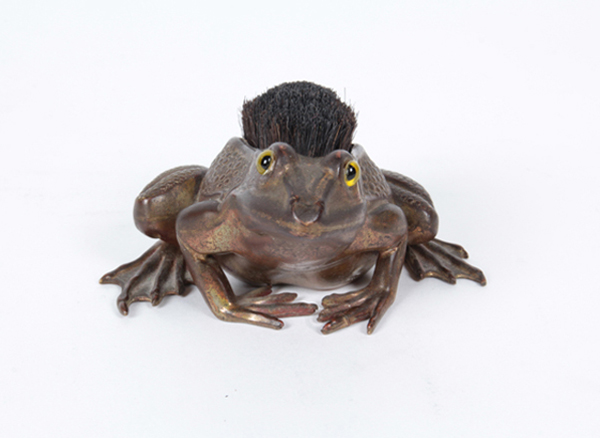
Franz Xaver Bergman Art Nouveau "Frog" pen wipe c. 1905-1910
More Information
Franz Xaver Bergman Art Nouveau “Frog” pen wipe c. 1905-1910
FRANZ XAVER BERGMAN (1861-1936) Austria
“Frog” pen wipe c. 1905-1910
Cold-painted bronze, boar’s hair bristles
For information see: Art Bronzes, Mich. Forrest (Schiffer, 1988).
L: 3 1/2″ x W: 3 1/2″ x H: 2″
Price: $1,675
A well-known animalier at the turn-of-the century, the sculptor Franz Bergman created a number of small bronzes in a variety of subject matter. Other figurative works were informed by the Jugendstil / Art Nouveau style and the European taste for the exotic as is found in his figures of rug merchants and camels. His animal sculptures, however, capture the Viennese tradition of naturalistic bronzes. The quality of the bronze casting shows tremendous detail, which was carefully brought out through the applied patination process known as cold painting.
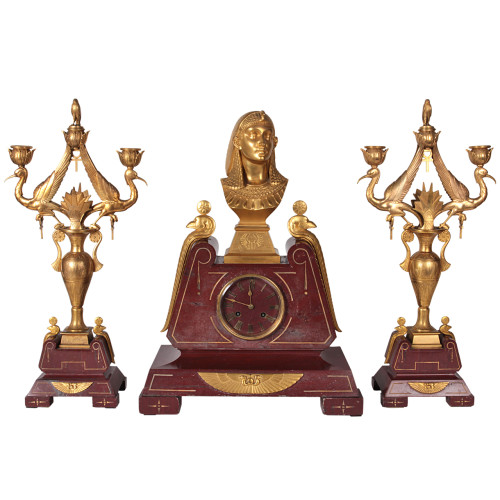
Paul-Auguste Gagné, French Egyptian Revival Gilt Bronze Garniture Set c. 1875
Paul-Auguste Gagné (Sculptor) France
Egyptian Revival garniture set, circa 1875
Gilt bronze and carved rouge marble mantle clock and candelabra in a high Egyptian Revival style
Marks: P.A. Gagne (elaborate incised scroll signature on the back of the portrait bust)
For more information on Gagné see: Dictionnaire des peintres, sculpteurs, dessinateurs et graveurs, vol. 4, E. Bénézit (Paris: Librairie Gründ, 1976) p. 579.
For other related Egyptian Revival garniture sets see: Egyptomania: Egypt in Western Art, 1730-1930 (Paris: Éditions de la Réunion des Musées Nationaux and Ottawa: National Gallery of Canada, 1994)
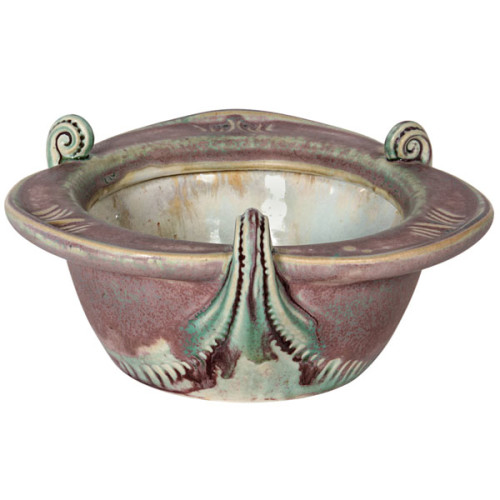
Louis Majorelle French Art Nouveau “Fiddleback Fern” bowl c. 1900
LOUIS MAJORELLE (1859-1926) France
MOUGIN FRÈRES Nancy, France
Fiddleback Fern trefoil bowl c. 1900
A rare stoneware example of Majorelle and the L’Ecole de Nancy with a mauve and sea-green glaze, crystalline formations in interior in a trefoil loped form with fiddleback ferns at each interval.
Marks: Majorelle. de (impressed facsimile signature) MOUGIN NANCY, 10.K , L
Illustrated: Majorelle: Une Aventure Moderne, Roselyne Bouvier (Paris:
La Bibliothèque des Arts/Editions Serpenoise, 1991) p. 34, illus. 32.
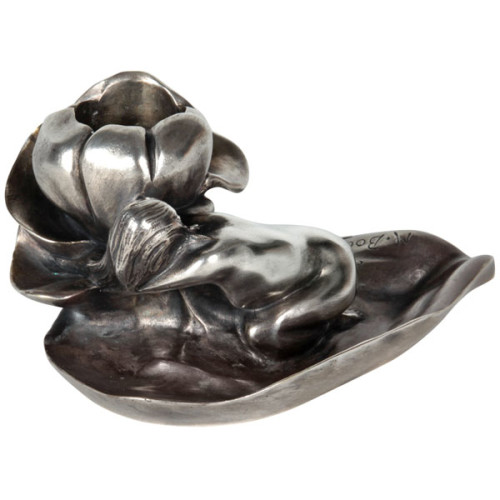
Maurice Bouval French Art Nouveau Nymph Silvered Bronze Candleholder c. 1900
MAURICE BOUVAL (born Toulouse, died 1920) France
M. COLIN France
“Nymph Embracing a Blossom” candle holder c.1900
Silvered cast bronze in the form of a nymph on a leaf embracing a blossom
Marks: M. Bouval (script signature) and COLIN, (Foundry) written above
For other examples of Bouval’s work see: The Paris Salons 1895-1914, Vol. V: Objets d’Art & Metalware, Alastair Duncan (Woodbridge, Suffolk: Antique Collectors’ Club, 1999), p. 127; Ecole to Deco, Small Sculptures from a Private Collection, Stephen C. McGough ed. (Oberlin, Ohio: Allen Memorial Art Museum, 1979) pp. 33-4; Art Nouveau Sculpture, Alastair Duncan (New York: Rizzoli, 1978) pp. 30-1.
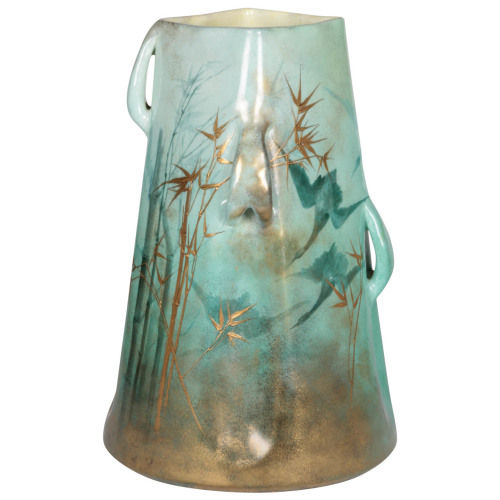
Clement Massier / French Art Nouveau “Bamboo and Flying Crane” Vase circa 1900
CLÉMENT MASSIER (1845-1917) France
MASSIER ART POTTERY Golfe Juan, France
“Bamboo and flying crane” vase c. 1900
Earthenware tapering form with applied handles, hand painted with bamboo and flying cranes with gilt motives and details
Marks: Clement Massier Golfe Juan (block impressed letters)
For more information and other works by the Massier family see: Lost Paradise: Symbolist Europe (Montreal, Quebec: The Montreal Museum of Fine Arts, 1995) p. 176, cat. 269; Jugendstil Art Nouveau, Floral and Functional Forms, Siegfried Wichmann (New York/Boston: Graphic Society/Little, Brown & Co., 1984) p. 45; Art Nouveau Belgium France. Exh. cat. Yvonne Brunhammer et al. (Houston, TX: Institute for the the Arts, Rice University, 1976); La Céramique Art Nouveau, Edgar Pélichet, Michèle Duperrex (Paris: La Bibliothèque des Arts, 1976) p. 89




 @hd_jewels