Gustav Gurschner, Secessionist / Byzantine Revival bronze vase c. 1905
More Information
Gustav Gurschner, Secessionist / Byzantine Revival bronze vase c. 1905
GUSTAV GURSCHNER (1873-1970) Austria
Vase c. 1905
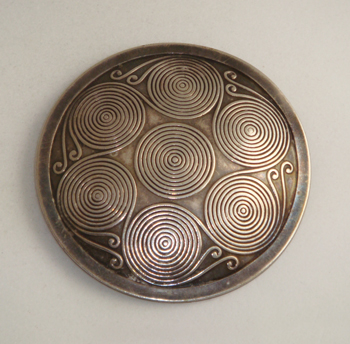
Cast bronze ovoid shaped vase with decorative Celtic motif, lightly gilded, the body of the vase simulating leather with a rich brown patina
Signed: GURSCHNER, M180 (stamped in the bronze)
Related works illustrated: The Studio, Special Summer Number 1906: The Art Revival in Austria, ill. no. D6; Studio Yearbook (London, 1909), pp. 139-140; Vienna Turn of the Century: Art and Design, Fischer Fine Art, exhib. cat. (London 1979), p. 23, illus. 1; Bronzes, sculptors & Founders, H. Berman, (Atglen 1994 III) p. 781, cat. nos. 2893, 2894; Decorative Art 1880-1980, Dan Klein & Margaret Bishop (Oxford, England: Phaidon and Christie’s Limited, 1986) p. 84, illus. 1
H: 7 1/4″ x D: 7″ x D: 4″
Price: $14,500
Gustav Gurschner was born in Tirol, Austria. He attended the Fachschule für Holzindustrie in Bozen from 1885-1888. After three years, his instructors encouraged him to attend the Austrian Museum for Applied Arts’ Kunstgewerbeschule in Vienna. After finishing his formal training, Gurschner pursued a career as a sculptor of monumental works. It was while he was in Paris in 1897, that he first turned his energies from the application of small-scale, sculptural works to the aesthetic design of household objects. Shortly thereafter, he returned to Vienna to join the Secessionists whose ideals he shared. By the turn-of-the-century, Gurschner was not only one of the better known artists working in Vienna but enjoyed a reputation that extended into other European countries as well.
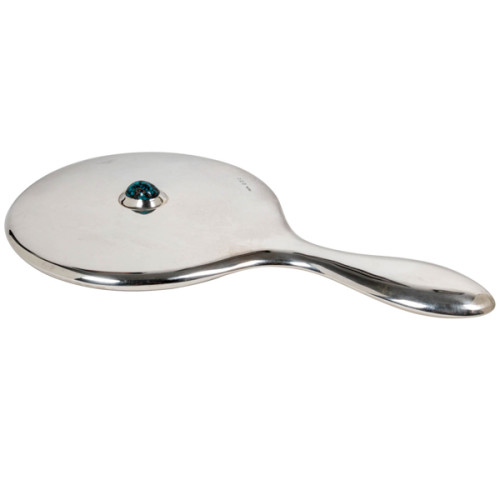
Archibald Knox / Liberty & Co. Sterling hand mirror 1908
ARCHIBALD KNOX (1864-1933) UK
LIBERTY & CO. London, UK
Hand mirror 1908
Sterling with large matrix cabochon turquoise
Marks: L & Co. cipher, Birmingham assay marks for 1908
Similar works with turquoise Illustrated: Archibald Knox, ed. by Stephen A. Martin (London: Academy Editions, 1995) ; Liberty Design 1874-1914, Barbara Morris (London: Pyramid Books, 1989) p. ; The Designs of Archibald Knox for Liberty & Co., A.J. Tilbrook (London: Ornament Press Ltd., 1976)
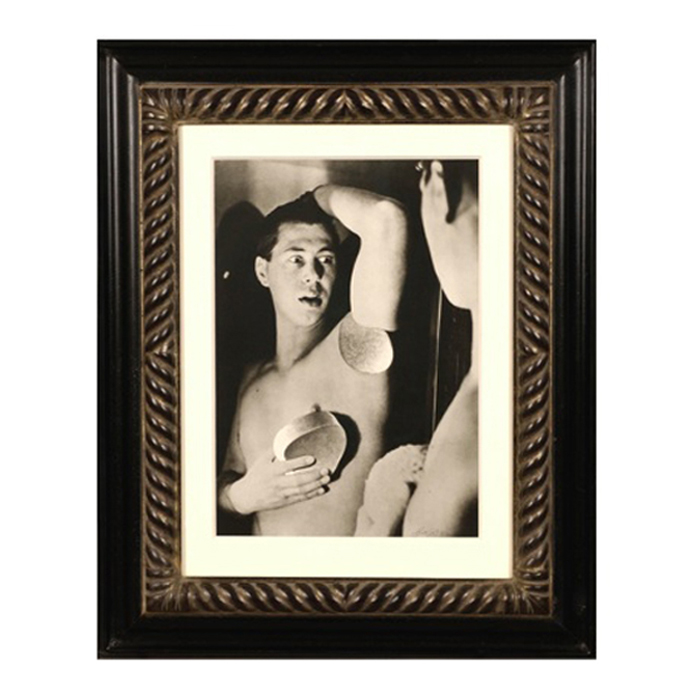
Herbert Bayer, Self Portrait, Gelatin silver print , 1932, printed later
HERBERT BAYER (1900-1985) Austria
Self portrait 1932 (printed later)
Silver gelatin print
Edition: 28/40
Signed: bayer 32 (in ink on bottom right corner)
Provenance: Kennedy Gallery, New York
H: 13 7/16” x W: 9 ½”
Framed size: H: 21 ½” x W: 17 ½”
Price: $16,000
Herbert Bayer (1900 – 1985) was an Austrian graphic designer, painter, photographer, and architect. Bayer apprenticed under the artist Georg Schmidthammer in Linz. Leaving the workshop to study at the Darmstadt Artists’ Colony, he became interested in Walter Gropius’s Bauhaus manifesto. After Bayer had studied for four years at the Bauhaus under such teachers as Wassily Kandinsky and László Moholy-Nagy, Gropius appointed Bayer director of printing and advertising. In the spirit of reductive minimalism, Bayer developed a crisp visual style and adopted use of all-lowercase, sans serif typefaces for most Bauhaus publications. Bayer is one of several typographers of the period including Kurt Schwitters and Jan Tschichold who experimented with the creation of a simplified more phonetic-based alphabet. Bayer designed the 1925 geometric sans-serif typeface, universal, now issued in digital form as Architype Bayer that bears comparison with the stylistically related typeface Architype Schwitters.
In 1928, Bayer left the Bauhaus to become art director of Vogue magazine’s Berlin office. He remained in Germany far later than most other progressives. In 1936 he designed a brochure for the Deutschland Ausstellung, an exhibition for tourists in Berlin during the 1936 Olympic Games. In 1938 he left Germany and settled in New York City where he had a long and distinguished career in nearly every aspect of the graphic arts. In 1946 Bayer relocated again. Hired by industrialist and visionary Walter Paepcke, Bayer moved to Aspen, Colorado as Paepcke promoted skiing as a popular sport. Bayer’s architectural work in the town included co-designing the Aspen Institute and restoring the Wheeler Opera House, but his production of promotional posters identified skiing with wit, excitement, and glamour. Bayer would remain associated with Aspen until the mid-1970s. Bayer gave the Denver Art Museum a collection of around 8,000 of his works. In 1959, he designed his “fonetik alfabet”, a phonetic alphabet, for English. It was sans-serif and without capital letters. He had special symbols for the endings -ed, -ory, -ing, and -ion, as well as the digraphs “ch”, “sh”, and “ng”. An underline indicated the doubling of a consonant in traditional orthography.
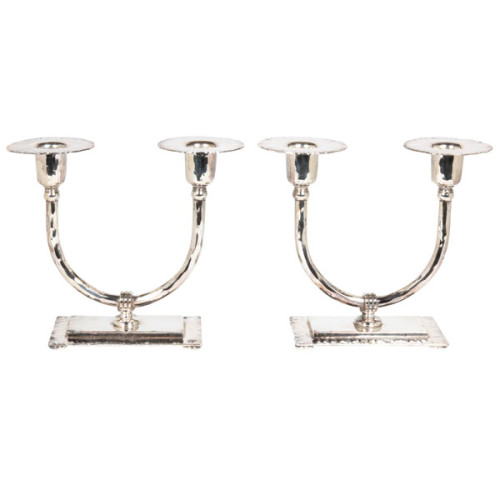
Roycroft / American Arts & Crafts Pair of Candlesticks c. 1915
ROYCROFT COPPER SHOP East Aurora, N.Y.
Pair of candlesticks c. 1915.
Hand wrought and textured copper, silver-plated.
Marks: impressed R, in orb with cross, ROYCROFT
For more information see: The American Arts & Crafts Movement in Western New York 1900-1928, Bruce A. Austin (Rochester Institute of Technology, 1992); Arts & Crafts Movement in New York State 1890’s – 1920’s, Coy Ludwig (Hamilton, N.Y.: Gallery Association of New York, 1983).




 @hd_jewels