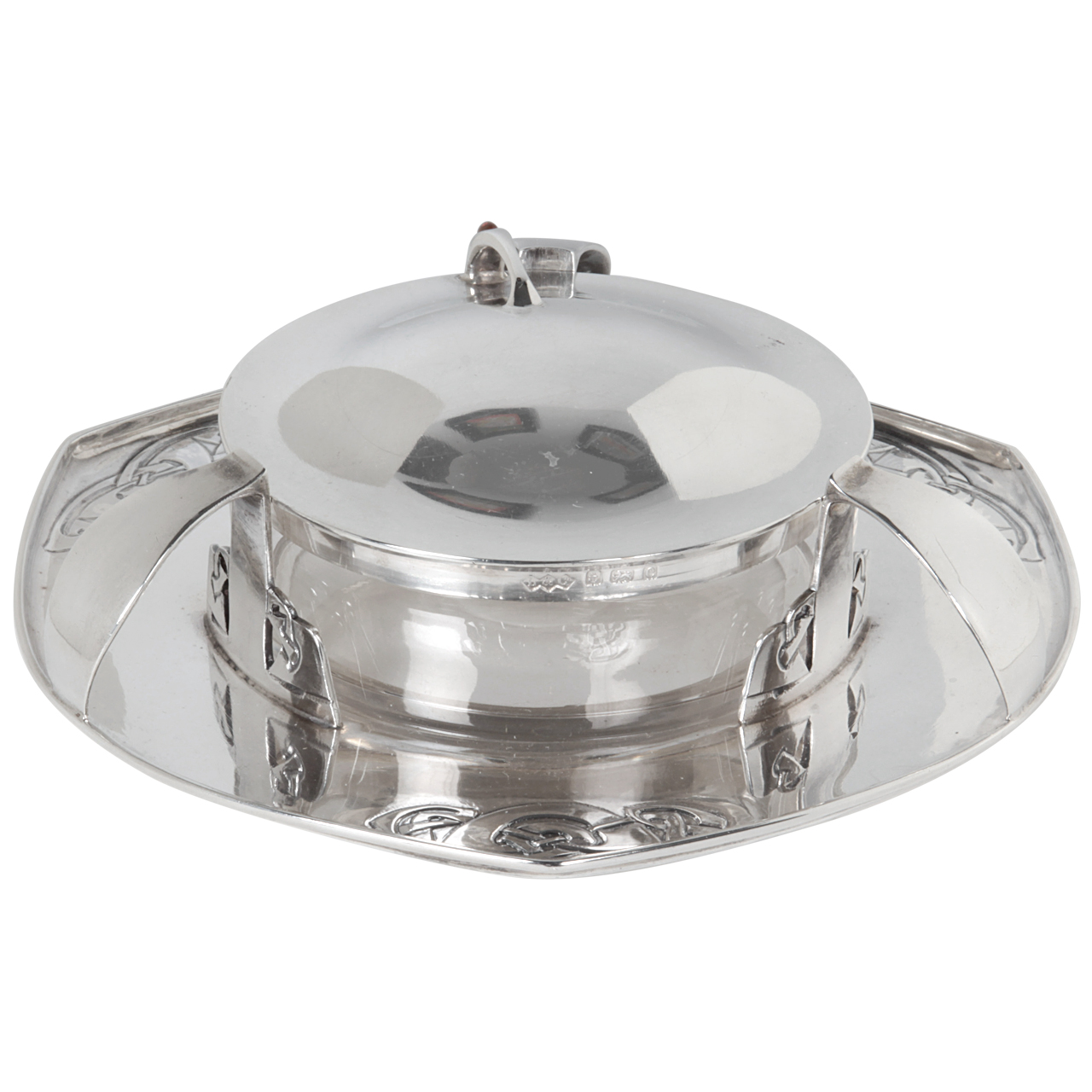
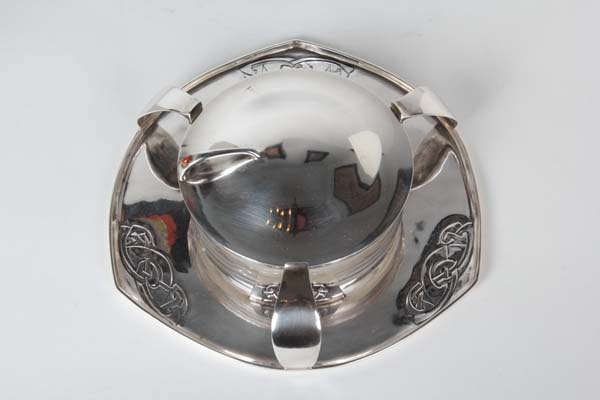
Archibald Knox / Liberty & Co. Rare Sterling and Opal caviar server 1904
More Information
Archibald Knox / Liberty & Co. Rare Sterling and Opal caviar server 1904
ARCHIBALD KNOX (1864-1933) UK
LIBERTY & COMPANY London, UK
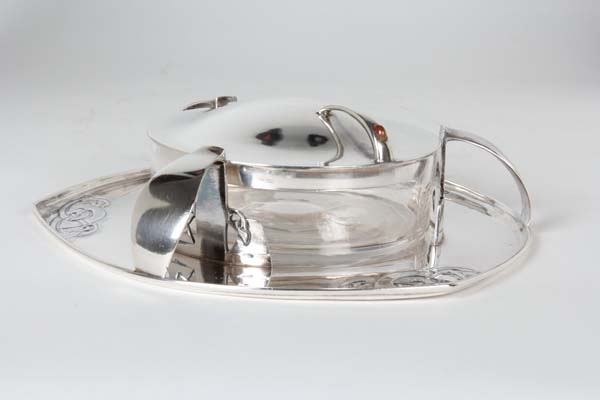
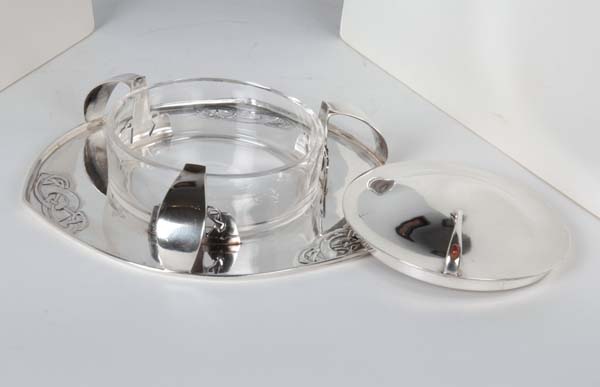
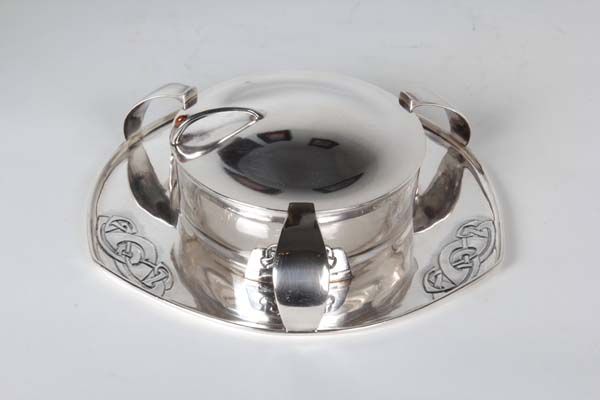
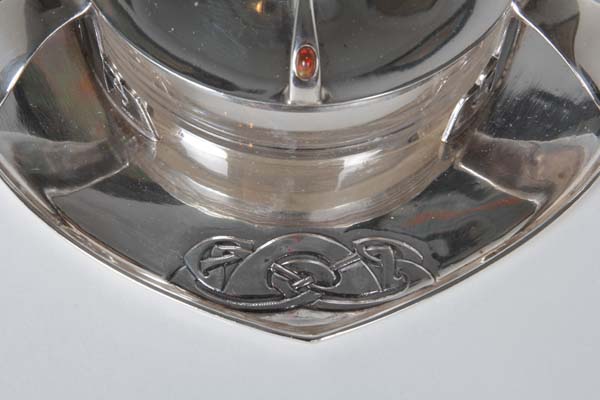
Cymric tri-handled covered server 1904
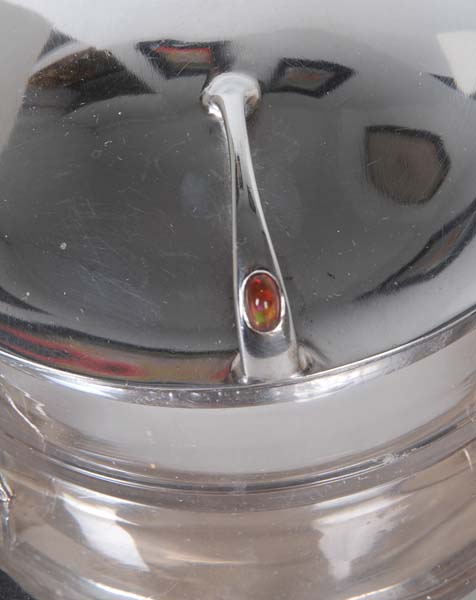
Sterling silver with repoussé Celtic knot motifs and three buttress handles; the handle of the domed lid inset with a jelly opal, cylindrical crystal bowl.
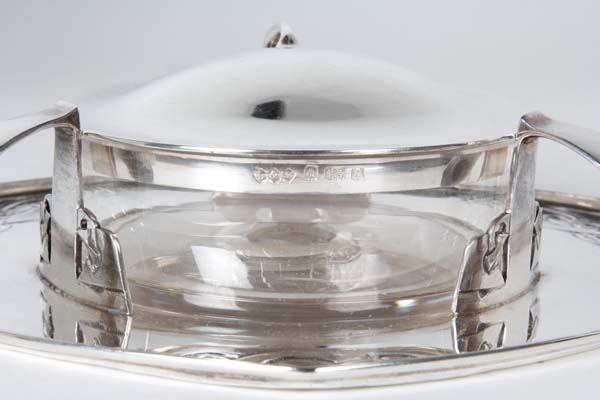
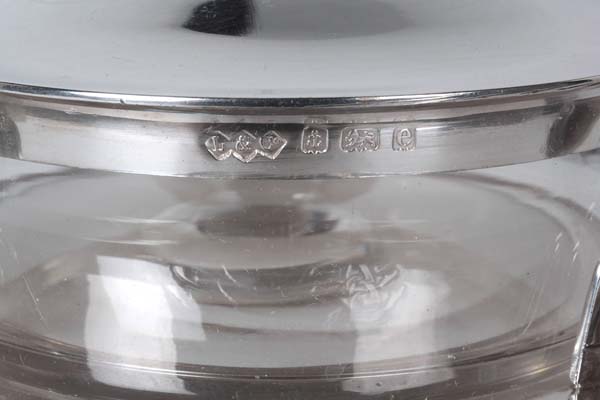
Marks: No. 5199, Liberty & Co., CYMRIC and Birmingham assay marks for 1904 (all the marks appear both on the underside of the base and on the cover)
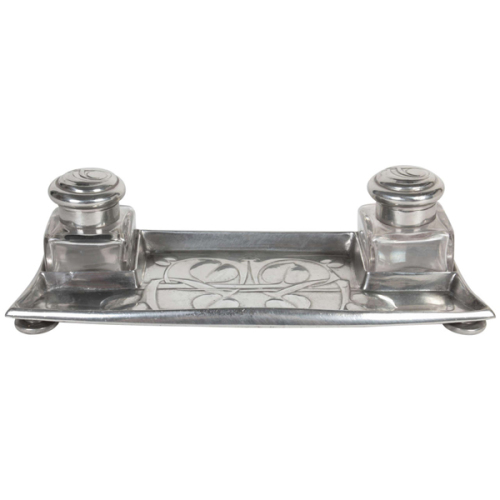
Archibald Knox / Liberty & Co. Double inkwell stand c. 1902-05
ARCHIBALD KNOX (1864-1933) UK
LIBERTY & CO. London
Double inkwell stand c. 1902-05
Pewter with abstract Celtic design in bas-relief
Condition: excellent, no repairs or damage
Marks: 3, ENGLISH PEWTER 00715
Illustrated: Archibald Knox, ed. by Stephen A. Martin (London: Academy Editions, 1995) p 113; Liberty Design 1874-1914, Barbara Morris (London: Pyramid Books, 1989) p. 86; The Designs of Archibald Knox for Liberty & Co., A.J. Tilbrook (London: Ornament Press Ltd., 1976) p. 158.
H: 2 ¾” x W: 9 ¼” x D: 4”
This early British inkwell stand demonstrates the profound influence of Celtic ornament upon Knox and his highly individual and sophisticated use of these ancient graphic devices of interlocking loops and tendrils.
Christopher Dresser / Linthorpe, Rare Aesthetic Movement Persian jug 1879
CHRISTOPHER DRESSER (1834-1904) UK
LINTHORPE ART POTTERY, Middlesbrough
HENRY TOOTH Artistic Manager Linthorpe (1842-1918) UK
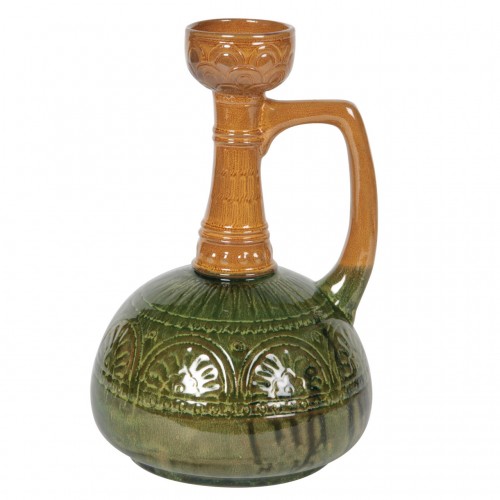
“Persian” jug 1879-1882
Glazed earthenware
Marks: LINTHORPE, Chr. Dresser (facsimile signature),
HT, no. 344
Illustrated: Truth, Beauty, Power: Dr. Christopher Dresser 1834-1904, exhibition catalogue Historical Design, Inc. (New York, 1998) p. 76.
H: 8 3/4″
Rare model.
The contrasts in Dresser’s designs for different materials showed how his approach to design was also shaped by the properties and nature of a material. In 1879 Dresser was appointed art director at the newly established Linthorpe pottery, near Middlesbrough. Founded by John Harrison, a local businessman, the pottery’s aim was to use local clay to provide jobs for local men. Dresser’s design for the moulds for the pottery were inspired by a wide range of cultures from Japan, Peru, Mexico, Morocco and Ancient British forms. These very striking pieces, with the metal oxides in the complex and innovative glazes providing the only decoration. All of his designs were impressed with a facsimile signature. When Linthorpe closed in 1889, its moulds were acquired by a rival, Ault Pottery in Derbyshire. In 1893, Dresser signed a contract with Ault for new designs specifying that each pot should be marked with his facsimile signature.


 @hd_jewels