
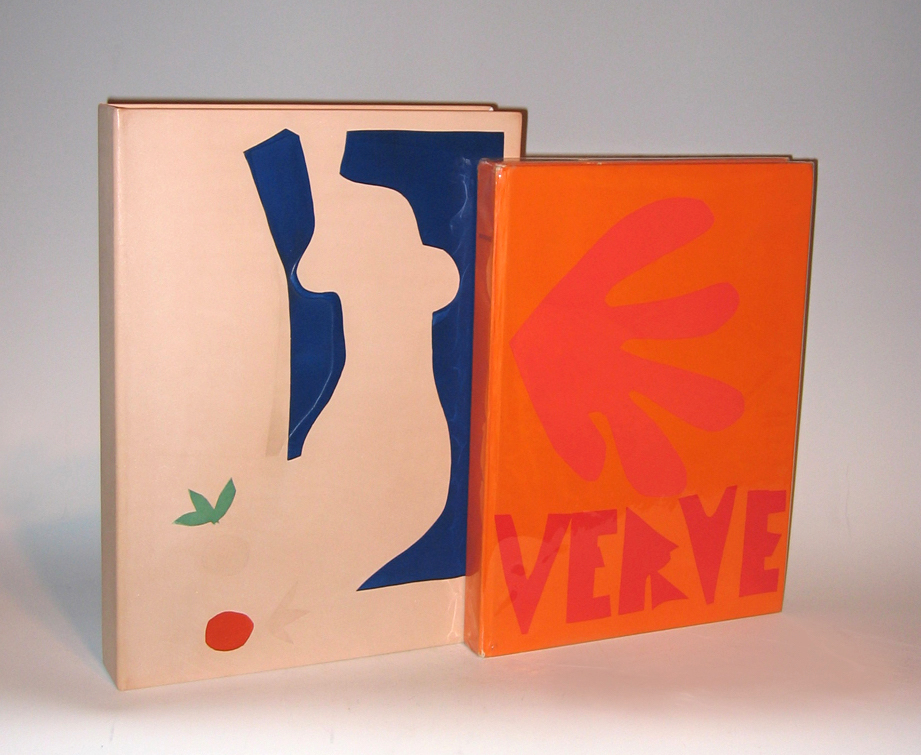
Product Description
Henri Matisse “Verve” Vol. IX No. 35 & 36, 1958

HENRI MATISSE (1869-1954) France
“Verve” Vol. IX No. 35 & 36 1958
Revue artistique et littéraire paraissant quatre fois par an
Created and editioned at the Mourlot Studio, Paris.
Published by E. Tériade, Paris 1958.
Dimensions:
Book: H 14 1/2” x W: 10 11/16”
Custom leather box: H: 15 13/16” x W: 11 5/8” x D: 2 1/16”
Custom linen case: H: 16 3/4” x 12 5/16” x D: 2 5/8”
Henri Matisse “Verve” Vol. IX No. 35 & 36, 1958
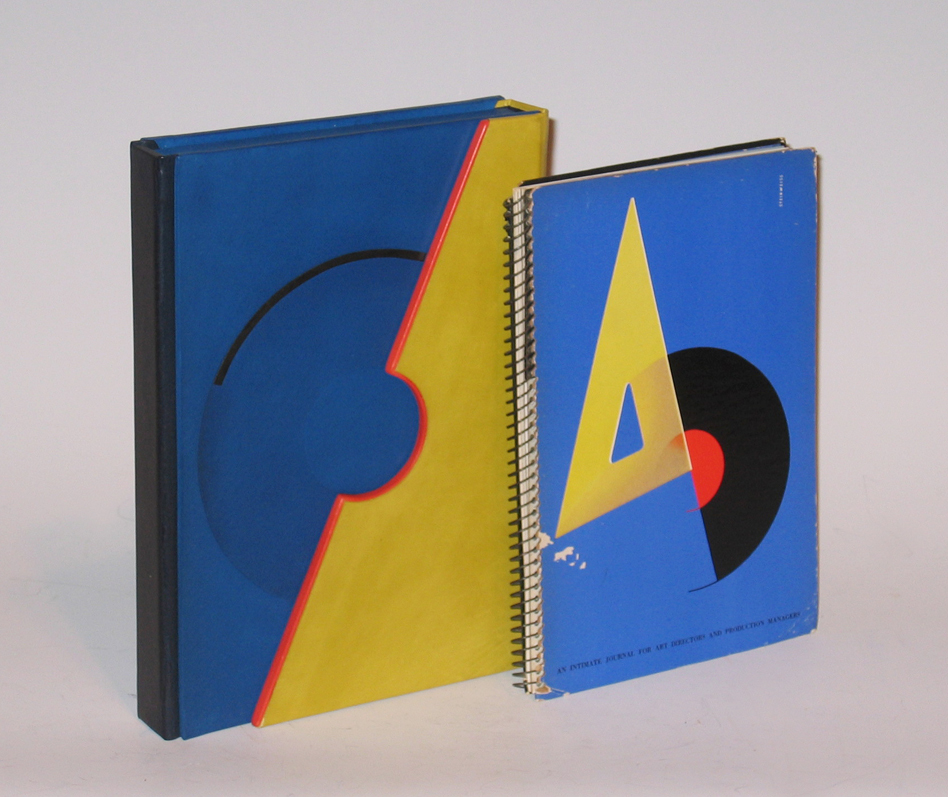
AD
“An Intimate Journal for Art Directors and Production Managers” 1941
Published by Steinweiss
Dimensions:
Book: H: 8 1/8” x W: 5 ¾”
Custom leather box: H: 9 1/16” x W: 6 9/16” x D: 1 7/16”
Custom silk slipcase: H: 12 9/16” x W: 9 3/16” x D: 2 ¾”
An Intimate Journal For Art Directors, production Managers, and their Associates
The Alex Steinweiss Issue
[Alex Steinweiss] Robert L. Leslie and Percy Seitlin [Editors]: A-D [AN INTIMATE JOURNAL FOR ART DIRECTORS, PRODUCTION MANAGERS, AND THEIR ASSOCIATES]. New York: The Composing Room/P.M. Publishing Co., June-July 1941 [Volume 7, No. 5]. Original edition. Spiral-bound paper-covered boards printed in 4-color letterpress. Screen-printed acetate frontis. Cover faintly creased. Interior contents unmarked and very clean. Letterpress cover designed by Alex Steinweiss. One of the hardest issues of PM/AD to find in collectible condition. A nearly fine copy.
This Steinweiss cover is widely recognized as a singular high point in American Graphic Design that has been reproduced in countless histories and anthologies.
5.5 x 8 digest with 68 [16] pages including numerous color and b/w reproductions. The artwork is reproduced in four-color letterpress, and magnificent b/w photo engraving. There is even a screen-printed acetate title page! Truly an increbible single issue of a trend-setting publication.
Contents for this issue:
• 16 page color profile of Alex Steinweiss, Art Director for Columbia Records (many examples of cutting edge streamline moderne graphics).
• Herbert Bayer’s Design Class: 13 b/w pages of student photomontages by William Taber, Gene Federico, E. G. Lukacs, Eleanor Mayer, Ernest Cabat, Jere Donovan, Fritz Brosius, Sol Benenson, David Weisman, Robert Pliskin, R. H. Blend, Eugene Zion, Edmund Marein.
• What is Taught and Why – A Footnote to the Recent Bayer Classwork Exhibit at the A-D Gallery.
• Designs in Glass by contemporary Artists from the Steuben Collection: 16 b/w pages including full-page reproductions of the art-glass work of Jean Cocteau, Salvador Dali, Raoul Dufy, Duncan Grant, Jean hugo, Peter Hurd, Fernand Leger, Aristide Maillol, Henri Matisse, Georgia oπKeefe and others.
• Peter Takal: 8 pages of b/w illustrations
• A-D Shorts mention Irving Pasternack , Herbert Roan, Bill Crawford, Leon Friend, Robert L. Leslie.
• Books Reviewed: Animal Drawing by John Skeaping; The Suicide Club by Robert Louis Stevenson
Nineteenth Annual of Advertising Art – 1940
• Trade advertising for Arrow Engraving Co., The Composing Room, Inc., Wilbar Photo Engraving Co. , Ludlow Typograph Co., Supreme Printing Service, Strathmore Paper Co., Reliance Reproduction Co., Flower Electrotypes, Pioneer Moss, Walker Rackliff, Fuchs and Lang Mfg. Co., Spiral, United Looseleaf Corp., Lumarith Protectoid.
In 1939, at the age of 23, Alex Steinweiss revolutionized the way records were packaged and marketed. As the first art director for the recently formed Columbia Records, Steinweiss saw a creative opportunity in the company’s packaging for its 78 rpm shellac records. The plain cardboard covers traditionally displayed only the title of the work and the artist. “They were so drab, so unattractive,” says Steinweiss, “I convinced the executives to let me design a few.” For what he saw as 12-inch by 12-inch canvasses inspired by French and German poster styles, he envisioned original works of art to project the beauty of the music inside. In 1947, for the first LP, Steinweiss invented a paperboard jacket, which has become the standard for the industry for nearly 50 years.
Alex Steinweiss was born in 1917 in Brooklyn, New York. His father loved music and instilled the passion in him. In 1930, Steinweiss entered Abraham Lincoln High School. His first artistic endeavors resulted in beautifully articulated marionettes. These brought him to the attention of the art department chair, Leon Friend, co-author of Graphic Design (1936), the first comprehensive American book on the subject.
Steinweiss’s first day in Friend’s class was a magical experience. “To see these young men painting letters with flat-tipped brushes was one of the great inspirations of my life,” he says, “I had to get involved with that!” He learned the principles of design and how to apply them through daily contact with the endless array of beautiful examples of poster design, typography, drawing, and calligraphy. Friend exposed Steinweiss to the works of the great graphic designers of the time, including Lucian Bernhard, A.M. Cassandre, and Joseph Binder.
Upon graduation from high school, the School Art League awarded Steinweiss a one-year scholarship to Parsons School of Design in New York. He almost left after the first year, convinced, in spite of the depression, that he would be able to get a job. Before quitting school, however, he wrote to illustrator Boris Artzybasheff, who, instead of offering employment, advised Steinweiss to finish school.
Steinweiss followed his advice. Afterward he presented himself, unannounced, to the New York studio of Lucian Bernhard, the German master of poster and type design. Bernhard’s son, Carl, answered the door with a rankled, “Don’t you know you’re supposed to call for an appointment?” But Steinweiss confidently handed him his portfolio and requested that the master peruse it. Carl glanced at the work, was impressed, and brought it to his father. A half an hour later, Bernhard came out of his office and informed Steinweiss that he had already phoned Joseph Binder, the Viennese poster maker who was looking for an assistant. Steinweiss worked for Binder for almost three years until he quit to form his own studio. Six months later he got a call from Robert L. Leslie, who recommended him as an art director to Columbia Records.
At Columbia, Steinweiss evolved a unique cover art style mingling musical and cultural symbols. His first cover, for a collection of Rodgers and Hart music, featured a theater marquee with the album’s title appearing in lights. He designed images for jazz recordings by Louis Armstrong and Earl Hines, and numerous classical, folk and pop recordings. Newsweek reported that sales of Brt/no Walter’s recording of Beethoven’s “Eroica” symphony “increased 895%” with its new Steinweiss cover.” His signature, the “Steinweiss scrawl,” became ubiquitous on album covers in the 1940s.
A-D magazine was the leading voice of the U. S. Graphic Arts Industry from its inception in 1934 (originally titled PM) to its end in 1942. As a publication produced by and for professionals, it spotlighted cutting-edge production technology, such as acetate inserts, 4-color letterpress printing, custom binding and the highest possible quality reproduction techniques (from engraving to plates). PM and A-D also championed the Modern movement by showcasing work from the vanguard of the European Avant-Garde well before this type of work was known to a wide audience.

AARON BOHROD (1907-1997) USA
F. CARLTON BALL (1911- 1992) USA
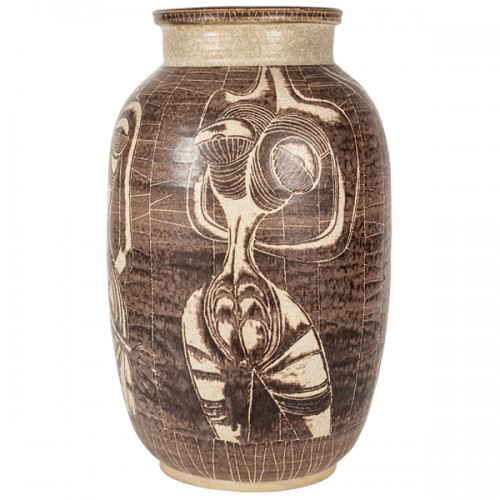
“Eve” vase 1952-56
Monumental glazed stoneware vase with a brown and cream beige glaze with sgraffito decoration of four stylized nudes.
Signed: A. Bohrod F.C. Ball (inscribed)
Illustrated: Aaron Bohrod: Figure Sketches, Edwin E. Elliott and Howard E. Wooden (Dodge City, Kansas: Gall and Shaull, 1990) p. 17, fig. 32. A Decade of Still Life: Aaron Bohrod (Madison, Wis.: University of Wisconsin Press, 1966) p. 41.
H: 20 3/4 x Dia: 12 1/2″
Price: $29,000
***Aaron Bohrod himself considered this vase his most important work in ceramic. This exact vase is illustrated in “A Decade of Still Life: Aaron Bohrod” in a bisque state. There is a stable firing crack that is visible on the base (see photo) near the Bohrod signature which happened in the firing, but in no way affects the structure of the piece. A letter from Aaron Bohrod himself describing this piece and the history surrounding it also accompanies the vase.
For more information see: The Potter’s Art in California: 1885-1955, Hazel V. Bray (Oakland: Oakland Museum Art Department, 1980) pp. 56-57.
A painter of cityscapes, landscapes and trompe l’oeil paintings, Aaron Bohrod lived in Chicago from birth until 1948, when he moved to Madison, Wisconsin. There he was a member of the University of Wisconsin’s art faculty. Bohrod was a graduate of the School of the Art Institute of Chicago, and he also attended the Arts Students League in New York.
Aaron Bohrod was an American artist who was nationally known in his lifetime. He was the subject of frequent exhibitions and gallery shows in various locations, generally focusing on a particular chronological period of his artistic production. The recipient of numerous prizes and awards (including two Guggenheims and the purchase prize at the “Artists for Victory” exhibition of 1942-43 at the Metropolitan Museum in New York), he was both proficient and prolific as a painter, sculptor, printmaker, ceramicist and as an illustrator. In addition, he was the author of several books on art and an autobiography. Although he studied at the Art Institute of Chicago and the Art Students League in New York with a number of well-known and influential teachers, the one who exerted the most profound influence on him was John Sloan, who taught him to value both the Old Masters and the visual reality of the urban American scene. Bohrod returned to Chicago after studying with Sloan in New York “determined to do in my own way with my own city what Sloan had done with New York.” (Bohrod’s stylistic development has been typically characterized in terms of his early relationship to the gritty urban realism of the Ashcan School with which Sloan was associated and his later magic realism style with its virtuoso and meticulous technique and witty visual repartee, almost as if they were two separate and unrelated developments. Although his own description of the origins of his unique still life approach in his autobiographical book, A Decade of Still Life, may have guided critics to look at his oeuvre in this way, a closer assessment reveals clear connections between the earlier and alter periods. Before 1940, for example, he had created a prototype of the still lifes that were to become his hallmark. By the mid 1950s, he began to dedicate himself to the creation of paintings that are by turns resonant, mysterious, evocative and humorous. The studied and careful detail of the bricks on the buildings foreshadow the care that Bohrod will lavish on each of the carefully observed and realized objects in his later still lifes, while the anecdotal detail predicts the accumulation of objects on which his later work depends. The polished and masterful technique of this later work also suggests the Old Masters to whom he was introduced by Sloan.
F. Carlton Ball (1911-1992)
F. Carlton Ball was born in Sutter Creek, California, He studied art at Sacramento Junior College before enrolling at USC. He graduated from the University of Southern California in 1933. He later did graduate studies under Glen Lukens at USC. He taught at several colleges/universities, such as the CCAC (his first position in 1935), Mills College, University of Wisconsin at Madison, University of Southern Illinois at Carbondale, USC University of Puget Sound and etc. From our research, we believe his last teaching position was in Tacoma, Washington, at the Tacoma Community College. Primarily known for his throwing, he did combine his pots with the decorative artistry of his first wife Kathryn Uhl Ball and most importantly, the Wisconsin artist, Aaron Bohrod. He exhibited at the Association of San Francisco Potters, 1952 Los Angeles County Fair’s 6000 Years Art in Clay and the Crocker-Kingsley of Sacramento, California, to mention a few locations. Exhibited at the Nationals in 1941-1949, 1951-1960 and 1966.
 @hd_jewels