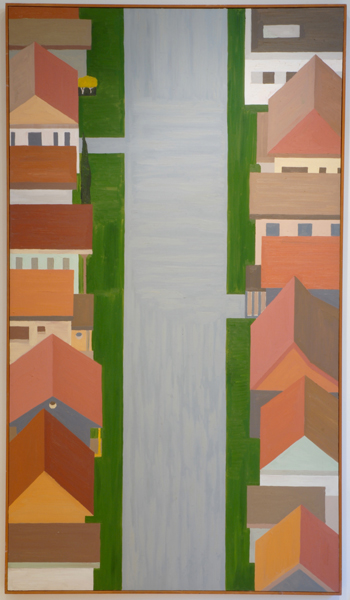
Illustrated: Nach Schiele, Tobias G. Natter and Thomas Trummer (Köln, Germany: Atelier Augarten, DuMont, 2006), p 142.
Provenance: Private Collection Vienna
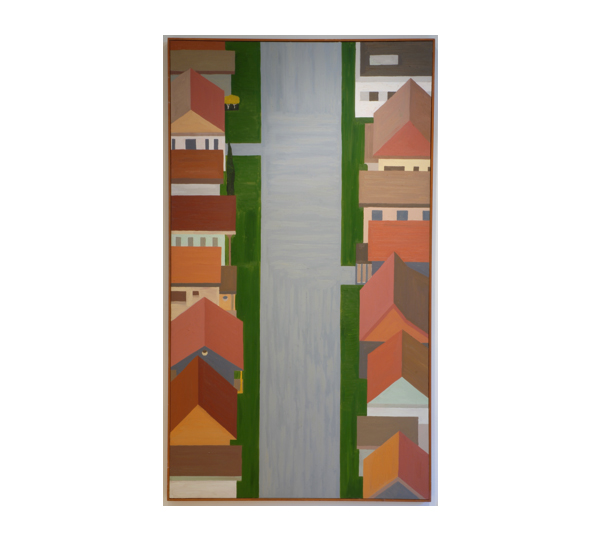
For related works by Hubert Schmalix see: Hubert Schmalix, Lóránd Hegyi exhibition catalog (Museum Moderner Kunst StiftungLudwig Wien) November 19, 1994 – January 1995.
H: 85” x W: 49”
Hubert Schmalix was born in Graz, Austria, on December 17, 1952 and studied at the Vienna Art Academy from 1971 to 1976. By 1979 Schmalix was showing work at the forward-looking exhibition ‘Europa 79 – Kunst der 80er Jahre’ in Stuttgart. In 1983 the London Tate Gallery invited Schmalix to present work at ‘New Art’, an important survey of contemporary art. Schmalix has become well-known world-wide as an exponent of ‘New Art’, working with a retrospective glance at both classical art history and modern art. Schmalix focuses on the world of things and the human figure. Although the expressive gesture was the dominant feature of his 1980s work, it yielded early in the 1990s to stringent tectonic composition. In 1984 Hubert Schmalix went to the Philippines and on to the US, moving to Los Angeles in 1987. In 1986-87 Schmalix taught at the Academy for the Decorative and Applied Arts in Vienna and from 1997 he has been a professor at the Vienna Art Academy. Schmalix is a visiting professor at the University of California Los Angeles (UCLA). In 1993 his work was featured at the Venice Biennale and in 1998 he was awarded the Fine Art Prize of the City of Vienna. Schmalix has done several large fresco cycles in Salzburg and his work has been shown extensively at numerous international solo and group shows and most recently at Art Basel 2006.
The Kunstforum in Vienna is dedicating a major retrospective show to Hubert Schmalix from May 6th – July 12th, 2015.
“I’m not nervous or angry when I paint, but well rested and concentrated. Each stroke of the brush is important! I’ve painted a whole lot of beautiful pictures this way.” (Hubert Schmalix)
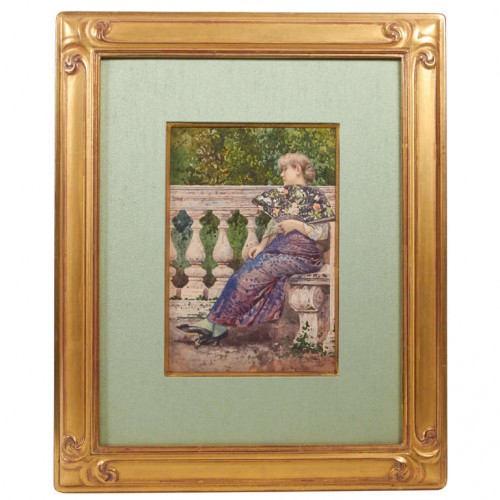
Giovanni Battista Filosa, In the Garden, Watercolor, 1884
GIOVANNI BATTISTA FILOSA (1850-1935) Naples, Italy
“In the Garden” 1884
Watercolor, gilt frame and filet with silk mount.
Signed: G Filosa '84
***Filosa exhibited at the Esposizione Internazionale d'Arte della Città di Venezia 1895 – La Biennale di Venezia, Venice
An extremely fine and exquisitely painted watercolor “In the Garden” by the Italian artist Giovanni Battista Filosa (1850-1935). It is a radiant painting with a wonderful subtle coloration and very charming late 19th century “en plein-air” imagery. Filosa's technique is similar in quality to the work of the 19th Century Pre-Raphaelite watercolorist, Albert Moore. Gilt frame and filet with silk mount. Signed: G Filosa '84 Filosa exhibited at the Esposizione Internazionale d'Arte della Città di Venezia 1895 – La Biennale di Venezia, Venice
Watercolor: H: 7 1/2″ x W: 5 1/4″
Framed: H: 14 1/2″ x W: 12″
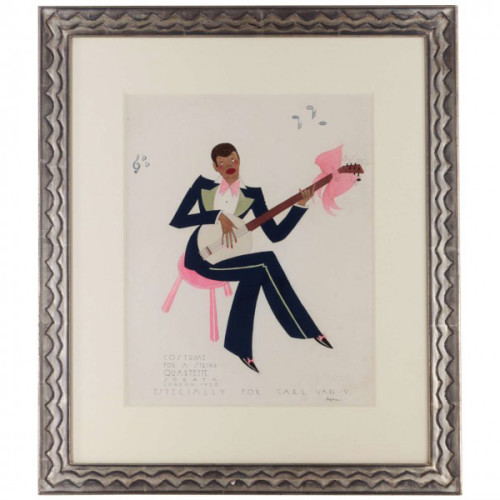
S O G A T A New York, NY, “Costume for a String Quartette” Watercolor and pencil on paper 1930
S O G A T A New York, NY
“Costume for a String Quartette” 1930
Watercolor and pencil on paper
Signed: COSTUME FOR A STRING QUARTETTE. SOGATA. LONDON: 1930. ESPECIALLY FOR CARL VAN V. with script signature (in pencil on lower left and beneath image)
For contextual history and similar art see: Rhapsodies in Black : Art of the Harlem Renaissance,(Berkeley: University of California Press, 1997); Harlem Renaissance Artists. Jordan, Denise (Chicago: Heinemann Library, 2003).
Paper H: 14 7/8″ x W: 10 7/8 ”
Image H: 14″ x W: 10 1/2″
Frame H: 20 1/2” x W: 17 1/4”
*This SOGATA New York Watercolor and pencil on paper has been gifted to The Wolfsonian – FIU, Miami Beach, FL.
Carl van Vechten (1880-1964), to whom this artwork is dedicated, was an influential novelist, critic, and photographer in New York during the 1920s, 30s, and 40s. His role in the Harlem Renaissance is well-documented. Van Vechten also introduced Miguel Covarrubias, a caricaturist and contemporary of Sogata, to prominent Manhattan artistic and society circles.
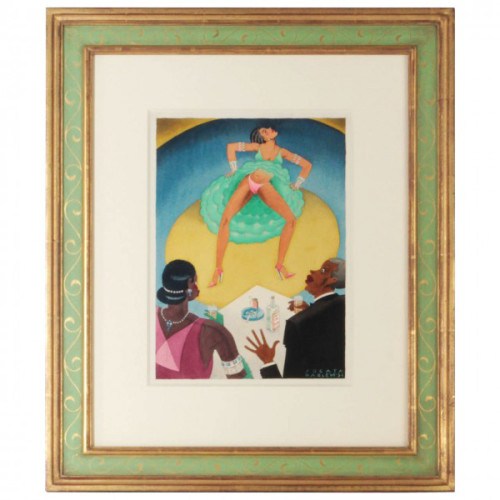
S O G A T A New York, NY “Harlem: Concert” Watercolor and pencil on paper 1931
S O G A T A New York, NY
“Harlem: Concert” 1931
Watercolor and pencil on paper
Signed: SOGATA · HARLEM 1931 (in pencil, lower left corner of image); HARLEM: CONCERT. (in pencil beneath image on left)
For contextual history and similar art see: Rhapsodies in black : art of the Harlem Renaissance, (Berkeley: University of California Press, 1997); Harlem Renaissance Artists. Jordan, Denise (Chicago: Heinemann Library, 2003).
Paper H: 14 7/8″ x W: 10 7/8″
Image H: 11″ x W: 7 1/2″
Frame H: 19 1/4” x W: 16”
*This SOGATA New York Watercolor and pencil on paper has been gifted to The Wolfsonian – FIU, Miami Beach, FL.
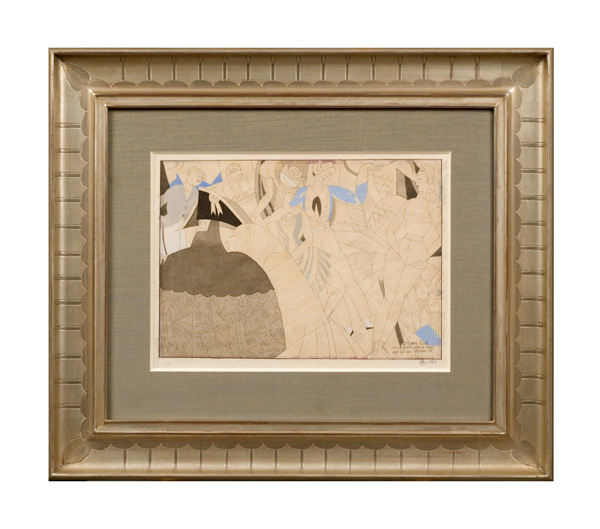
Charles Martin, “Feu d’Artifice”, Pencil, ink, gouache and watercolor on paper 1927
CHARLES MARTIN (1884-1934) France
Feu d’Artifice 1927
Pencil, ink, gouache and watercolor on paper.
Signed: Martin, A L’Ami Koval (dedication on lower right corner)
H: 8” x W: 11 7/16”
Price: $12,500
Charles Martin was a notable French illustrator, graphic artist, posterist, fashion and costume designer. His drawings are charming, amusing and sophisticated. The artist studied at the Montpelier Ecole des Beaux Arts, Academie Julian and Ecole Des Beaux Arts, Paris. Throughout his career, Martin was also a contributor to the French fashion journals Gazette du Bon Ton, Modes et Manieres d’Aujourd’hui, Journal Des Dames et Des Modes, and Vogue. His illustrated books include the hat catalogue “Les Modes en 1912,” the erotic “Mascarades et Amusettes” 1920, and “Sports et Divertissements” 1919, written in collaboration with composer Erik Satie.


 @hd_jewels