Product Description
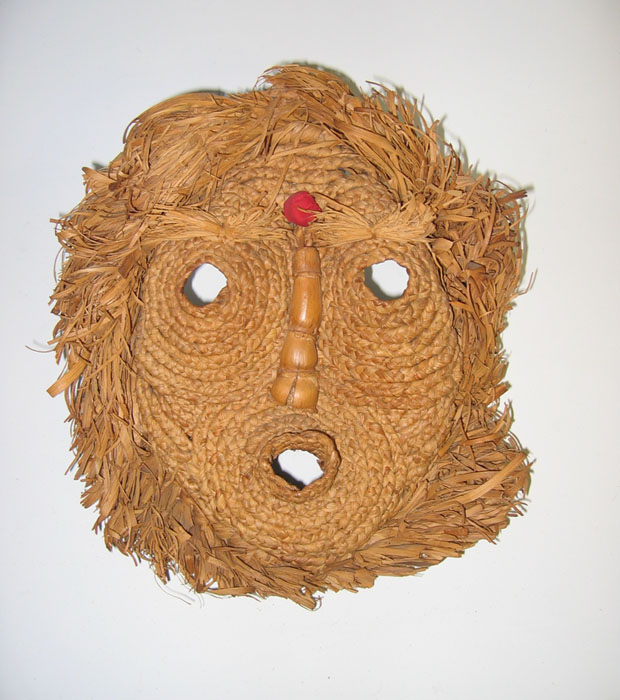
Iroquois Corn Husk Mask, woven corn husk, corn cob nose, red cloth medicine bag c. 1900

Iroquois Corn Husk Mask, woven corn husk, corn cob nose, red cloth medicine bag c. 1900
HENDRIK PETRUS BERLAGE (1856 – 1934) Netherlands
BECHT & DYSERINCK for ‘t Binnenhuis
Rare Architectural Candelabrum c. 1900
Riveted and detailed “Eiffel Tower” like form in brass and copper with four feet, small cut out designs and two bobeche trays supporting five candles.
H: 14″ x W: 8 1/4″ x D: 8 1/4″
Hendrik Petrus Berlage, a Dutch architect and designer attended the Rijksakademie in Amsterdam and a year later switched to architecture. Berlage enrolled in 1875 in the architecture department of the Eidgenössische Technische Hochschule in Zurich. Through 1878 Berlage studied in Zurich under Gottfried Semper, whose teachings had a lasting influence on his work. After finishing these studies, Berlage spent three years traveling in Germany (1879) and Italy (1880-1881) before returning to his native Amsterdam. From 1881 Berlage was employed by the Amsterdam architect Theodor Sanders and from 1884 Berlage was a partner in the business until he opened his own practice in 1889. In 1884 he submitted a design for the projected Commodity Exchange (Beurs van Berlage) in Amsterdam, winning the competition in 1896. This building, completed in 1903, was Hendrik Paulus Berlage’s first important commission, which also solidified his reputation. Also in Amsterdam and at this same time, Berlage built the Diamond Guild building (1897-1900). In 1900 along with the architect and designer Jacob van den Bosch, Hendrik Paulus Berlage opened the gallery, “‘t Binnenhuis”. They sold their own designed furniture and objects they from 1900-1929. In 1900 Berlage was also commissioned to plan a southern extension of Amsterdam. This was Berlage’s most important contribution to urban planning and he worked on the project until 1915. In 1911 Berlage went to the US, where he saw the new buildings by Frank Lloyd Wright and Louis Sullivan. Berlage built his own house in The Hague and moved into it with his family in 1913. The Gemeentemuseum in The Hague (1919-1935) was Berlage’s last important building, however it was not completed until shortly after his death. Hendrik Petrus Berlage was the founder of the “Amsterdam School” and was a pioneer of modern architecture in the Netherlands. In his 1905 essay “Gedanken über Stil in der Baukunst”, Berlage fiercely criticized 19th-century historicizing architecture as pompous, reserving his praise for the austere simplicity of early period styles. His criticism was severe since he stated flatly that historicizing architecture was all appearance rather than reality, was not art; too much was imitation, more iron was used than stone, and so on. Hendrik Petrus Berlage was therefore an early critic of Historicism even though his Amsterdam Exchange still reveals Romanesque features.
Franz Xaver Bergman (1861–1936) (attr.) Vienna, Austria.
Bull pen wipe c. 1900
Cold painted bronze, boar’s hair bristles, horn.
For information see: Art Bronzes, Mich. Forrest (Schiffer, 1988).
H: 5 1/4” x L: 11”
Franz Xaver Bergman (1861–1936) was the owner of a Viennese foundry who produced numerous patinated and cold-painted bronze Oriental, erotic and animal figures, the latter often humanized or whimsical, humorous objects d’art.
A well-known anamalier at the turn-of-the century, the sculptor Franz Bergman created a number of small bronzes in a variety of subject matter. Other figurative works were informed by the Jugendstil/Art Nouveau style and the European taste for the exotic as is found in his figures of rug merchants and camels. His animal sculptures, however, capture the Viennese tradition of naturalistic bronzes. The quality of the bronze casting shows tremendous detail, which was carefully brought out through the applied patination process known as cold painting.
EDUARD STELLMACHER (designer) Turn-Teplitz, Austria
RIESSNER, STELLMACHER & KESSEL Turn-Teplitz, Austria
AMPHORA ART POTTERY Turn-Teplitz, Austria
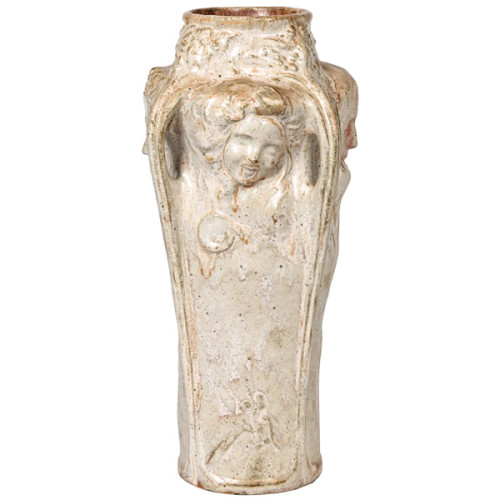
Ewer c. 1900
Glazed porcelain
Marks: RStK MADE IN AUSTRIA Turn-Teplitz Bohemia, AMPHORA (in oval), 16, 531
For more information see: Deutsche Kunst und Dekoration, ( March 1901) pp. 346-349; Sammlung Bröhan: Kunsthandwerk, Glas, Holz, Keramik, Vol. 1 Band II (Berlin: Bröhan Museum, 1976), pp. 284-293.
H: 9″ x W: 7 1/2″ x D: 7″
Ando Jubei Nagoya, Japan
Japanese Meiji Period (1868-1912) Japan
Enamel and copper covered box circa 1900
Patinated copper, applied foil-backed enameled red berries, stylized green leaves and vines, riveted corners.
H: 1 5/8″ x D: 4″ x W: 5 3/4″