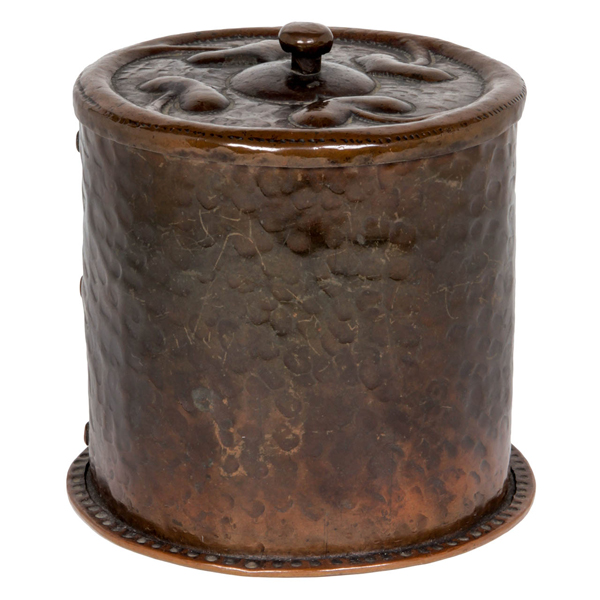
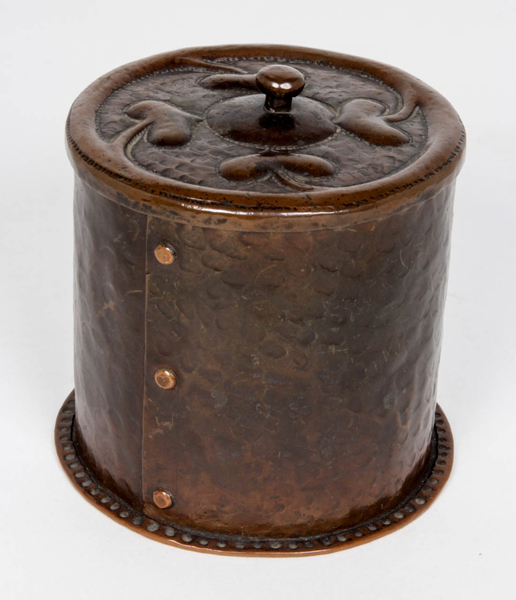
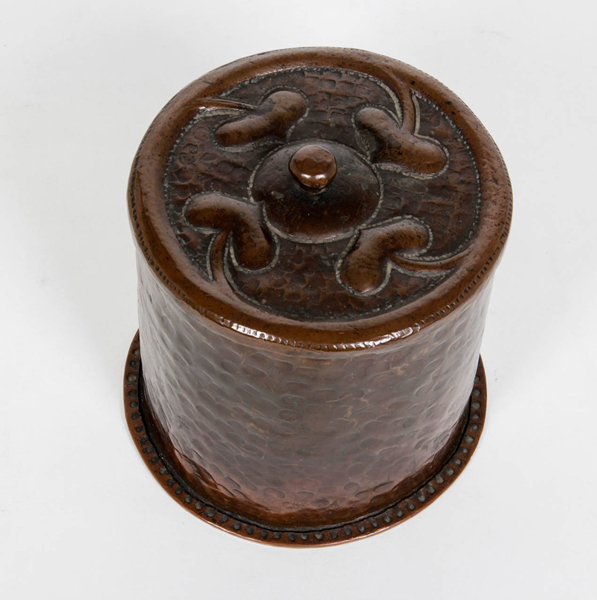
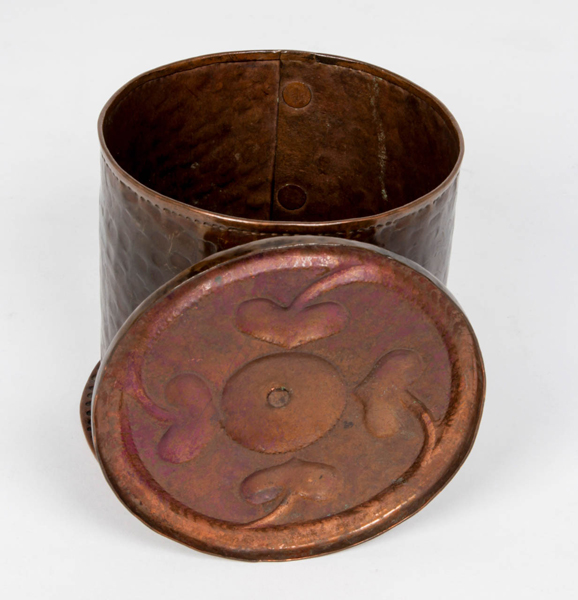
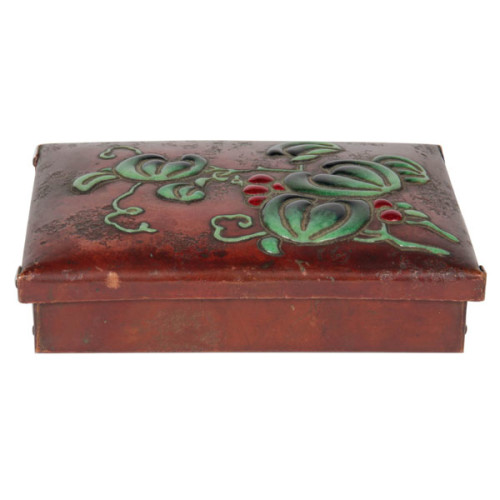
John Pearson / British Arts & Crafts Handwrought copper tea caddy c. 1900
More Information
John Pearson / British Arts & Crafts Handwrought copper tea caddy c. 1900
JOHN PEARSON (19th century) UK
Tea caddy c. 1900
Handwrought copper with rivets, repoussé lid with 4 heart-shaped leaves, rich red brown original patina
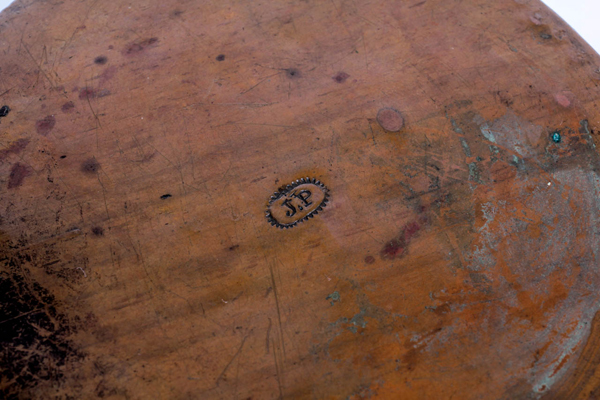
Marked: JP in an oval cartouche (on bottom)
H: 4 1/2″ x D: 4 1/4″
For more information on Pearson see: CR Ashbee: architect, designer & romantic socialist, Alan Crawford (New Haven, CT: Yale University Press, 1985), pp. 32-33, 46, 313-316; Reflections: arts and crafts metalwork in England and the United States (New York: Kurland – Zabar, 1990), pp. 32-33.
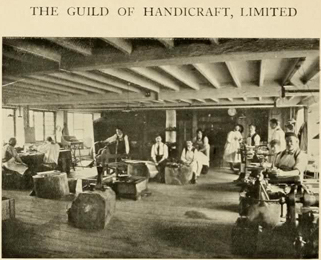
Pearson was an original member of CR Ashbee’s Guild of Handicraft starting in 1888. He later resigned to join the Newlyn Industrial Class. He also worked for the designer & ceramicist William De Morgan which is where many of his fanciful themes in repousse are inspired. He is considered one of the finest repousse metalsmiths of the period. His shop remained active until after the turn of the century, most pieces are dated.
Maurice Bouval French Art Nouveau Nymph Silvered Bronze Candleholder c. 1900
MAURICE BOUVAL (born Toulouse, died 1920) France
M. COLIN France
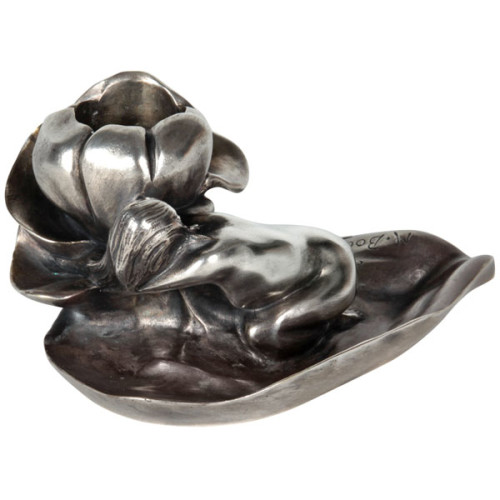
“Nymph Embracing a Blossom” candle holder c.1900
Silvered cast bronze in the form of a nymph on a leaf embracing a blossom
Marks: M. Bouval (script signature) and COLIN, (Foundry) written above
For other examples of Bouval’s work see: The Paris Salons 1895-1914, Vol. V: Objets d’Art & Metalware, Alastair Duncan (Woodbridge, Suffolk: Antique Collectors’ Club, 1999), p. 127; Ecole to Deco, Small Sculptures from a Private Collection, Stephen C. McGough ed. (Oberlin, Ohio: Allen Memorial Art Museum, 1979) pp. 33-4; Art Nouveau Sculpture, Alastair Duncan (New York: Rizzoli, 1978) pp. 30-1.
Louis Majorelle French Art Nouveau “Fiddleback Fern” bowl c. 1900
LOUIS MAJORELLE (1859-1926) France
MOUGIN FRÈRES Nancy, France
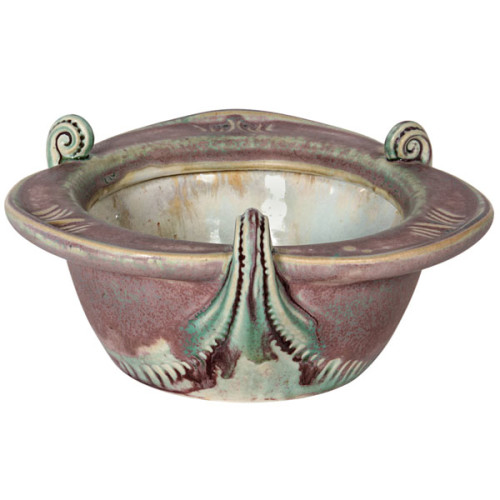
Fiddleback Fern trefoil bowl c. 1900
A rare stoneware example of Majorelle and the L’Ecole de Nancy with a mauve and sea-green glaze, crystalline formations in interior in a trefoil loped form with fiddleback ferns at each interval.
Marks: Majorelle. de (impressed facsimile signature) MOUGIN NANCY, 10.K , L
Illustrated: Majorelle: Une Aventure Moderne, Roselyne Bouvier (Paris:
La Bibliothèque des Arts/Editions Serpenoise, 1991) p. 34, illus. 32.
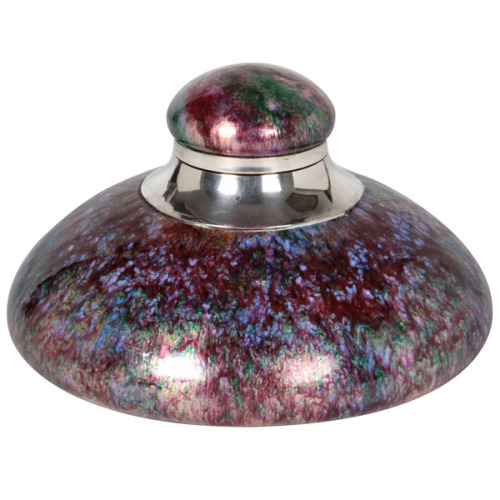
Paul Haustein Germany Rare Jugendstil enamel and silver inkwell c.1900
PAUL HAUSTEIN (1880-1944) Germany
HERMANN BEHRND (b. 1849) SILBERWARENFABRIK (silver) Dresden, Germany
JAKAB RAPOPORT (enamelist) Budapest, Hungary
Inkwell c. 1900
Multicolored burgundy, purple, blue and green enamel with silver mounts, glass insert
Marks: Moon, crown, 800, HB (Hermann Behrnd mark)
Same model with variant mount illustrated: Deutsche Goldschmiede-Zeitung, n.d. (circa 1903-05), p. 23
For related works and more information see: Art Nouveau in Munich: Masters of Jugendstil, ed. Kathryn Bloom Hiesinger (Philadelphia: Philadelphia Museum of Art, 1988) pp. 67-69; Jugendstil in Dresden, Aufbruch in die Moderne, Gisela Haase et al., exh. cat. (Dresden: Staatliche Kunstsammlungen Dresden; Wolfratshausen: Edition Minerva, 1999).


 @hd_jewels