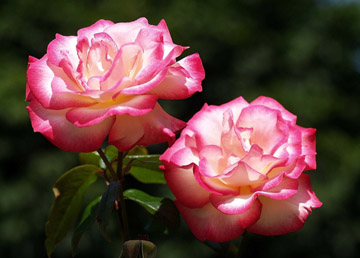
Italian Majolica Pair of “Rose” wall pockets c. 1885
ITALIAN MAJOLICA
Pair of “Rose” wall pockets c. 1885
Three dimensional realistically rendered pink roses with leaf and stems all in the Barbotine technique
Marks: Made in Italy
Barbotine is the French term for ceramic slip or a mixture of clay and water for molding or decorating pottery. This technique was used to create applied adornments on 19th century majolica items.
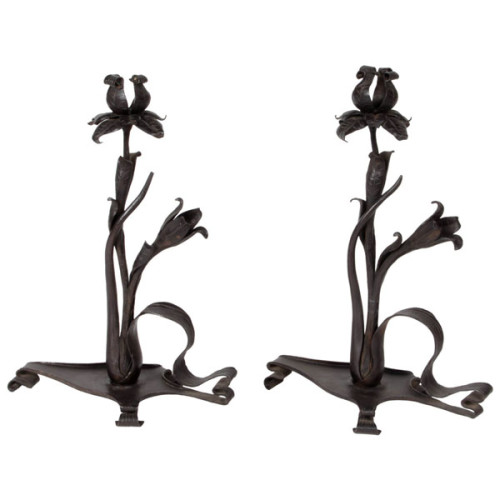
Otto Eckmann (attr.) Pair Of Hand Wrought Iron Floral Candlesticks c. 1900
OTTO ECKMANN attr. (1865-1902) Germany
Pair of candlesticks c. 1900
Hand-wrought iron with floral and foliage design
H: 12 ¼” x W: 8 ¼”
Price: $7,475
Otto Eckmann (19 November 1865 – 11 June 1902) was a German painter and graphic artist. He was a prominent member of the “floral” branch of Jugendstil. Otto Eckmann was born in Hamburg, Germany in 1865. He studied at the Kunstgewerbeschule in Hamburg and Nuernberg and at the academy in Munich. In 1894, Eckmann gave up painting (and auctioned off his works) in order to concentrate on applied design. He began producing graphic work for the magazines Pan in 1895 and Jugend in 1896. He also designed book covers for the publishers Cotta, Diederichs, Scherl and Seemann, as well as the logo for the publishing house S. Fischer Verlag. In 1897 he taught ornamental painting at the Unterrichtsanstalt des Königlichen Kunstgewerbemuseums in Berlin. In 1899, he designed the logo for the magazine Die Woche. From 1900 to 1902, Eckmann did graphic work for the Allgemeine Elektrizitätsgesellschaft (AEG). During this time, he designed the fonts Eckmann (in 1900) and Fette Eckmann (in 1902), probably the most common Jugendstil fonts still in use today.
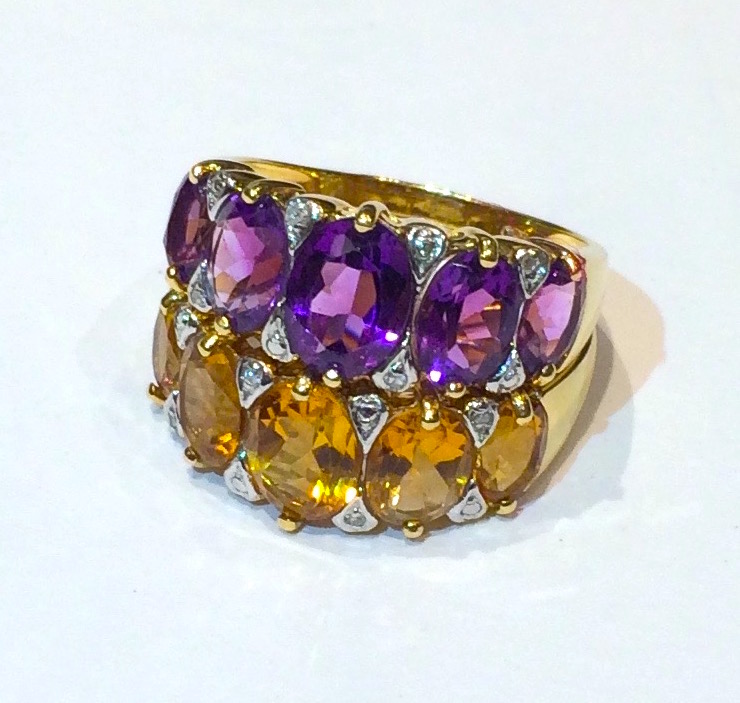
Suzanne Belperron / Groene et Darde Paris, Pair of multi stone rings, five oval cut citrines and five oval cut amethysts all set in 18K gold further set with platinum mounted diamonds, signed, c. 1940’s / early 1950’s




 @hd_jewels