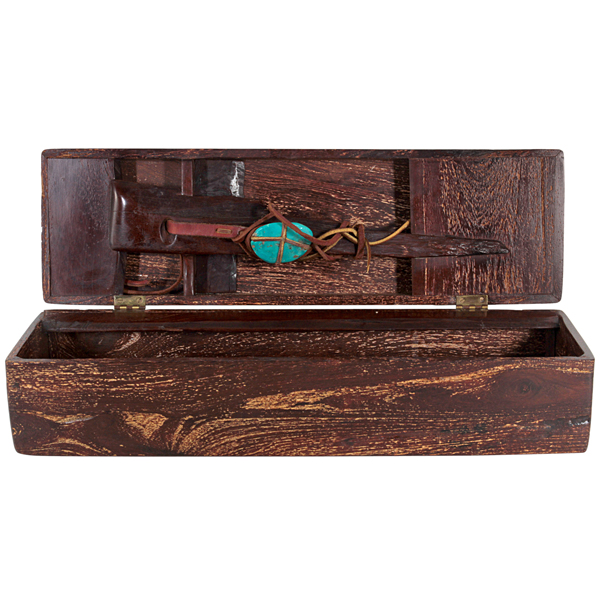
Jan de Swart hand carved Zebra wood Mystery box c. 1970
More Information
Jan de Swart hand carved Zebra wood Mystery box c. 1970
JAN DE SWART (1908-1987) Netherlands / USA
Mystery box c. 1970
Hand carved and assembled box form with a curiosity element of a large turquoise cabochon with raw hide wraps underneath the lid.
For more information see: Jan de Swart: A Day That Becomes a Lifetime, exhibition catalogue (California: Fine Arts Gallery at the San Fernando Valley State College, February 1972); Jan de Swart, Mike McGee and William G. Otton (Laguna Beach, California: Laguna Art Museum, 1986).
W: 16 1/2″ x H: 4 1/2″ x D: 5″
Price: $4,700
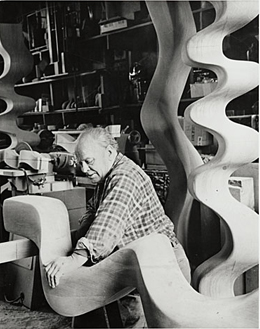
Constantly seeking and inventing new materials Jan de Swart was a true modernist. He was influenced by artists such as Isamu Noguchi, Harry Bertoia, Charles Eames, and later Sam Maloof and Wendell Castle. Although he had been creating small sculptures since his arrival in California from Holland in 1929, he had not been widely recognized until being introduced to John Entenza, publisher of Arts & Architecture magazine in 1947. Soon thereafter, he was able to create larger works and began collaborating with architects such as Whitney Smith and Victor Gruen on special commissions. His work is in the permanent collection of Los Angeles County Museum of Art, The Smithsonian, and the Ford Foundation. He was honored with the American Institute of Architects Gold Medal for Sculpture in 1965.
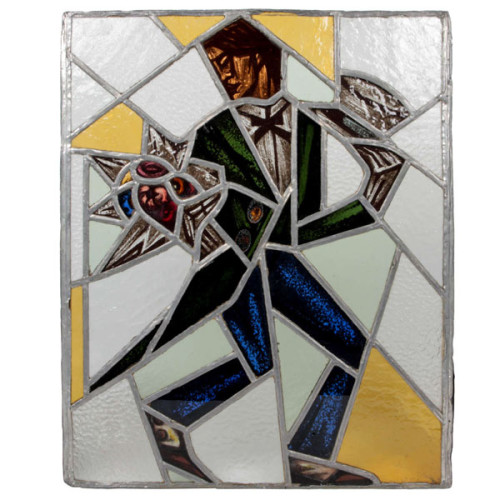
Reinhold Klaus / Carl Geyling Atelier Vienna “Cubist Man with top hat and flowers” stained glass window c. 1930
REINHOLD KLAUS (1881-1963) Vienna, Austria
CARL GEYLING ATELIER (founded 1841) Vienna, Austria
Man with tophat and flowers c. 1930
Window of stained and hand-painted leaded glass
Provenance: Estate of Carl Geyling (1814-1880), Vienna
H: 17 3/4″ x W: 14 1/2″
Reinhold Klaus studied from 1898-1902 with Alfred Roller at the Kaiserlich-Königliche Kunstgewerbeschule in Vienna. In 1914 Klaus married into the Carl Geyling family and became extensively involved with with stained glass painting. As early as 1918 Klaus worked on a stained glass window for the Siegestempel am Bisamberg in Vienna. In 1934 he became a professor of stained glass painting at the Kunstgewerbeschule, as well as creative director of the C. Geylings Erben glass painting company. Reinhold Klaus, a member of the Künstlerhaus since 1924 received many prizes and honors. He worked on commissions for the St. Veits cathedral in Prague, the St. Stephan cathedral in Vienna and many others.
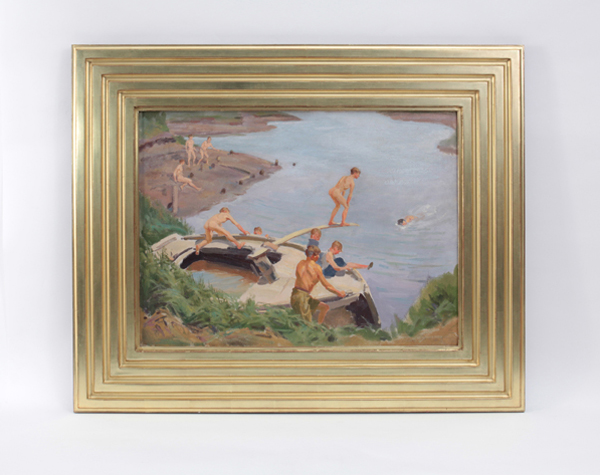
Edmund F. Ward “The Swimming Hole” Oil on canvas c. 1930
EDMUND F. WARD (b. 1892 – 1991) USA
“The Swimming Hole” c. 1930
Oil on canvas
Marks: signed Edm. F. Ward (lower right); partial labels verso:Westchester Arts and Crafts Guild; 4 Edmund F. Ward
For more information on the artist see: Who Was Who in American Art,Peter Hastings Falk, ed. (Madison, Conn.: Sound View Press, 1985), p. 658.
Canvas H: 18” x W: 24”
Framed H: 27 9/16” x W: 33 9/16”
Price: $14,000
Ward studied at the Arts Student’s League with Edward Dufner, George Bridgeman, and Thomas Fogarty. He was an illustrator for several national magazines and books. In 1925, Ward exhibited an award winning work at the Art Institute of Chicago. He is perhaps best known for his WPA mural in the Federal Building, White Plains, New York.
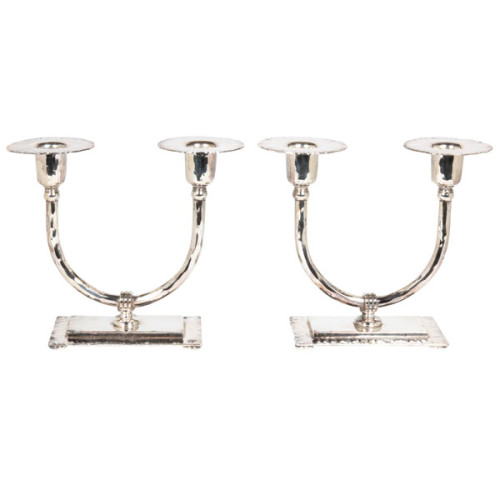
Roycroft / American Arts & Crafts Pair of Candlesticks c. 1915
ROYCROFT COPPER SHOP East Aurora, N.Y.
Pair of candlesticks c. 1915.
Hand wrought and textured copper, silver-plated.
Marks: impressed R, in orb with cross, ROYCROFT
For more information see: The American Arts & Crafts Movement in Western New York 1900-1928, Bruce A. Austin (Rochester Institute of Technology, 1992); Arts & Crafts Movement in New York State 1890’s – 1920’s, Coy Ludwig (Hamilton, N.Y.: Gallery Association of New York, 1983).
Aram Gesar has been published internationally and has exhibited his photographic work in New York, San Francisco, Zurich and Geneva since 1977. As a producer, art director and photographer, Gesar created advertising campaigns for major corporations in the U.S. and Europe focusing on the fields of travel, banking, financial services, aerospace and motion pictures. He also created and produced documentaries on travel, aviation and yachting for national cable networks and the home video markets and television commercials and corporate programs for various U.S. and European corporations.
Gesar is currently one of the leading international experts on travel and air transport, and the founder and CEO of The Pyramid Media Group, which includes several magazines, newsletters, web sites, books, eBooks and other publications integrating a spectrum of business, travel and aviation content.





 @hd_jewels