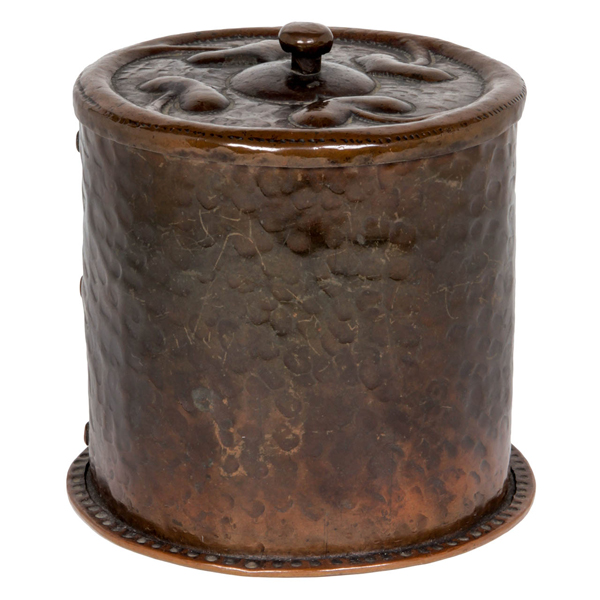
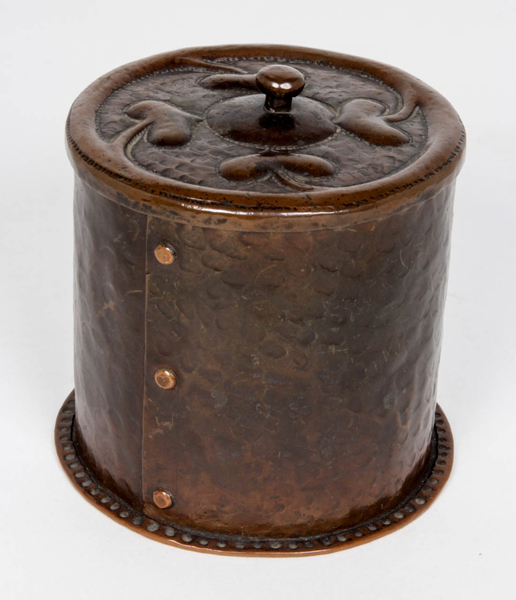
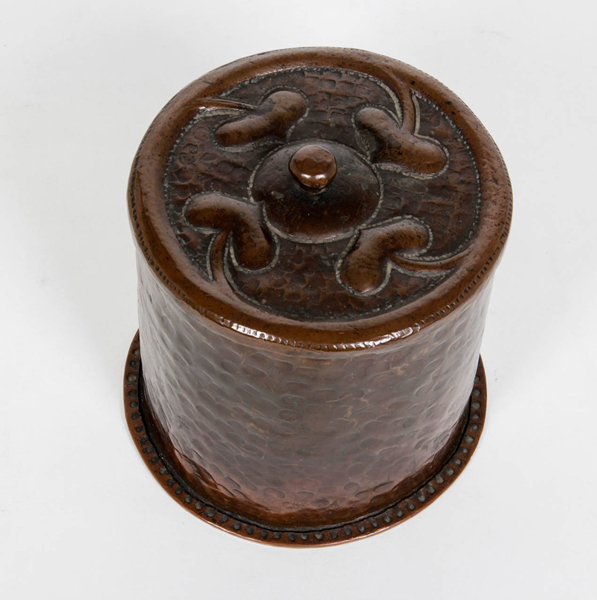
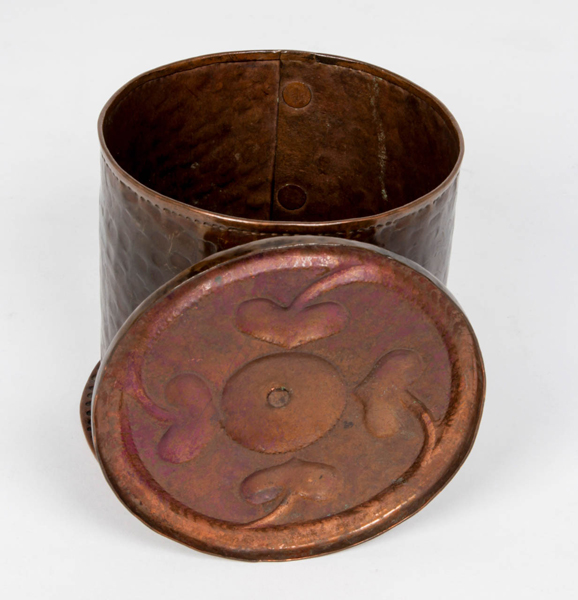
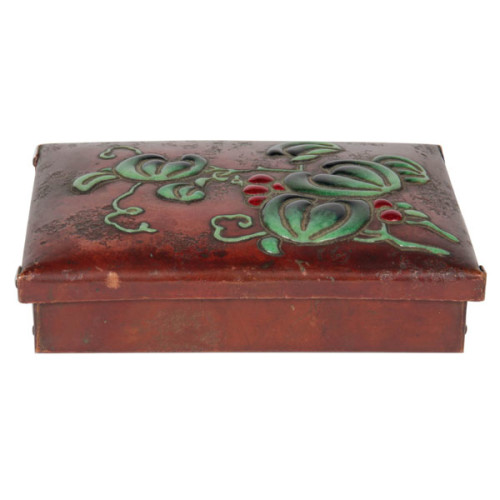
John Pearson / British Arts & Crafts Handwrought copper tea caddy c. 1900
More Information
John Pearson / British Arts & Crafts Handwrought copper tea caddy c. 1900
JOHN PEARSON (19th century) UK
Tea caddy c. 1900
Handwrought copper with rivets, repoussé lid with 4 heart-shaped leaves, rich red brown original patina
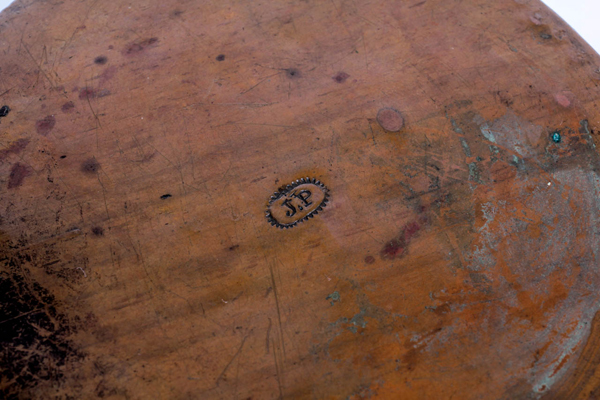
Marked: JP in an oval cartouche (on bottom)
H: 4 1/2″ x D: 4 1/4″
For more information on Pearson see: CR Ashbee: architect, designer & romantic socialist, Alan Crawford (New Haven, CT: Yale University Press, 1985), pp. 32-33, 46, 313-316; Reflections: arts and crafts metalwork in England and the United States (New York: Kurland – Zabar, 1990), pp. 32-33.
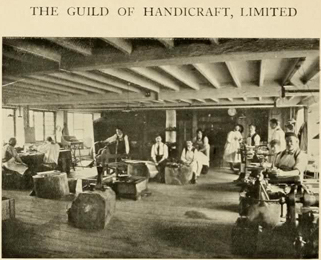
Pearson was an original member of CR Ashbee’s Guild of Handicraft starting in 1888. He later resigned to join the Newlyn Industrial Class. He also worked for the designer & ceramicist William De Morgan which is where many of his fanciful themes in repousse are inspired. He is considered one of the finest repousse metalsmiths of the period. His shop remained active until after the turn of the century, most pieces are dated.
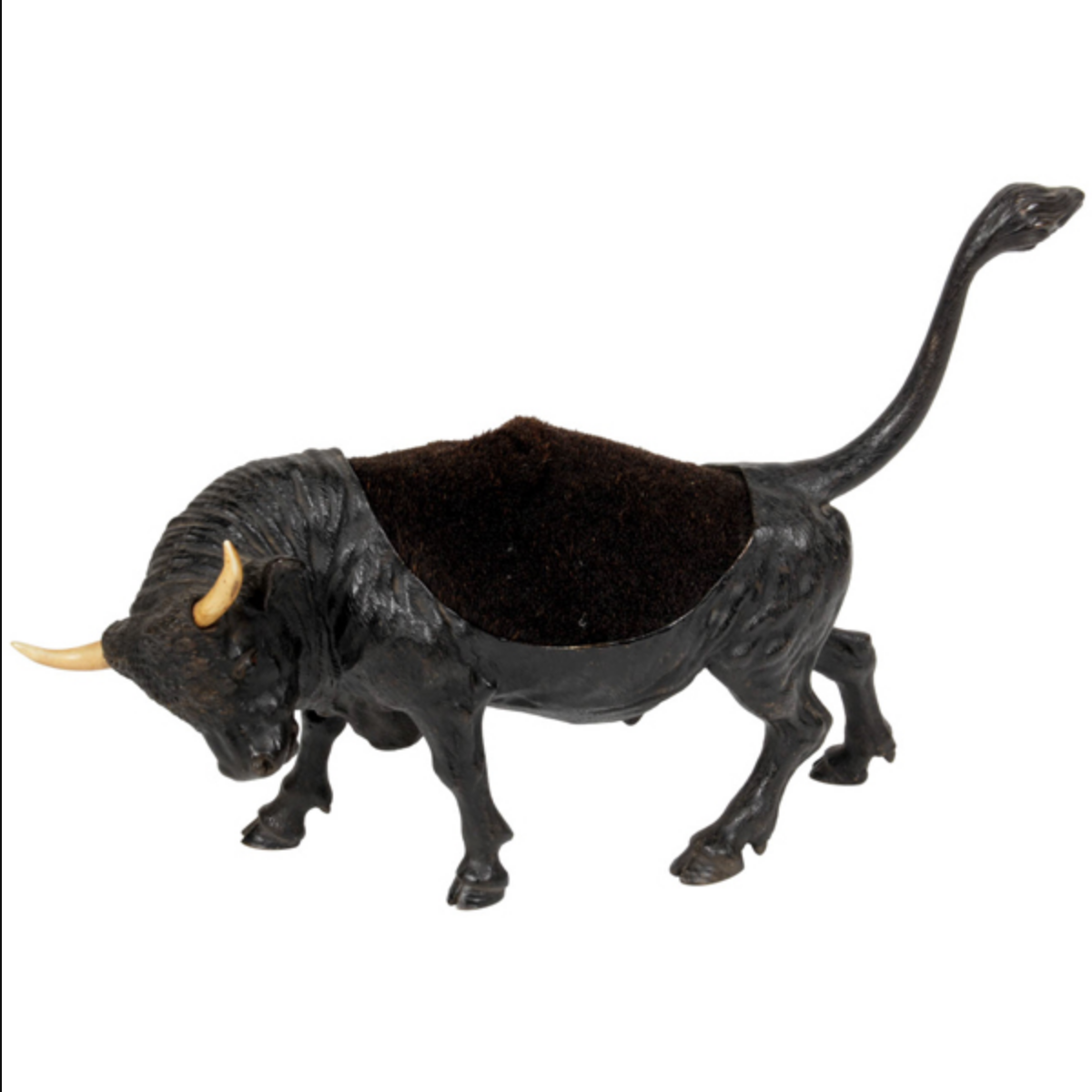
Franz Bergman (attr.) Bronze Bull Pen Wipe c. 1900
Franz Xaver Bergman (1861–1936) (attr.) Vienna, Austria.
Bull pen wipe c. 1900
Cold painted bronze, boar’s hair bristles, horn.
For information see: Art Bronzes, Mich. Forrest (Schiffer, 1988).
H: 5 1/4” x L: 11”
Franz Xaver Bergman (1861–1936) was the owner of a Viennese foundry who produced numerous patinated and cold-painted bronze Oriental, erotic and animal figures, the latter often humanized or whimsical, humorous objects d’art.
A well-known anamalier at the turn-of-the century, the sculptor Franz Bergman created a number of small bronzes in a variety of subject matter. Other figurative works were informed by the Jugendstil/Art Nouveau style and the European taste for the exotic as is found in his figures of rug merchants and camels. His animal sculptures, however, capture the Viennese tradition of naturalistic bronzes. The quality of the bronze casting shows tremendous detail, which was carefully brought out through the applied patination process known as cold painting.
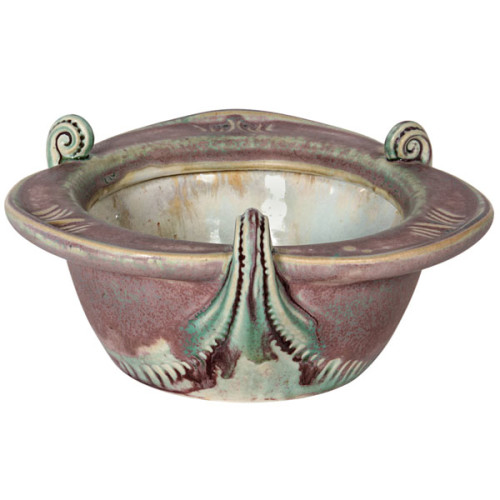
Louis Majorelle French Art Nouveau “Fiddleback Fern” bowl c. 1900
LOUIS MAJORELLE (1859-1926) France
MOUGIN FRÈRES Nancy, France
Fiddleback Fern trefoil bowl c. 1900
A rare stoneware example of Majorelle and the L’Ecole de Nancy with a mauve and sea-green glaze, crystalline formations in interior in a trefoil loped form with fiddleback ferns at each interval.
Marks: Majorelle. de (impressed facsimile signature) MOUGIN NANCY, 10.K , L
Illustrated: Majorelle: Une Aventure Moderne, Roselyne Bouvier (Paris:
La Bibliothèque des Arts/Editions Serpenoise, 1991) p. 34, illus. 32.


 @hd_jewels