
Product Description
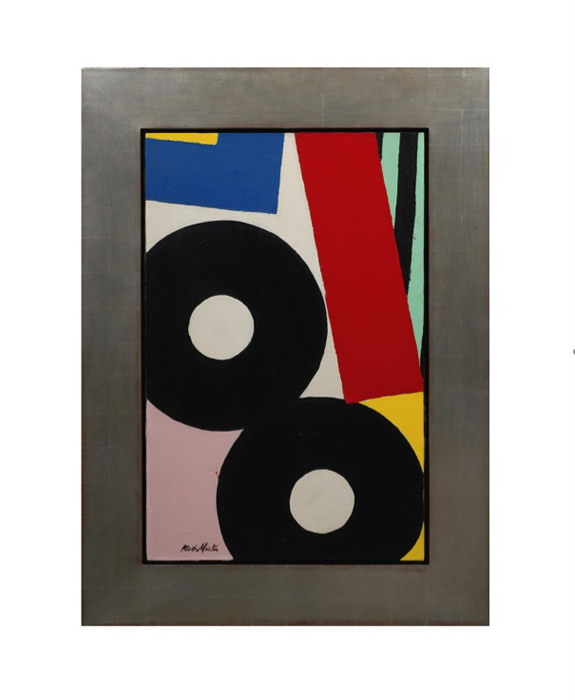
Knox Martin, “Eight”, Magna and oil on canvas 1958

KNOX MARTIN (1923-) USA
Eight 1958
Magna and oil on canvas
Signed: Knox Martin on lower left on front of canvas, Knox M on back of canvas
Marks: From: CORE, 38 Park Row, New York 38, NY, To: Martin, Knox, Eight, 1958, Magna/Oil, 30×40, 700. (paper label), Fischbach Gallery, 799 Madison Avenue, New York 21, Knox Martin, Eight, C.O.R.E., Price $700 (paper label), Mr. Ned L. Pines, 605 Park Ave., New York 21, NY (address label).
Exhibited: Fischbach Gallery, New York 1963; I. Jankowski Gallery, New York, 1975
Provenance: Personal Collection of the artist; Private Collection New York
Canvas: H: 40 1/4” x W: 26 1/4””
Framed: H: 52 3/8” x W: 38 3/8”
From 1957 to about 1964, the spirit of art in New York City was moving in directions for which Abstract Expressionism had not prepared us. By 1965, the strokes, swipes, drips, and splatters of New York painting had given way to cool, laconic representations of the most ordinary of ordinary objects. It was a transformation in artistic culture in which intellectual rewards replaced, or at least supplemented, visual ones, and the whole philosophical face of art was beginning to disclose itself in a particularly vivid way. I saw Knox Martin’s paintings as embodying this transformative moment. In them, I thought, the tension between the two rival philosophies of art could be felt. the way I saw them: they appeared at first glance to be collages, made of large, irregular, overlapping swatches of patterned cloth. Some of the swatches were striped, some appeared to be decorated with circles. It must be conceded that stripes and circles belong to the vocabulary of one kind of abstract art, while the irregular shapes, which felt as though they had been torn from bolts of material, belonged to another.
So one might properly claim that Martin was synthesizing an expressionist abstraction with a geometrical one. For me, however, Knox’s stripes and circles evoked the life of the circus: the striped tents, the loudly patterned costume of clowns. And Martin’s colors—pistachio, raspberry, banana—were festive and impudent. That is why I felt that the paintings referred to vernacular reality, as much so as Campbell Soup cans or Coca Cola bottles. The circus was a recurring theme in modernist art, and I thought it appropriate for late modernist painting to reduce the circus to patterned rags expressive of its raucous gaiety.
Knox Martin, “Eight”, Magna and oil on canvas 1958
JACK RICHARD SMITH (1950-) Taos, NM
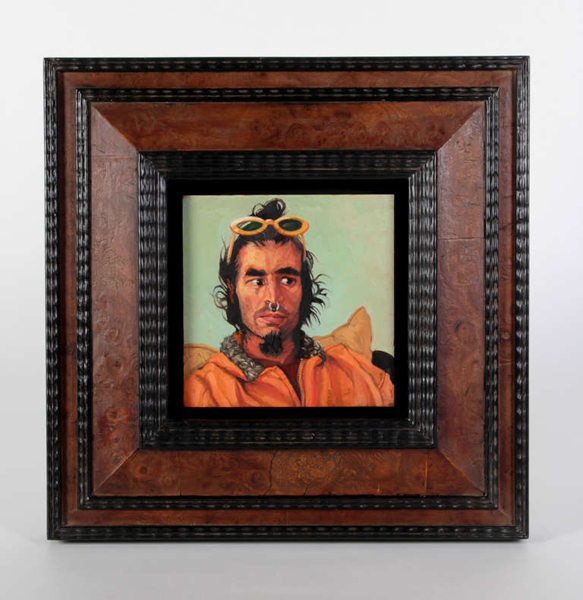
“Spiros Antonopoulos” 2004
Blackoil, wax, lead salts on copper, burl wood and ebonized wood Dutch old master style frame
Exhibited: “Taos Portraits” by Jack Smith, Harwood Museum of Art, University of New Mexico, Taos, New Mexico, May 14th – August 15th, 2004
Illustrated: “Taos Portraits” by Jack Smith, May 14th – August 15th, 2004, exhibition catalogue (Taos, NM: Harwood Museum of Art, University of New Mexico) illustr. 16
Painting: 6” x 6”
Framed: 13 3/4” x 13 11/16”
Price: $14,500
Incorporating blackoil, wax, lead salts, and copper Smith’s small format portraits and paintings are detailed and intimate depictions of creative individuals and charged tableaux. Smith’s singular style of portraits glow with a warm inner light and present honest, straightforward images that speak of personal narratives. Smith’s interest in miniatures developed first as a matter of convenience. In 1982, while preparing for a winter of travel in Mexico, he experienced logistical problems traveling with the larger size painting materials he was using at the time. The solution seemed to be a block of watercolor paper and casein, a milk base paint of versatile possibilities and vehement drying power. Suddenly, his paintings went from three by five feet to three by five inches. The history of oil painting, principally centered around the Dutch schools and their development of a method called black oil painting, often executed in miniature, also captured his interest. Black oil, an oleoresin comprised of white beeswax, raw linseed oil and litharge of lead, suspends the pigment above the painting ground, which was traditionally wood panel, linen or copper plate. This medium seems to suspend the pigment, allowing light to penetrate and reflect from the surface and illuminate the imaged from behind, a sort of light from within. The small format is an act of compression that requires the viewer to draw in close to a more intimate proximity and will, if the painting works, hopefully approach Joseph Campbell’s description of art as an “object of fascination” to engage the viewer and stop for a moment one’s busy mind. Jack Smith was born in 1950. At age 16, he began his training at the Interlochen Arts Academy in Michigan before moving to Ohio to attend Columbus College of Art and Design. He also studied for a brief time at the Instituto de Allende, at San Miguel de Allende, GTO, Mexico. He now resides in New Mexico. Reflecting a profound knowledge of art history and and an alchemist’s sense of the painting craft, contemporary painter Jack Smith has forged his own place amongst the most powerful of contemporary portraitists working in America. Jack Smith recently received a prestigious Past Achievement Award from the Peter and Madeleine Martin Foundation for the Creative Arts, following an important solo exhibition titled, Jack Smith: The Taos Portraits at the Harwood Museum of Art at the University of New Mexico in 2004. The exhibition featured fifty portraits of Taos, New Mexico residents, executed between 2000 and 2003. The series was intended as a visual biography of this unique artistic community at the turn of the century. Smith’s subjects range from the famous to the infamous — including artists, writers, art patrons, Native peoples, and street peoples. Spiros Antonopoulos’s (he always dropped the s in Spiros when saying his name) past is a little sketchy. I understand that he was trained as a musician and through that came to the world of computers, which he mastered immediately given his hot tub size brain pan. He also told me once that he had “done lots of drugs and some porn movies” while in college. Before we met he used to drive by my house in Arroyo Hondo, NM when he lived above us on the ridge road called Atalaya, about fifteen miles north of Taos and would make funny faces at me through the smudged window of his ghostly, lowrider station wagon. He was wildly eccentric dresser and had a selection of sunglasses that Elton would envy, mostly a thrift store wardrobe kind of guy. As I mentioned before, he tended to remind me of a mad computer geek samurai, which I tried to capture in this portrait. I’ve heard he now lives in the East Village and has forsaken his aforementioned life for obsessive Bikram yoga…… and that’s where the trail gets cold. The Taos portrait series was executed from 1999 to 2003 and was intended as a visual biography of this peculiar valley and town of Taos, NM. The subjects range from famous artists, writers and political activists to street people and what we affectionately call “sage bunnies”, or, folks that live out in the hinterlands in a grow hole with a goat or two and come to town once a month for provisions and bathe in patchuli oil, I presume, to save water. I would have liked to have had more of these folks but lining them up proved problematic as they tend to live in a parallel universe called locally, “the land of poco tiempo”, or “little time” , a condition caused, in their case, by smoking too much cheeba. This same time thing is true of my attempts at several more Native American friends from the pueblo…… it is something I greatly admire about them, unless of course you are scheduling a portrait sitting for the fourth time and they just had to go to Walmart without warning. But then “this is Taos” as John Nichols mentions in the forward to theexhibition catalogue and it is often referred to as an “open air asylum” for a myriad of good reasons. I thought it would be interesting to look back at some future time and see the weft and warp of the tapestry of Taos at the turn of themillennium. I could easily have done three hundred, but one must stop somewhere. The show was hanging in conjunction with Wayne Theibauld’s “City/ Country” exhibition at the Harwood Museum in Taos, New Mexico, June to September, 2004. – as told by Jack Smith, May 2006
S O G A T A New York, NY
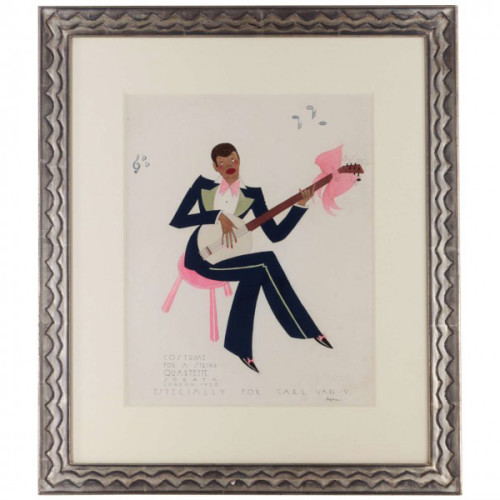
“Costume for a String Quartette” 1930
Watercolor and pencil on paper
Signed: COSTUME FOR A STRING QUARTETTE. SOGATA. LONDON: 1930. ESPECIALLY FOR CARL VAN V. with script signature (in pencil on lower left and beneath image)
For contextual history and similar art see: Rhapsodies in Black : Art of the Harlem Renaissance,(Berkeley: University of California Press, 1997); Harlem Renaissance Artists. Jordan, Denise (Chicago: Heinemann Library, 2003).
Paper H: 14 7/8″ x W: 10 7/8 ”
Image H: 14″ x W: 10 1/2″
Frame H: 20 1/2” x W: 17 1/4”
*This SOGATA New York Watercolor and pencil on paper has been gifted to The Wolfsonian – FIU, Miami Beach, FL.
Carl van Vechten (1880-1964), to whom this artwork is dedicated, was an influential novelist, critic, and photographer in New York during the 1920s, 30s, and 40s. His role in the Harlem Renaissance is well-documented. Van Vechten also introduced Miguel Covarrubias, a caricaturist and contemporary of Sogata, to prominent Manhattan artistic and society circles.
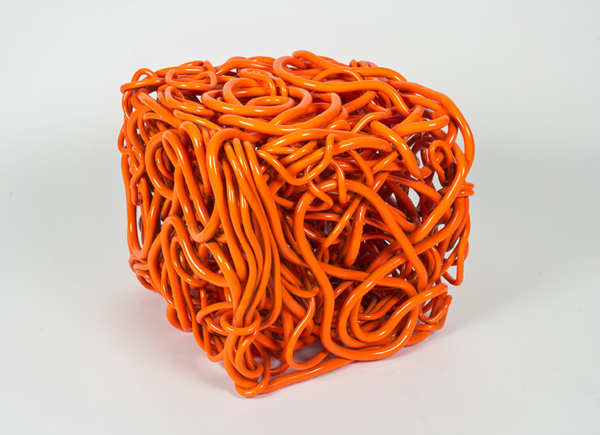
FORREST (FROSTY) MYERS (1941- ) USA
Orange cube 2008
Orange anodized and contoured aluminum wire manipulated into a cube form
Signed: Orange Cube, 08, Forrest Myers (on plaque)
For more information see: Who Was Who in American Art (Madison, Conn.: Sound View Press, 2003-2004 25th Edition), Dictionary of American Sculptors: 18th Century to the Present, Glen Opitz (Poughkeepsie, NY: Apollo, 1984).
Dimension: 10 1/2″ cube
Price: $15,000
A sculptor and art teacher born in Long Beach, California, Forrest Myers settled in Brooklyn, New York. Myers studied at the San Francisco Art Institute. His teaching venues include the San Francisco Art Institute, School of Visual Arts in New York, Kent State University, and the Parsons School of Design. His studio is in Brooklyn.
In the early 1980s, Forrest Myers was applying Buckminster Fuller's principles of tensegrity and repeated tetrahedrons into his designs for furniture. This exploration culminated in the use of aluminum wire that becomes structural when bent and pressed into a dense tangle.
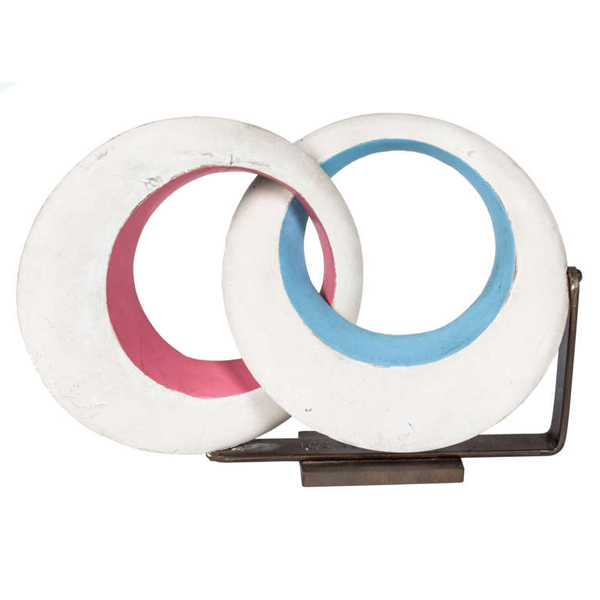
RAYMOND BARGER (1906-2001) USA
Sculpture c. 1955
Polychrome contoured wood of interlocking circular forms in white, blue and pink on a bronze base.
Signed: RB (artist initials), USA, Z0I
H: 8 1/2” x L: 12 ¾” x D: 8
Price: $5,800
Raymond Granville Barger was a sculptor working in metal, plastelin, and bronze among other materials. Barger was educated at Carnegie Institute of Technology and Yale University School of Fine Art. He received a Winchester Fellowship from Yale, and a special fellowship from the American Academy in Rome. Barger moved to California, where he died in 2001.
 @hd_jewels