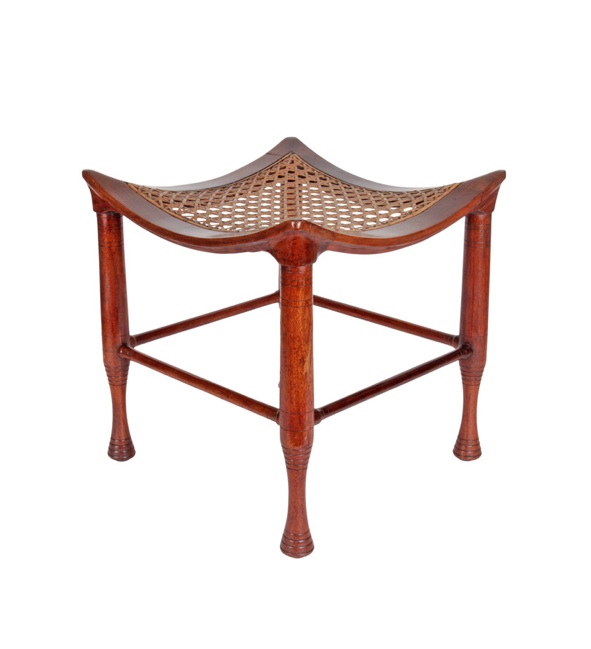
Liberty & Co. / Leonard Wyburd Egyptian Revival Four-Legged Mahogany Thebes Stool c. 1890-95
More Information
Liberty & Co. / Leonard Wyburd Egyptian Revival Four-Legged Mahogany Thebes Stool c. 1890-95
Leonard Wyburd UK
Liberty & Company London
Four-legged Thebes stool circa 1890-95.
Mahogany, woven wicker seat, turned details.
Comparable Liberty stools illustrated: Egyptomania: Egypt in Western Art, 1730-1930 (Paris: Éditions de la Réunion des Musées Nationaux and Ottawa: National Gallery of Canada, 1994), pp. 465-66.
H: 15 3/4″ x D: 15″ x W: 15″
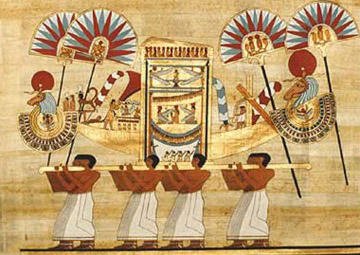
One of the driving influences of the Aesthetic Movement of the late 19th century was an informed interest in authentic ancient designs inspired by recent archaeological discoveries. Both the three- and four-legged Thebes stool were inspired by actual furniture and wall paintings unearthed from royal tombs in the ancient Egyptian city for which they are named. Leonard Wyburd, who was one of the principal designers for Liberty, patented his designs for the Thebes stools in 1884. Liberty & Co. continued to make the popular stools into the early 1900’s.
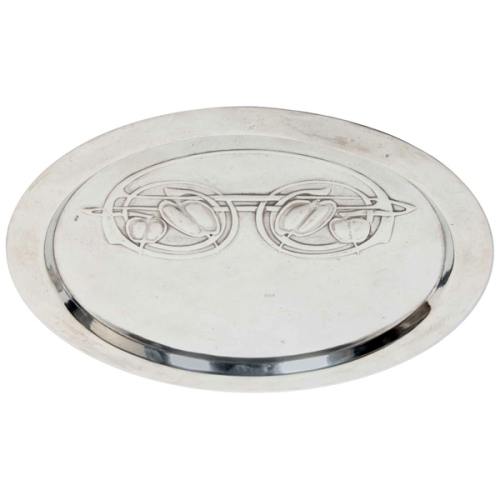
Archibald Knox / Liberty & Co. Tudric charger / tray c. 1902-05
ARCHIBALD KNOX (1864-1933) UK
LIBERTY & CO. London
Tudric charger c. 1902-05
Pewter with abstract Celtic design in bas-relief
Marks: TUDRIC, 0163, Made in England
Illustrated: Archibald Knox, ed. Stephen A. Martin (London: Artmedia Press, 2001) p 203
Drawing illustrated: Archibald Knox, ed. by Stephen A. Martin (London: Academy Editions, 1995) p 137;
D: 9 9/10”
This British avant-garde charger demonstrates the profound influence of Celtic ornament upon Knox and his highly individual and sophisticated use of these ancient graphic devices of interlocking loops and tendrils.
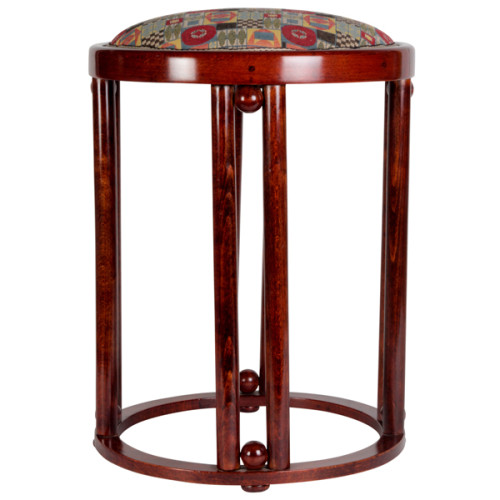
Josef Hoffmann / J. & J. Kohn Vienna Secession Stool c.1907
JOSEF HOFFMANN (1870-1956) Austria
JACOB & JOSEF KOHN Vienna
Stool c. 1907
Mahogany-stained beech with upholstery fabric (new) designed by Josef Hoffmann by Backhausen, Vienna
Illustrated: Jacob & Josef Kohn 1916 catalogue (reprint), p. 37, Model no. 728/s; Klassiker des Modernen Möbeldesign, Dorothee Müller (Munich: Keysersche Verlagsbuchhandlung, 1980) illus. 85, p. 110: Jacob & Josef Kohn catalogue (reprint in Moderne Vergangenheit Wien 1800-1900 (Vienna: Künstlerhaus, 1981) p. 63; 1909 Jacob & Josef Kohn catalogue (reprint) in Bent Wood and Metal Furniture: 1850- 1946, Derek E. Ostergard, ed. (New York: The American Ferderation of Arts, 1987) p. 107.
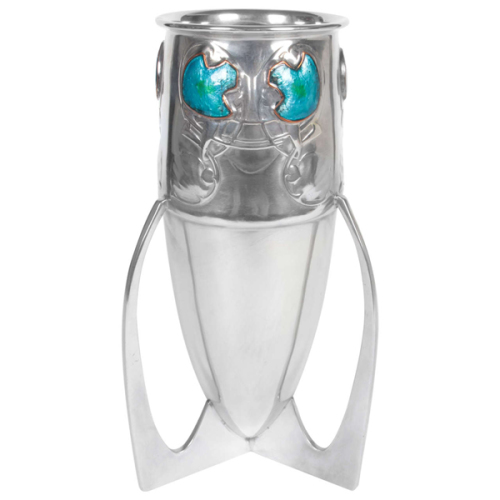
Archibald Knox / Liberty & Co. Tri-footed pewter vase with blue enamel c. 1902-05
ARCHIBALD KNOX (1864-1933) UK
LIBERTY & CO. London
Tri-footed vase c.1902-05
Pewter with blue enamel
Marks: Liberty & Co., ENGLISH PEWTER, 0927
Model illustrated: Liberty’s 1875-1975, An Exhibition to mark the Firm’s Centenary (London: Victoria & Albert Museum, 1975) p. 76; The Liberty Style, introduction by Victor Arwas (NY: Rizzoli, 1979) cat. no. 36
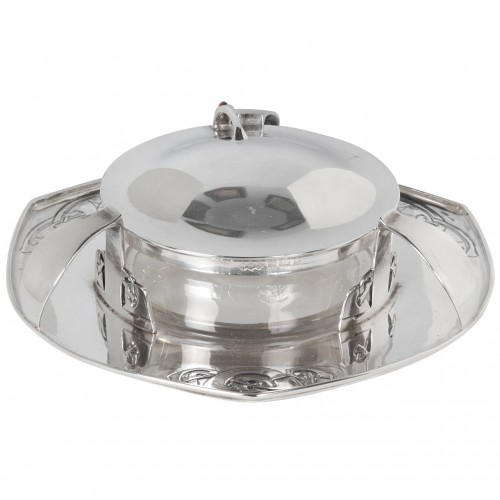
Archibald Knox / Liberty & Co. Rare Sterling and Opal caviar server 1904
ARCHIBALD KNOX (1864-1933) UK
LIBERTY & COMPANY London, UK
Cymric tri-handled covered server 1904
Sterling silver with repoussé Celtic knot motifs and three buttress handles; the handle of the domed lid inset with a jelly opal, cylindrical crystal bowl.
Marks: No. 5199, Liberty & Co., CYMRIC and Birmingham assay marks for 1904 (all the marks appear both on the underside of the base and on the cover)


 @hd_jewels