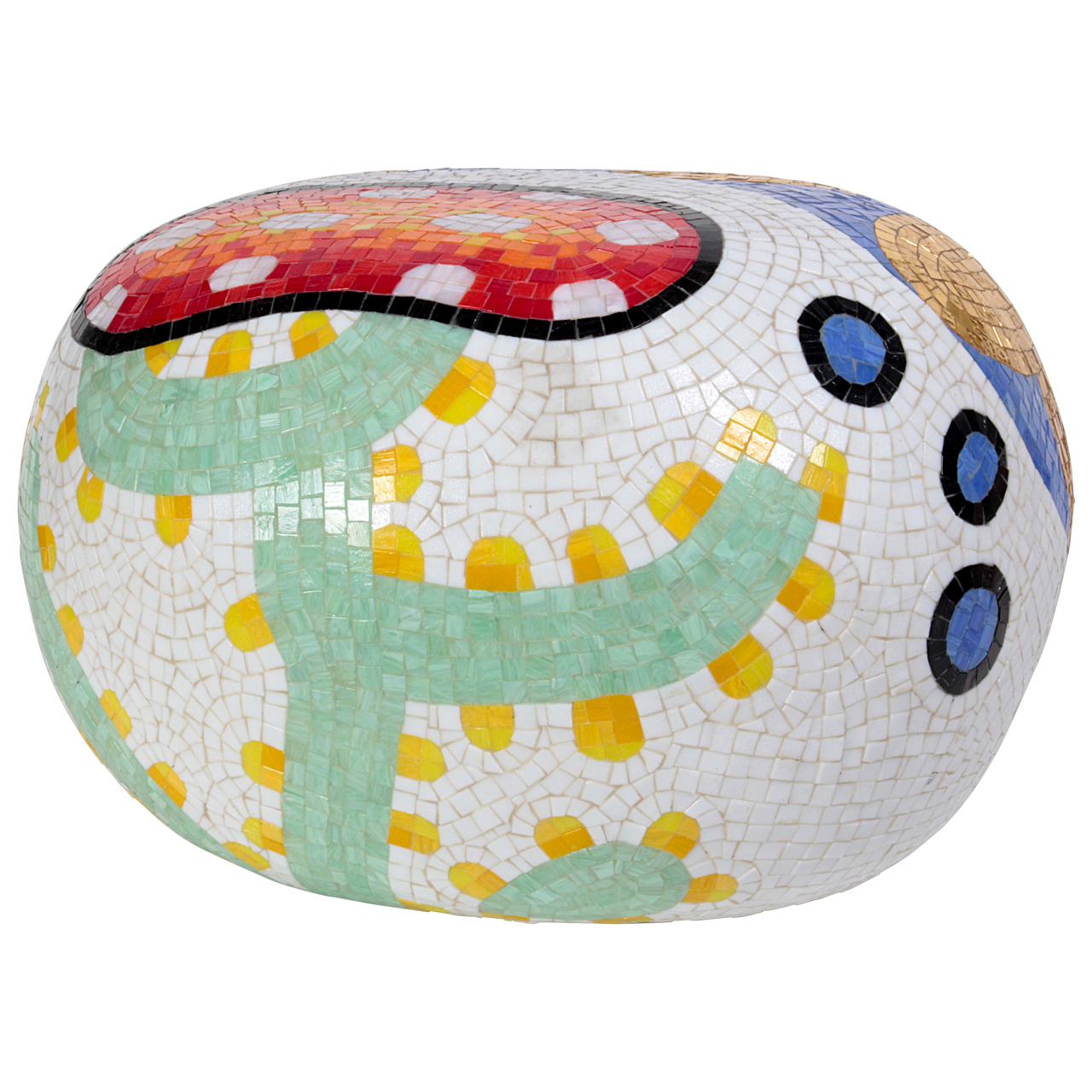
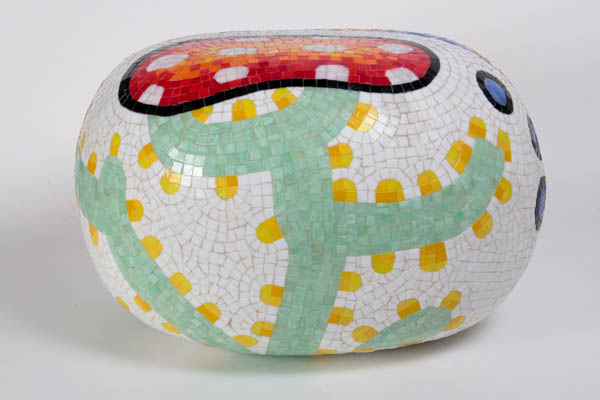
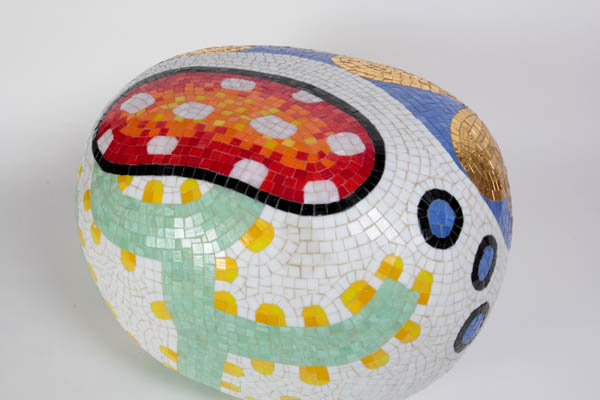
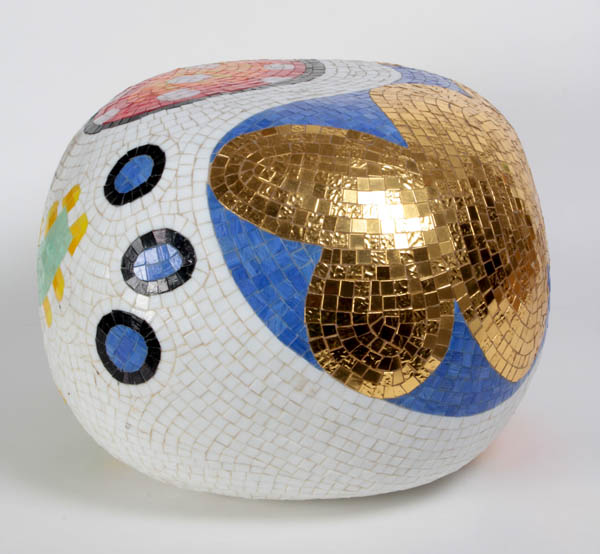
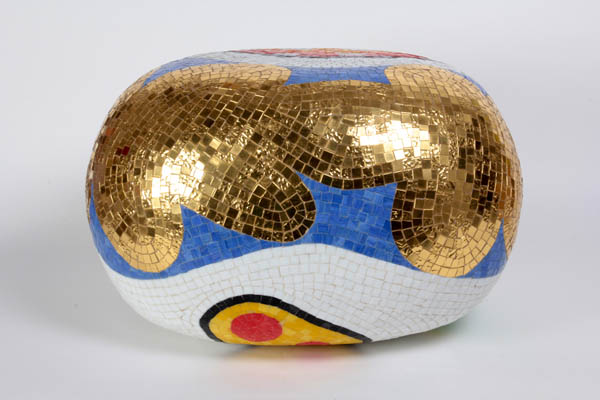
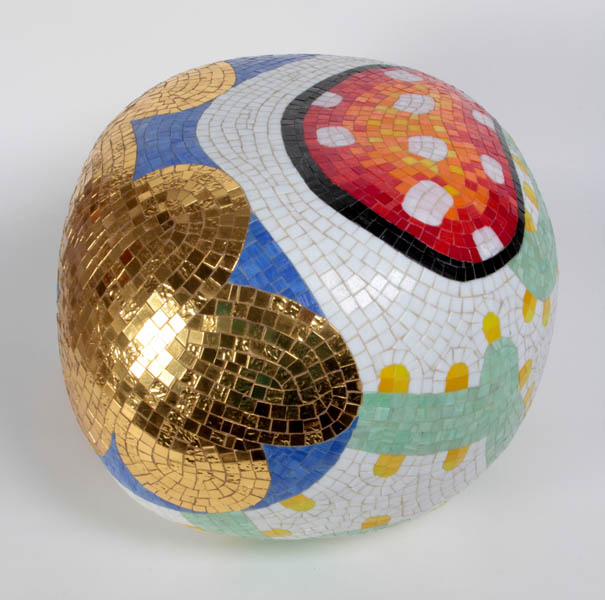
Marcel Wanders "One Morning They Woke Up" mosaic table/stool 2004
More Information
Marcel Wanders, One Morning They Woke Up, mosaic table/stool 2004
MARCEL WANDERS (1963-) The Netherlands
“One morning they woke up” mosaic occasional table or stool 2004
Gilt and lively colored glass mosaic, fiberglass body
H: 13″ x D: 17″
Price: $18,500
Marcel Wanders (1963) grew up in Boxtel, the Netherlands, and graduated at the School of the Arts Arnhem in 1988 with a cum laude certificate. He is now an independent industrial product designer operating out of Amsterdam where he has his own studio, Marcel Wanders studio. Marcel continues to work on diverse products and projects for Cappellini, Mandarina Duck, Magis, Droog Design and Moooi amongst others. For the latter he is associated as creative director. Marcel also co-operates in other design-related projects, such as the Vitra Summer Workshop where he was project leader for the second time. Also he was a juror for various prizes like the Rotterdam Design Prize (for which his own products were nominated several times) and the Kho Liang Ie prize. He lectured at SFMoMA, Limn the Design Academy and has taught at various design academies in the Netherlands. Marcel won the Rotterdam Design Prize (public prize) for the Knotted Chair, and received several other awards including the George Nelson Award (Interiors magazine) and Alterpoint Design Award 2000. In the 2001, Marcel has been nominated in the category ‘designer of the year’ in WIRED magazine’s 2001 wired rave awards. Designs of Marcel Wanders have been selected for the most important design collections and exhibitions in the world, like the Museum of Modern Art in New York and San Francisco, the Stedelijk Museum in Amsterdam, Museum Boijmans van Beuningen in Rotterdam, the Central Museum in Utrecht, and various Droog Design exhibitions. In the book ‘Wanders Wonders, design for a new age’ (1999) which accompanied a solo exhibition in Museum ‘t Kruithuis in Den Bosch, the most important products are shown, from the Knotted Chair to the Shadows lamps and from the Nomad Carpet to the Eggvase. Works of Marcel have been published in all leading design magazines.
Illustrated: Domestic Animals: The Neoprimative Style Andrea and Nicoletta Branzi, (London, 1987) n.p.; Designed by Architects in the 1980s, Julie Capella and Quim Larrea, Barcelona, 1987, p. 37; Anne Bony, Paris Les années 80, 1995, p. 520; Charlotte and Peter Fiell, 1000 Chairs, Cologne, 2000, p. 588
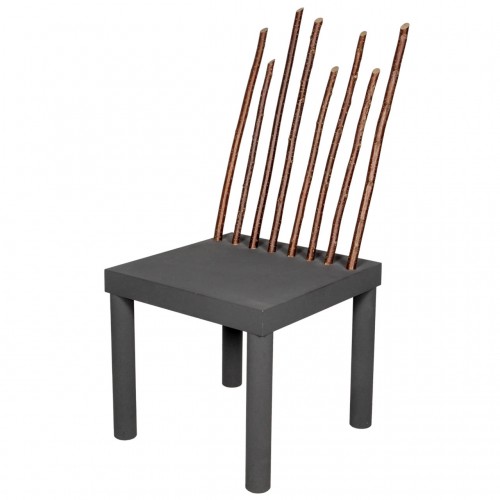
H: 42 3/4″ x W: 19 3/4″ x D: 24″
Price: $19,000
The “Cucus” chair was part of the “Domestic Animals” series
designed in 1985/86 by Andrea Branzi for Zabro.
Andrea Branzi's “Domestic Animals” series was designed in 1985 and 1986 for the Italian firm Zabro. Designs were later also manufactured by Zanotta. Andrea Branzi created “Domestic Animals” in collaboration with Nicoletta Branzi, who produced limited edition art clothing for this series. The “Neoprimitive” style in which this collection has been rendered utilizes natural materials such as sticks to create an object that brings archetypal symbols into the home to produce emotional effects. These objects combine technology and nature and the symbols and codes that these entail demonstrating that “a hybrid love between different creatures is possible.” (Branzi, Domestic Animals, 1987, n.p.) With these objects Branzi aims to “domesticate” technological inventions so as to make them a positive presence in man's life.
“The difference between a domestic animal and a trained (or tamed) one lies in the fact that the latter is the outcome of an unnatural and violent attitude, while the domestic animal establishes the dream of a loving relationship with man.” (Branzi, Domestic Animals, 1987, n.p.)
Andrea Branzi, architect and designer, born in Florence in 1938, where he graduated in 1967, lives and works in Milano. From 1964 to 1974 he was a partner of Archizoom Associati, first vanguard group internationally known, whose projects are preserved at Centro Studi e Archivio della Comunicazione in Parma and at Centre Georges Pompidou in Paris.
Since 1967 he works in the fields of industrial and research design, architecture, urban planning, education and cultural promotion.He is Professor at the Third Faculty of Architecture and Industrial Design of Politecnico di Milano.
Alberto Marconetti / Italian Post-War Design Armchairs c. 1960’s
ALBERTO MARCONETTI Milan, Italy (active Argentina)
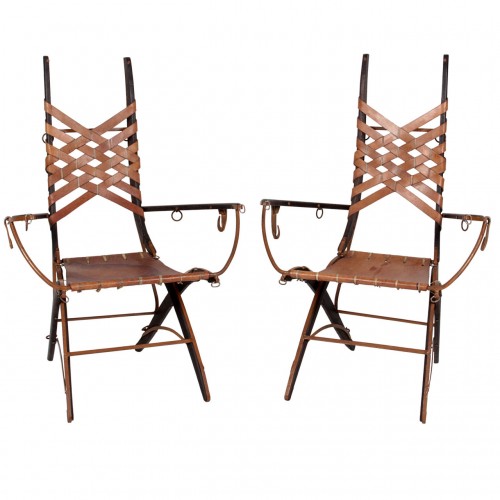
Armchairs (Two available) c. 1960’s
Oak, painted iron, leather strapwork and seat
Marks: by Alberto Marconetti (script signature)
H: 40 1/2” x W: 27” x D: 21”
Seat height: 19″
Price: $7,450 (each)
This pair of armchairs nods to the influence of such Italian designers as Carlo Bugatti and Carlo Mollino yet are their own unique creation. They have an unusual anthropomorphic quality in that the frame suggests a skeletal structure. In addition, the leather strapwork, iron loops and hooks allude to the equipage of the ancient Roman equestrian order.
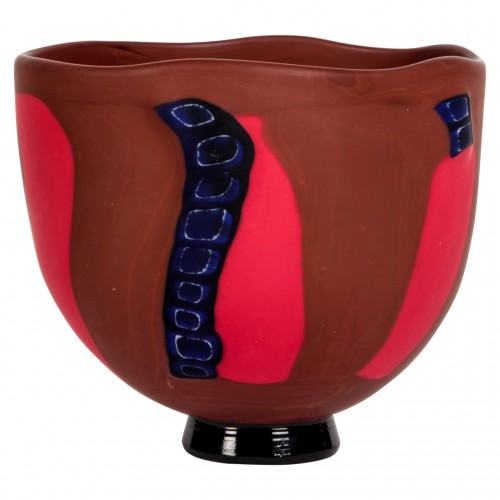
Overall matte finish art glass vase with an elaborate mosaic technique inset with red rectangular patchwork sections and blue murrina jewels all on a chocolate brown body with a black glass foot
Marks: Tsuchida Yasuhiko 99, 77
For more information see: Tsuchida Yasuhiko, exh. cat., Franco Schiavon (Murano, Italy: Palazzo del Vetro, 2000).
Provenance: Pauly & Co. Venice
H: 4 3/4″ x Dia: 5 1/8″
Price: $5,450
Yasuhiko Tsuchida was born in Osaka, Japan in 1969. In 1988, soon after graduating TSUJI Culinary Institute, he left Japan to explore food and art in Paris. Since 1992, he has lived in Venice, Italy. Tsuchida has been making glass work in Murano Island since 1995, and next year assumed the office of art director at Schiavone Glass Co. Ltd. In 1996 he presented a glass sculpture entitled “Bamboo Collection”
with Japanese motif of bamboo. The work was highly acclaimed, which gave him a chance to start to hold solo exhibitions around the world. In 2000, Tsuchida became a member of the board of directors at Venetian Glass Institute, and a chief director there in 2003. In 2004, he won Honorary Technique Prize in Düsseldorf, Germany, and in 2008, received Award of Contribution to Cultural
Promotion from Grosseto city, Toscana. In the same year, he
represented Japan at International Open Exhibition of Sculpture, and won the Grand-Prix. In 2010, Tsuchida was invited to the Issei Miyake “IM10” Project Competition, and held a solo exhibition at Lorusso Gallery, Andria, Italy. Tsuchida continues to exhibit in many solo shows around the world.
African Tribal Nupe stool Nigeria, early to mid 20th Century
NUPE TRIBE, Nigeria
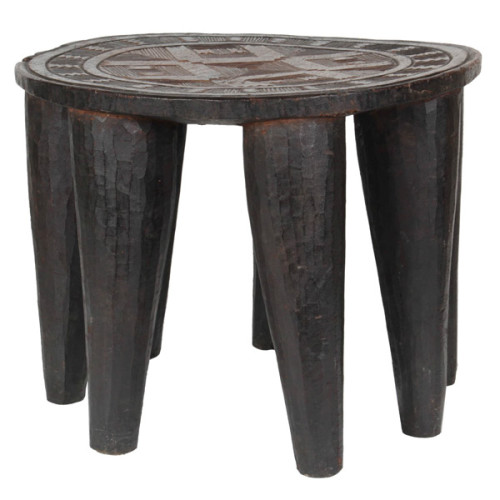
Nupe stool, Nigeria early to mid 20th Century
Hand carved and decorated wood with a rich developed brown black patina.
This finely hand carved African stool was created by the Nupe tribe of Nigeria. The stool is carved from one piece of wood with intricate refined geometric patterns carved into the top and has seven tapered legs.



 @hd_jewels
Reviews
There are no reviews yet, would you like to submit yours?