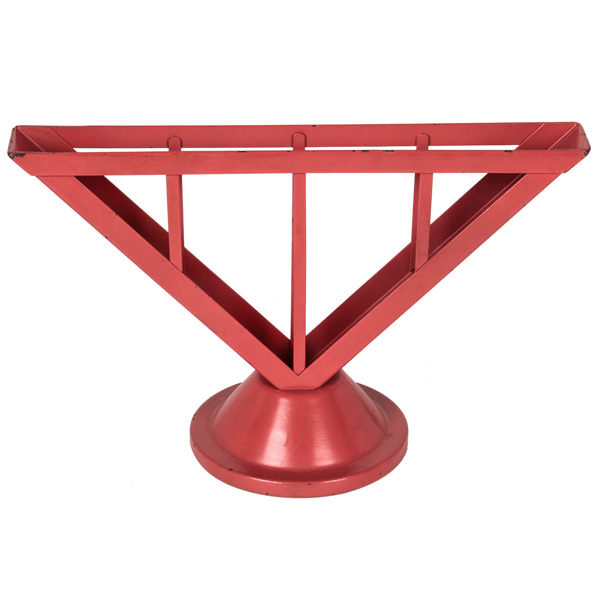
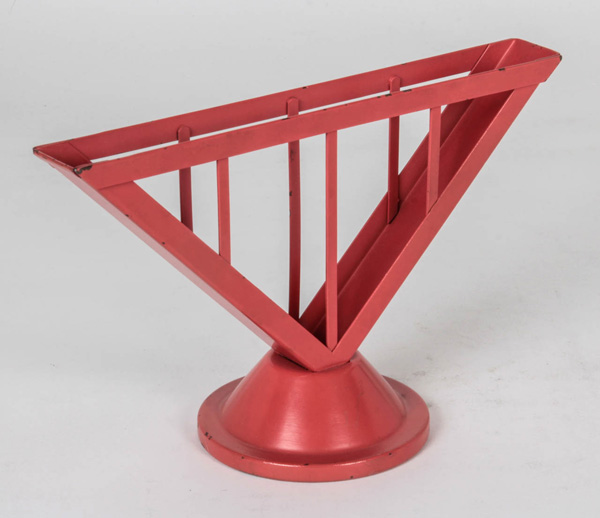
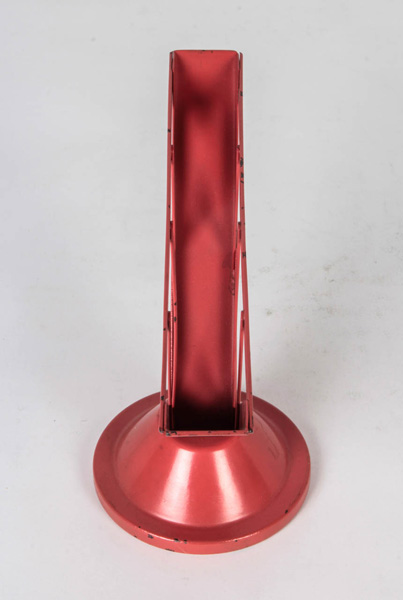
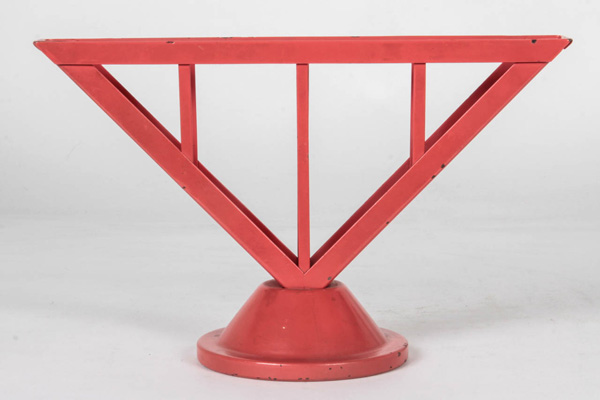
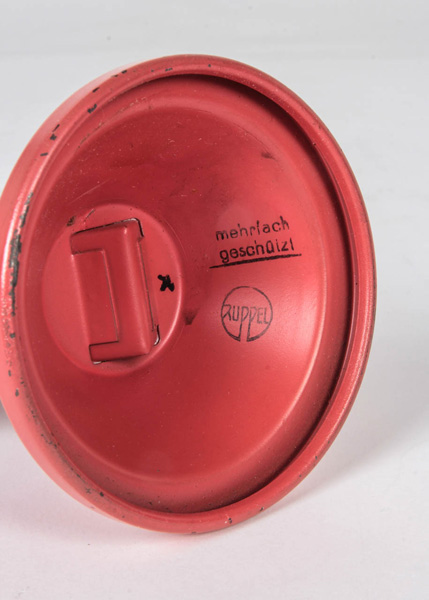
Salmon enameled metal napkin holder in a triangular form
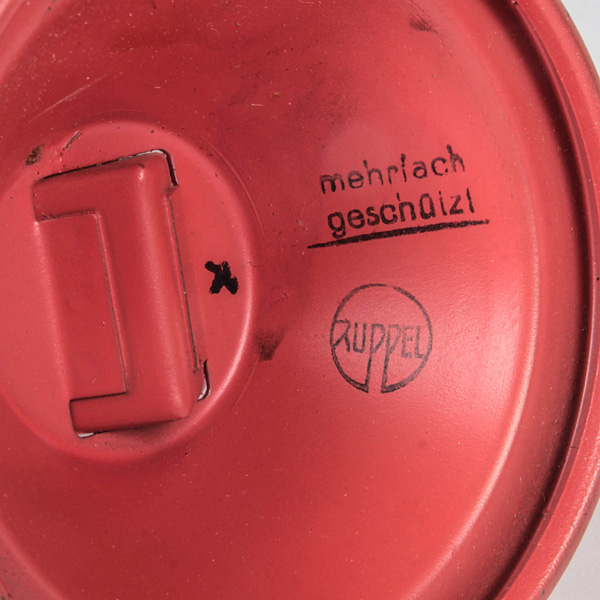
Marks: RUPPEL (in a circle) mehrfach geschützt
Illustrated: Avantgarde Design 1880-1930, Torsten Bröhan, Thomas Berg (Cologne: Benedikt Taschen, 1994) p. 105.
For other works by Brandt for Metallwarenfabrik Ruppelwerk see: Die Metall Werkstatt am Bauhaus, (Berlin: Bauhaus-Archiv, Museum für Gestaltung, 1992) pp. 180-183; Die Metall Werkstatt am Bauhaus, (Berlin: Bauhaus-Archiv, Museum für Gestaltung, 1992) pp. 181-3;
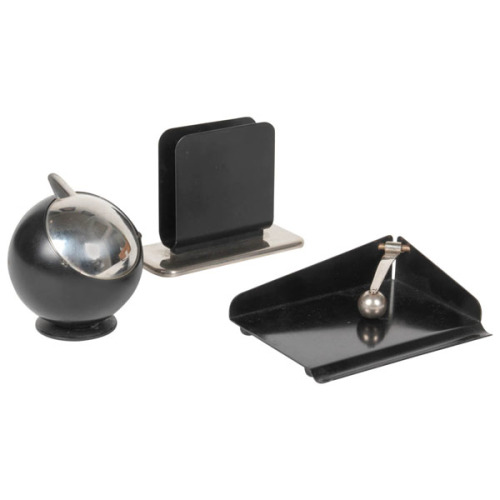
Black enameled and nickeled metal, hinged ball weight, ball feet
Marks: RUPPEL (in a circle), mehrfach geschützt
Illustrated: Die Metall Werkstatt am Bauhaus, (Berlin: Bauhaus-Archiv, Museum für Gestaltung, 1992) pp. 181-3;
H: 1 5/8” x W: 5 1/4” x D: 4”
Napkin holder c. 1930
Black enameled metal and nickeled base
Marks: RUPPEL (in a circle), mehrfach geschützt, 85/4440/37, Ruv 5 (numbers in red crayon)
H: 3 ¾” x W: 5” x D: 2 1/8”
For other works by Brandt for Metallwarenfabrik Ruppelwerk see: Die Metall Werkstatt am Bauhaus, (Berlin: Bauhaus-Archiv, Museum für Gestaltung, 1992) pp. 180-183; Die Metall Werkstatt am Bauhaus, (Berlin: Bauhaus-Archiv, Museum für Gestaltung, 1992) pp. 181-3; Avantgarde Design 1880-1930, Torsten Bröhan, Thomas Berg (Cologne: Benedikt Taschen, 1994) p. 105.
F.W. QUIST Esslingen, Germany
Ball ashtray “Smokny”
Nickel plated metal and black lacquered surface
Marks: Quist (on bottom)
H: 3 1/2″
The hardwarefactory F.W.Quist, Esslingen, Germany was founded 1868 as „Lackier- und Metallwaarenfabrik“ from the turner and metal-turner Jacob Schweizer, jun.. In the year 1872, the conversion of the business from a public company occurred, the “Actien-Plaqué Fabrik”. From 1890, the director and shareholders Friedrich Wilhelm Quist took over the business as alone-owner. In his succession four generations continued the business as family-businesses until 1981.
The business always stood for the manufacture more representatively props in the taste of the time. „Tischkultur, Gastlichkeit, Geschenkkultur dienten als Felder, einen gehobenen, verfeinerten Lebensstil zu dokumentieren und das unabhängig von der gesellschaftlichen Zugehörigkeit.“ (Served table-culture, hospitality, gift-culture as fields should document lifestyle, independently of the social affiliation) (Esslingen 2004, S.60)
So, the form of the 1970 as newness presented ball-ashtray was borrowed this famous „ball“ or „globe“ (presented for the first time, 1966 at the international furniture-fair in Cologne) and „bubble“ (1968) chairs by the finish designer Eero Aarnio. The completely new and unconventional shape, Aarnio developed on basis of the simplest geometrical form, the ball. It advanced to a cult-object of the following decade and didn’t lose anything modernity until today.
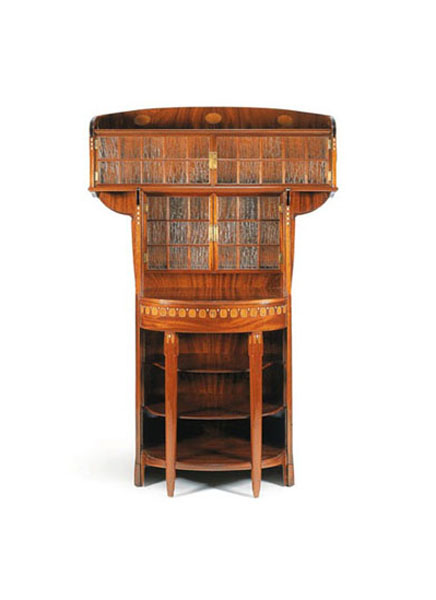
Alfred Grenander / W. Kummel 1904 St. Louis Exhibition cabinet, unique 1904
ALFRED GRENANDER (1863-1931) Sweden / Germany
W. KUMMEL Berlin, Germany (cabinetmaker)
Cabinet (unique) c. 1904
Flamed mahogany, ebony, ivory and fruitwood inlays, brass hardware and details, textured glass
Marks: American import label (from Germany) for the St. Louis exhibition
Exhibited: The 1904 St. Louis Exhibition, German Section in the Herrenzimmer
Illustration of Grenander room: Deutsches Kunstgewerbe St. Louis 1904, Hugo Nachtlicht, 1904, p. 80.
Commentary on Grenander’s display at St. Louis Exhibition: Deutsche Kunst und Dekoration, Band XV Oktober 1904-Marz 1905, “Die Wohnungskunst auf der Welt –Austellung in St. Louis”, Dr. Hermann Muthesius, p. 213-16.
Related bookcase-cabinet illustrated: Deutsche Kunst und Dekoration, Band XVI April-September 1905, p. 426.
For other works by Grenander see: Deutsche Kunst und Dekoration, Band XVI April-September 1905, p. 395-407, 426, 427, 671-73, 694, 695; Das Deutsche Kunstgewerbe 1906, 111. Deutsche Kunstgewerbe-Austellung Dresden 1906, (München, Verlagsanstalt P. Bruckmann A.G., 1906) p. 129-133, 232, 261
H: 79 1/2” x W: 57” x D: 23”
Price: $95,000
Alfred Grenander was born in June 1863 in Skövde, Sweden, and came to Berlin in 1885 to study. The city became his home, and he built his first buildings here together with his brother-in-law Otto Spalding. In 1897 Grenander began teaching at the Unterrichtsanstalt des Berliner Kunstgewerbemuseums (college attached to Berlin’s Museum of Arts and Crafts). His involvement with underground railway architecture began in 1900 and came to dominate his life’s work, with more than 80 buildings. He died on 14 July 1931 in Berlin.
From the turn of the century through the early 1930s, Alfred Grenander provided the emerging metropolis of Berlin with an extensive net of subway stations. He was an architect, draughtsman, and city planner; as well as a remarkable furniture designer. Grenander was the celebrated German representative at the 1904 World’s Fair in St. Louis, where he was being honored as “the renewer of German art.” This mahogany cabinet inlaid with pewter, ebony and ivory was exhibited in the elegant Herrenzimmer of the German pavilion at the Louisiana Purchase Exposition, St. Louis, Missouri, 1904, was bought in 1904 by a Kansas City, Missouri family and the piece descended in the family.



 @hd_jewels