Product Description
Marianne Brandt / Metallwarenfabrik Ruppelwerk / F.W. Quist Bauhaus Black enameled desk accessories & ashtray c. 1930

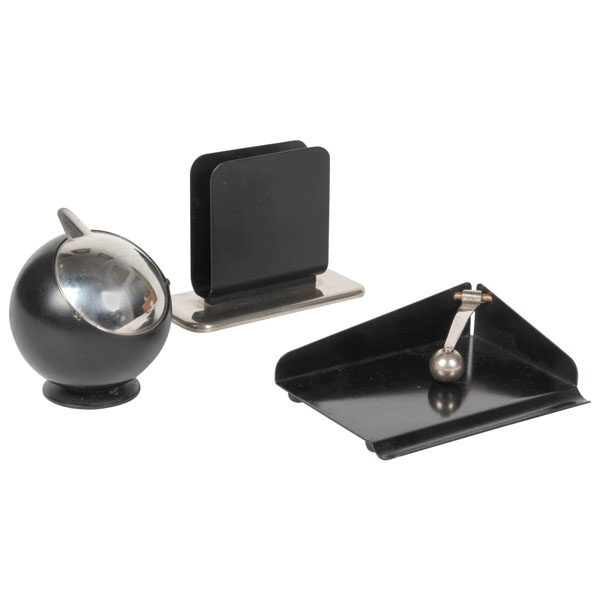
MARIANNE BRANDT (1893-1983) Germany
METALLWARENFABRIK RUPPELWERK Gotha, Germany
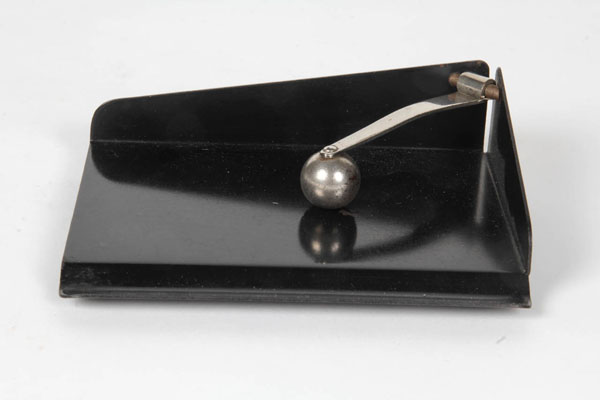
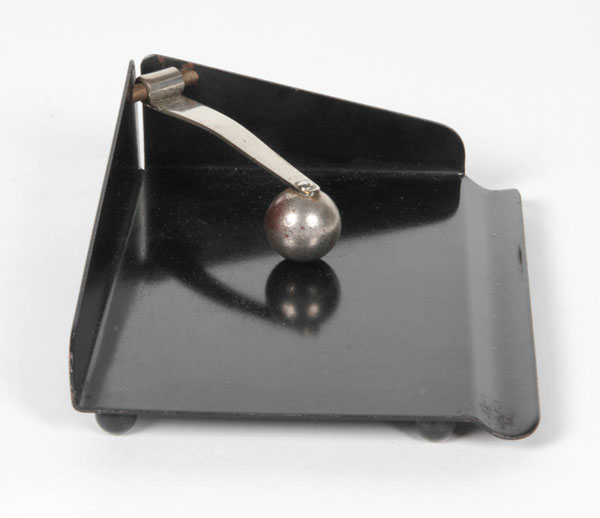
Paper holder c. 1930
Black enameled and nickeled metal, hinged ball weight, ball feet
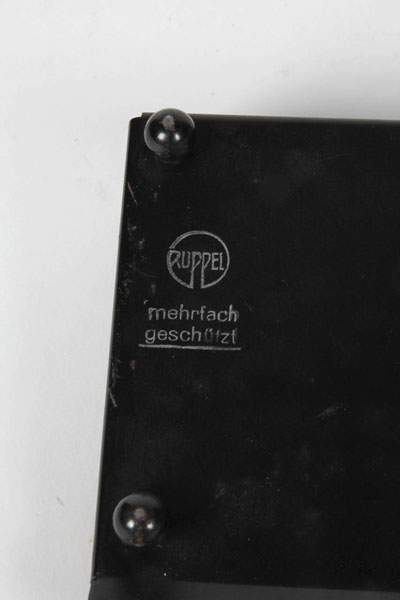
Marks: RUPPEL (in a circle), mehrfach geschützt
Illustrated: Die Metall Werkstatt am Bauhaus, (Berlin: Bauhaus-Archiv, Museum für Gestaltung, 1992) pp. 181-3;
H: 1 5/8” x W: 5 1/4” x D: 4”
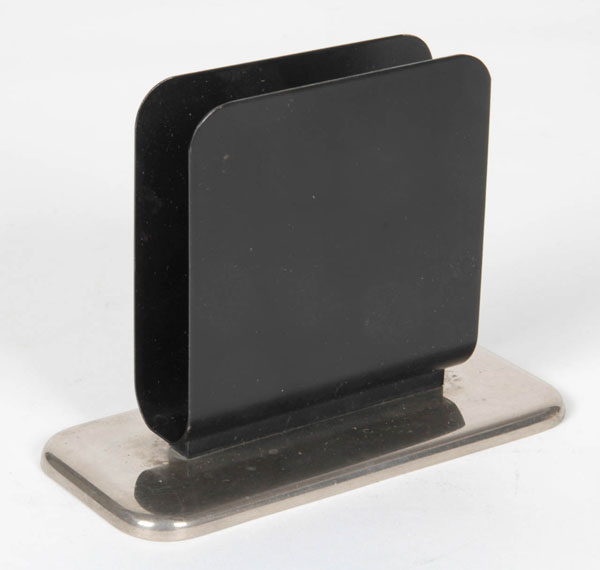
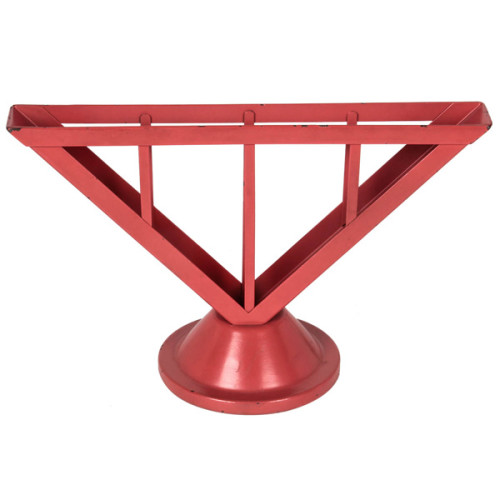
Napkin holder c. 1930
Black enameled metal and nickeled base
Marks: RUPPEL (in a circle), mehrfach geschützt, 85/4440/37, Ruv 5 (numbers in red crayon)
H: 3 ¾” x W: 5” x D: 2 1/8”
For other works by Brandt for Metallwarenfabrik Ruppelwerk see: Die Metall Werkstatt am Bauhaus, (Berlin: Bauhaus-Archiv, Museum für Gestaltung, 1992) pp. 180-183; Die Metall Werkstatt am Bauhaus, (Berlin: Bauhaus-Archiv, Museum für Gestaltung, 1992) pp. 181-3; Avantgarde Design 1880-1930, Torsten Bröhan, Thomas Berg (Cologne: Benedikt Taschen, 1994) p. 105.
F.W. QUIST Esslingen, Germany
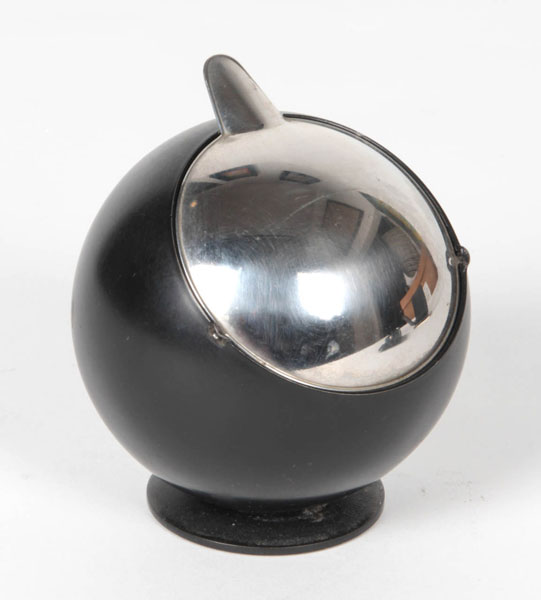
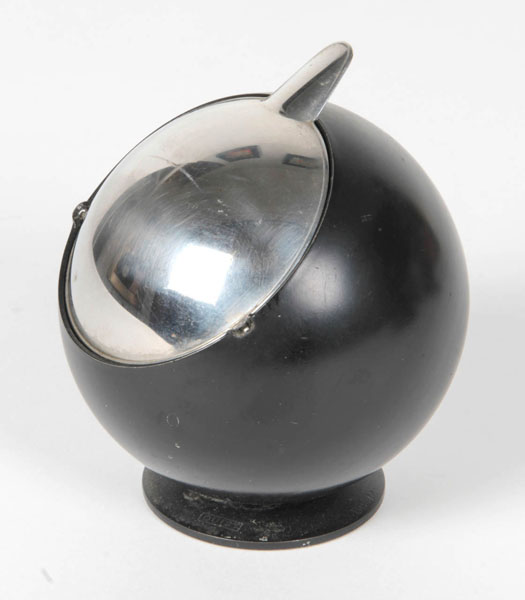
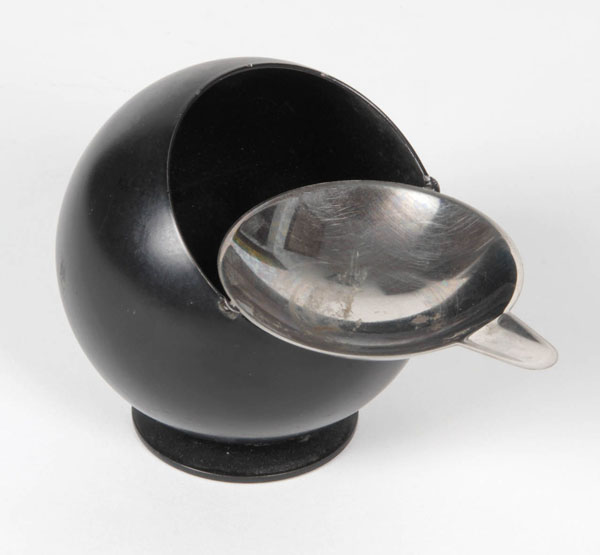
Ball ashtray “Smokny”
Nickel plated metal and black lacquered surface
Marks: Quist (on bottom)
H: 3 1/2″
The hardwarefactory F.W.Quist, Esslingen, Germany was founded 1868 as „Lackier- und Metallwaarenfabrik“ from the turner and metal-turner Jacob Schweizer, jun.. In the year 1872, the conversion of the business from a public company occurred, the “Actien-Plaqué Fabrik”. From 1890, the director and shareholders Friedrich Wilhelm Quist took over the business as alone-owner. In his succession four generations continued the business as family-businesses until 1981.
The business always stood for the manufacture more representatively props in the taste of the time. „Tischkultur, Gastlichkeit, Geschenkkultur dienten als Felder, einen gehobenen, verfeinerten Lebensstil zu dokumentieren und das unabhängig von der gesellschaftlichen Zugehörigkeit.“ (Served table-culture, hospitality, gift-culture as fields should document lifestyle, independently of the social affiliation) (Esslingen 2004, S.60)
So, the form of the 1970 as newness presented ball-ashtray was borrowed this famous „ball“ or „globe“ (presented for the first time, 1966 at the international furniture-fair in Cologne) and „bubble“ (1968) chairs by the finish designer Eero Aarnio. The completely new and unconventional shape, Aarnio developed on basis of the simplest geometrical form, the ball. It advanced to a cult-object of the following decade and didn’t lose anything modernity until today.
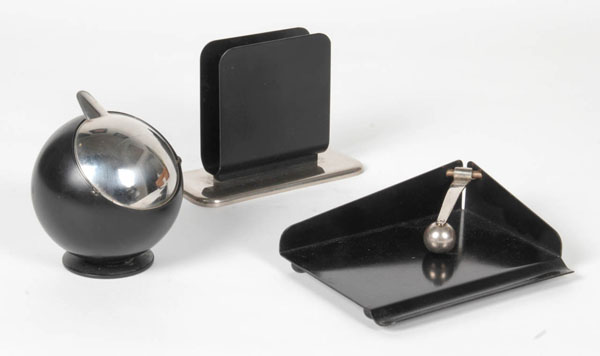
Marianne Brandt / Metallwarenfabrik Ruppelwerk / F.W. Quist Bauhaus Black enameled desk accessories & ashtray c. 1930
STEINGUTFABRIKEN VELTEN-VORDAMM Werk Velten, Germany
Vase c. 1920
Handpainted and glazed earthenware
Marks: VELTEN-VORDAMM company logo
Similar work illustrated: Keramik und Bauhaus, Klaus Weber et al., exhib. cat. (Berlin: Bauhaus-Archiv, 1989), p. 229, illus. 289.
H: 5” x Dia: 5 1/2″
PAUL HAUSTEIN (1880-1944) Germany
HERMANN BEHRND (b. 1849) SILBERWARENFABRIK (silver) Dresden, Germany
JAKAB RAPOPORT (enamelist) Budapest, Hungary
Inkwell c. 1900
Multicolored burgundy, purple, blue and green enamel with silver mounts, glass insert
Marks: Moon, crown, 800, HB (Hermann Behrnd mark)
Same model with variant mount illustrated: Deutsche Goldschmiede-Zeitung, n.d. (circa 1903-05), p. 23
For related works and more information see: Art Nouveau in Munich: Masters of Jugendstil, ed. Kathryn Bloom Hiesinger (Philadelphia: Philadelphia Museum of Art, 1988) pp. 67-69; Jugendstil in Dresden, Aufbruch in die Moderne, Gisela Haase et al., exh. cat. (Dresden: Staatliche Kunstsammlungen Dresden; Wolfratshausen: Edition Minerva, 1999).
Dia: 7 1/4″ x H: 4 1/2″
Joseph Maria Olbrich (1867-1908) Austria
Clarfeld & Springmeyer Hemer (Westfalen), Germany
Ludwig Ziech Vereinigter Silberbesteckfabrik Hamburg, Germany
Cake Server, 1901.
Silvered alpaca with JO (J. Olbrich) monogram and stylized linear motif .
Marks: A.B.S.Z. 60
Illustrated: Joseph M. Olbrich 1867-1908, Eckhart G. Franz, et al., exhib. cat. (Darmstadt: Mathildenhöhe, 1983), p. 346.
For other examples of this service see: Bestecke des Jugendstils: Art Nouveau Knives, Forks and Spoons, Barbara Grotkamp-Schepers and Reinhard W. Sänger (Stuttgart: Arnoldsche, 2000), p. 100, illus. 104; Catalogue Museum Künstlerkolonie Darmstadt, Klaus Wolbert et al. (Darmstadt: Institut Mathildenhöhe, n.d.), illustr. 306, p. 198; Das Deutsche Silber-Besteck 1805-1918: Biedermeier – Historismus – Jugendstil, Reinhard W. Sänger (Stuttgart: Arnoldsche Verlagsanstalt GmbH, 1991), pp. 176-180.
L: 10 5/8″ x W: 2 9/16″
Price: $3,750