Product Description
Pierre Sterlé Paris, “Hummingbird” brooch, carved natural ruby in zoisite mounted in 18K gold set with diamonds set in platinum, original suede box, signed, c. 1950’s

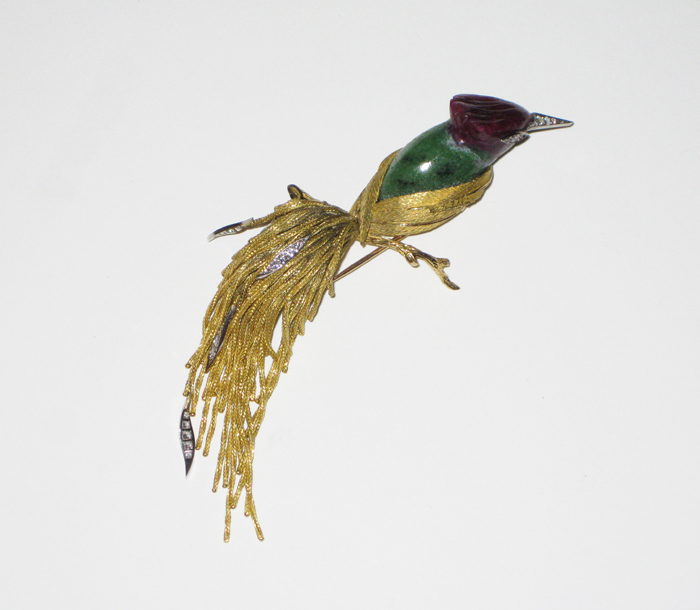
Pierre Sterlé Paris, “Hummingbird” brooch, carved natural ruby in zoisite mounted in 18K gold set with diamonds set in platinum, original suede box, signed, c. 1950’s
TIFFANY & CO. New York, NY
“Frog on a lily pad” cigarette case 1880
Hand wrought sterling silver with repoussé and chased gold design of a frog sitting on a lily pad with a dragonfly in it’s mouth, “lap over edge” and hand hammered details, gilt interior and spring action to the hinge when the sides are pressed
Tiffany Archive Illustration: Design for Cigarette Case No. 5804, No. 1019, 249, stamped Tiffany & Co. New York, February 26, 1880
Model and Archive illustration: Bejewelled by Tiffany 1837-1987 Clare Phillips (New Haven and London: Yale University Press, 2006)
For more information see: Tiffany Silver, Charles H. Carpenter, Jr. (New York: Dodd, Mead & Company, 1978); The Silver of Tiffany & Co., 1850-1987, Charles H. Carpenter, Jr. and Janet Zapata (Boston: Museum of Fine Arts, 1987).
Marks: Tiffany & Co., 5804, M, 2540, Sterling-Silver, 1019
H: 3/4” x W: 2 7/8” x D: 2 1/8”
The Frog and the Dragonfly
from The Lost Lagoon
by Reg Down, 2010
Once upon a time a dragonfly lived beside a lake high in the mountains. He flitted from bulrush to bulrush – and zipped after mosquitoes. He snapped them out of the air so quickly that no one could ever quite see what he was doing.
One day, as he was flying across the water, his beautiful wings glistening like rainbows, he came across a frog.
“Ribbit!” said the frog. “Come here, Mr. Dragonfly. I would like to have a better look at you.”
But the dragonfly was clever. In fact, he was so clever that his eyes were made up of hundreds of eyes all put together on the top of his head. And each one of those eyes said to him: “That frog wants to eat me!”
So he landed on top of a bulrush where the frog could not get him, and said, “Yes, Mr. Frog, I am close enough for you. What do you want?”
“Ribbit! Ribbit!” croaked the frog, “I think you should come closer because my eyes are not very good.”
So the dragonfly came a little closer. He flitted to a flower floating on the water—but still not close enough for the frog to grab him with his mouth.
“Yes, Mr. Frog, what do you want?” he asked.
“Oh, Mr. Dragonfly,” said the frog, “I have an itch on the end of my nose and my legs aren”t long enough to reach it. But your legs are scratchy—they will be able to scratch my itchiness much better that I ever could.”
The dragonfly found this quite funny. He thought, “That frog wants to eat me! I am sure that frog wants to eat me!” So he flew behind the frog and landed on his back.
The frog could feel the dragonfly crawling on his back, but he could not turn around to grab him. “Oh, Mr. Dragonfly,” he said, “you have to come closer to my nose. In fact, my lips are getting very itchy—please come closer.”
So the dragonfly went and sat between the frog”s eyes. Now the frog”s eyes were looking into the dragonfly”s eyes, and the frog saw that the dragonfly had far, far more eyes than he had. So he said, “Oh, Mr. Dragonfly, you are surely much, much more wise than I am. You have so many eyes that you can see the whole world!”
And the dragonfly replied, “Of course I can see the whole world! I have so many eyes that I am the wisest of all flies!”
“Well,” said the frog, “I have a little tickle in the bottom of my throat—what is happening there?”
And the dragonfly looked, and looked, and looked…….and Snap! the frog ate him up.
ALEXANDRE NOLL (1890-1970) France
Covered box c. 1930
Mahogany with ebony peg details and 1 ¼ inch thick Saint-Gobain glass.
Marks: ANoll
Provenance: Private Collection New York, Galerie de Beyrie Paris, Odile Noll (A. Noll’s daughter), Alexandre Noll Estate
For more information see: Alexandre Noll, Olivier Jean-Elie, Pierre Passebon (Paris:Edition du Regard, 1999); Alexandre Noll: Les Matres de L’ Art Decoratif Contemporain, Collection dirigée par R. Moutard-Uldry edited by (Geneve: Pierre Cailler, 1954); Le Mobilier du Xxe Siécle: Dictionnaire des
Créateurs, Pierre Kjellberg (Paris: Les Éditons de l’Amateur, 1994) p. 455-456.
H: 2 1/2″ x D: 5 3/8″ x W: 8″
JAN DE SWART (1908-1987) Netherlands / USA
Mystery box c. 1970
Hand carved and assembled box form with a curiosity element of a large turquoise cabochon with raw hide wraps underneath the lid.
For more information see: Jan de Swart: A Day That Becomes a Lifetime, exhibition catalogue (California: Fine Arts Gallery at the San Fernando Valley State College, February 1972); Jan de Swart, Mike McGee and William G. Otton (Laguna Beach, California: Laguna Art Museum, 1986).
W: 16 1/2″ x H: 4 1/2″ x D: 5″
Price: $4,700
Constantly seeking and inventing new materials Jan de Swart was a true modernist. He was influenced by artists such as Isamu Noguchi, Harry Bertoia, Charles Eames, and later Sam Maloof and Wendell Castle. Although he had been creating small sculptures since his arrival in California from Holland in 1929, he had not been widely recognized until being introduced to John Entenza, publisher of Arts & Architecture magazine in 1947. Soon thereafter, he was able to create larger works and began collaborating with architects such as Whitney Smith and Victor Gruen on special commissions. His work is in the permanent collection of Los Angeles County Museum of Art, The Smithsonian, and the Ford Foundation. He was honored with the American Institute of Architects Gold Medal for Sculpture in 1965.
Ando Jubei Nagoya, Japan
Japanese Meiji Period (1868-1912) Japan
Enamel and copper covered box circa 1900
Patinated copper, applied foil-backed enameled red berries, stylized green leaves and vines, riveted corners.
H: 1 5/8″ x D: 4″ x W: 5 3/4″