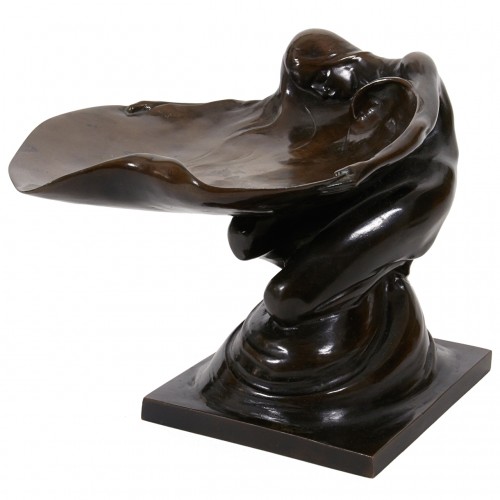
Friedrich Gornik Bronze "Pelican" Art Nouveau Vide Poche c.1910
More Information
Friedrich Gornik Bronze “Pelican” Art Nouveau Vide Poche c.1910
Friedrich Gornik (1877-1943) Austria.
“Pelicans” vide poche c. 1910.
Bronze with a natural gold patina of two pelicans on a rock, one seated and the other eating fish.
Marks: F Gornik and monogram.
For more information on Friedrich Gornik see: Der Österreichische Werkbund, Astrid Gmeiner & Gottfried Pirhofer (Salzburg & Wien: Residenz Verlag,1985) p. 228; Österreichische Keramik des Jugendstils, Waltraud Neuwirth (Munich: Prestel-Verlag, 1974) p. 156.
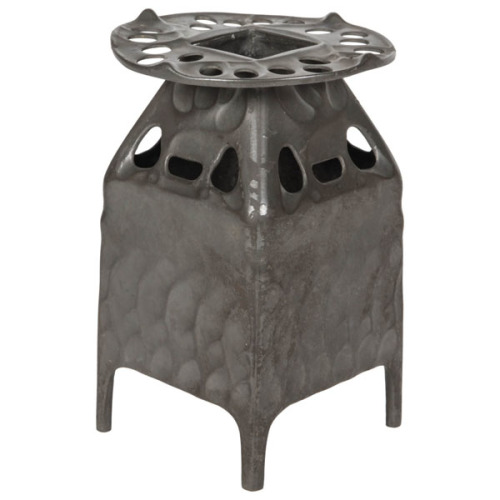
Karl Berghof / Kayserzinn Extremely Rare German Jugendstil Art Nouveau Pewter Vase 1904
KARL BERGHOF Germany
J. P. KAYSER SOHN Krefeld, Germany
Vase 1904
Pewter squared vase with round flange top, open work details
Marks: Kayserzinn 4541 7 (in a raised oval)
Illustrated: Zinn des Jugendstils, Eckard Wagner (Cologne: Rheinland-Verlag, 1978), p. 63, cat. no. 148; J. P. Kayser Sohn Krefeld: Fabrik kunstgewerblicher Metallgegenstände, Musterbuch 1907 (Munich: Verlag Dry, 1982) p. 46.
***This is an extremely rare, other worldly Kayserzinn form.
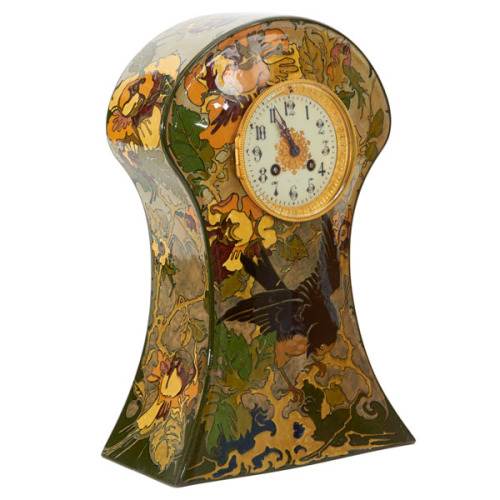
Rozenburg Pottery Holland, W.P. Hartgring Art Nouveau Mantle Clock, 1904
W. P. HARTGRING
ROZENBURG POTTERY The Hague, The Netherlands
Blackbird mantle clock 1904
Handpainted earthenware with exotic foliage and a bird, porcelain face, gilt bronze surround, original clock mechanism.
Marks: H (artist’s monogram) 534, Rozenburg den Haag trademark, date mark symbol for 1904
For more information see: Art et Décoration, vol. 8 (1900) 193, illus. p. 189 (A. Sandier, La ceramique à l’Exposition); Kunst und Kunsthandwerk, vol. 3. (1900) 395, illus. p. 392; Art et Décoration, vol. 9 (1901) 56 Abb. S. 54 (A. Sandier, La Ceramique à l’Exposition II); Der Moderne Stil, Julius Hoffmann, Vol. 3, (1901) Taf. 53.; La Kunstgewerbeblatt Neue Folge, Vol. 12. (1901) p. 95, Abb. S. 82,89; “The International Exhibition of Modern Decorative Art at Turin – The Dutch Section,” Enrico Thovez in The Studio, vol. 26 (1902), pp. 204-6; Kunst und Kunsthandwerk, Vol. 7 (1904), p. 568, Abb. S. 574-5, (K. Ruge, Kunst und Kunstgewerbe auf der Weltausstellung zu St. Louis); Art et Décoration, vol. 17 (1905) p.86 Abb. S. 77, 88 (G. Mourey, L’Art Decoratif Hollandais); Sprechsaal, Vol. 38, (1905) p. 517 (W.H. Zimmer, Die Weltausstellung in St. Louis; Rozenburg, Monographie einer Manufaktur 1883-1917, Marjan Boot et al. (Munich: Verlag Künst & Antiquitäten, 1984); Sammlung Bröhan: Kunsthandwerk 1-Jugendstil, Werkbund, Art Deco, Glas, Holz, Keramik, (Berlin: Karl H. Brohan, 1976) p. 367-380.
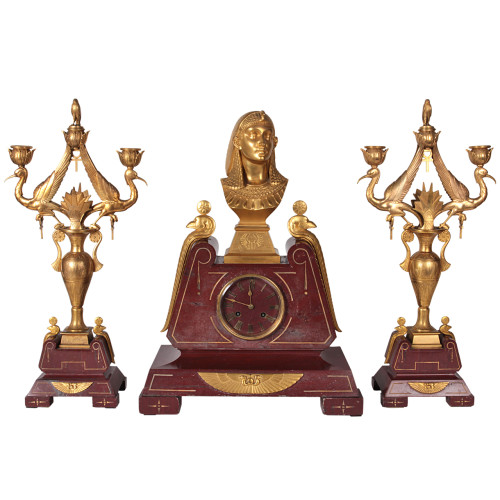
Paul-Auguste Gagné, French Egyptian Revival Gilt Bronze Garniture Set c. 1875
Paul-Auguste Gagné (Sculptor) France
Egyptian Revival garniture set, circa 1875
Gilt bronze and carved rouge marble mantle clock and candelabra in a high Egyptian Revival style
Marks: P.A. Gagne (elaborate incised scroll signature on the back of the portrait bust)
For more information on Gagné see: Dictionnaire des peintres, sculpteurs, dessinateurs et graveurs, vol. 4, E. Bénézit (Paris: Librairie Gründ, 1976) p. 579.
For other related Egyptian Revival garniture sets see: Egyptomania: Egypt in Western Art, 1730-1930 (Paris: Éditions de la Réunion des Musées Nationaux and Ottawa: National Gallery of Canada, 1994)





 @hd_jewels