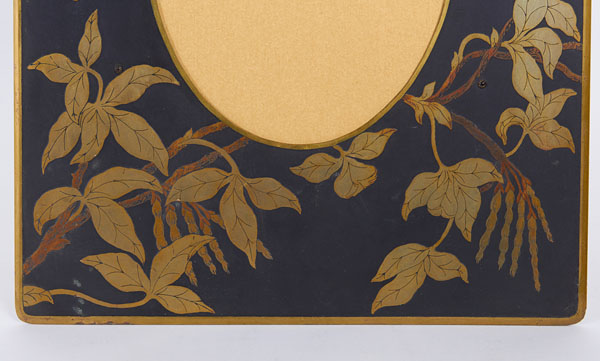
Scandinavian Art Nouveau "Wisteria" bronze photo frame c.1910
More Information
Scandinavian Art Nouveau “Wisteria” bronze photo frame c.1910
SCANDINAVIAN ART NOUVEAU
“Wisteria” bronze photo frame c.1910
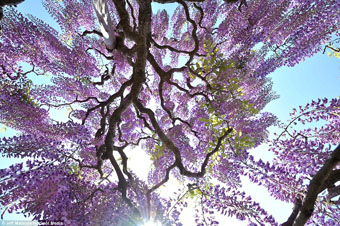
Elaborately detailed, acid etched and multi-patinated bronze table top photo frame with gilt details of a cascade of wisteria blossoms, leaves and vines.
Overall Frame: H: 12” x W: 7 ½”
Oval photo window opening H: 5 ½” x W: 4”
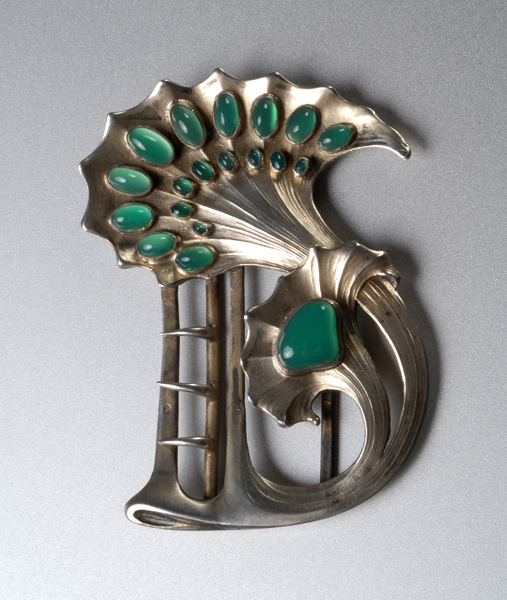
Paul Follot for La Maison Moderne, Art Nouveau waist clasp, silver and chrysoprase, signed c. 1900
PAUL FOLLOT Paris, France
LA MAISON MODERNE Paris, France
Art Nouveau waist clasp c.1900
Gilt silver with chased whiplash design set with 19 cabochons of chrysoprase.
Marks: P. FOLLOT, French swan mark (silver standard mark for small objects)
Illustrated: Documents sur l’Art Industriel au XXe Siecle (Paris: Edition de la Moderne) p. 20, plate 5, n. 53-11
PAUL FOLLOT (1877-1941) French
In the Late 1890’s, Follot studied under graphic designer Eugène Grasset at the Ecole Normale d’Enseignement du Dessin in Paris and later succeeded Grasset in that post. From 1901 to 1904, he designed metalwork, jewelry and textiles for La Maison Moderne, art critic Julius Meier-Graefe’s gallery in Paris. He became director of the interior design studio Pomone of the Paris department store Le Bon Marché in 1923, introducing the Art Deco style into many middle-class home.
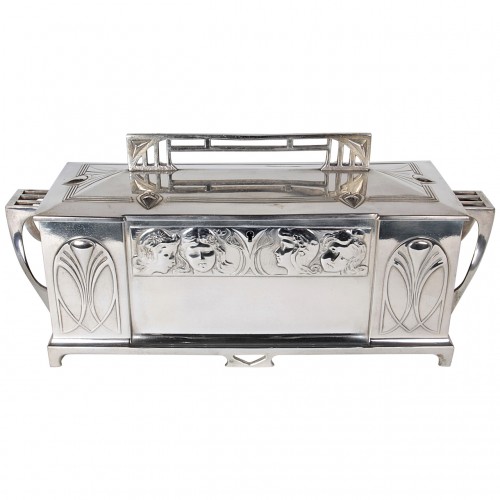
WMF Jugendstil Art Nouveau Four Seasons Jewelry box c. 1900
WMF [Württembergische Metallwarenfabrik] Germany
“Four Seasons” Art Nouveau Jewelry box c. 1900
Silver plate with Jugendstil design buttress handles and open work handle with a frieze of Art Nouveau maidens representing the four seasons, velvet lined with two original keys.
Marks: WMF mark, I/O (in a box), E
For more information see: WMF: Glas, Keramik, Metall, 1925-1950, Jörg Schwandt (Berlin: Kunstgewerbemuseum, Staatliches Museum Preussischer Kulturbesitz, 1981); Metallkunst, Band IV (Berlin: Brohan-Preussischer Kulturbesitz, 1981) pp. 546-579.
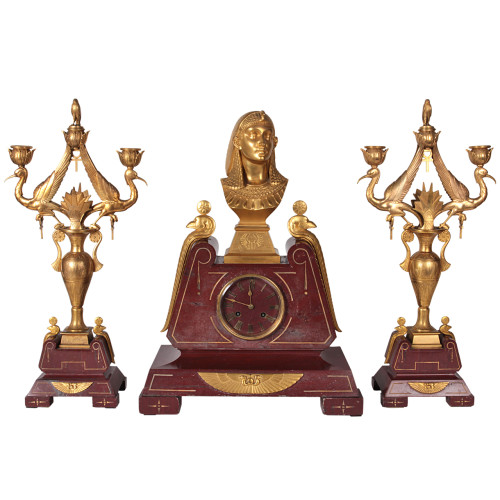
Paul-Auguste Gagné, French Egyptian Revival Gilt Bronze Garniture Set c. 1875
Paul-Auguste Gagné (Sculptor) France
Egyptian Revival garniture set, circa 1875
Gilt bronze and carved rouge marble mantle clock and candelabra in a high Egyptian Revival style
Marks: P.A. Gagne (elaborate incised scroll signature on the back of the portrait bust)
For more information on Gagné see: Dictionnaire des peintres, sculpteurs, dessinateurs et graveurs, vol. 4, E. Bénézit (Paris: Librairie Gründ, 1976) p. 579.
For other related Egyptian Revival garniture sets see: Egyptomania: Egypt in Western Art, 1730-1930 (Paris: Éditions de la Réunion des Musées Nationaux and Ottawa: National Gallery of Canada, 1994)
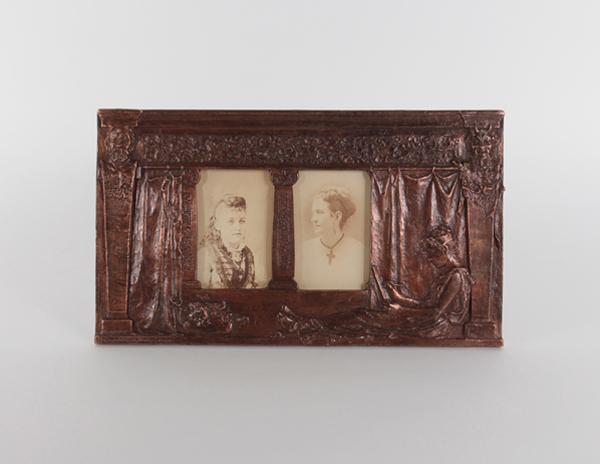
Sir William Reynold Stephens / British Arts & Crafts Bronze / Copper photo frame 1886
SIR WILLIAM REYNOLD STEPHENS (1862–1943) London, UK
BRITISH ARTS & CRAFTS
Photo frame 1886
Bronze / copper lost wax casting with an elaborate stage set with a seeded figure and two capitals with mythological telamons, easel back
Marks: 18 December 1886, W Reynold Stephens London (signature and markings in the cast, bottom left front)
H: 6 5/8″ x W: 11 1/2″
Sculptor of decorative works, portraits and monumental figures, goldsmith and painter. Born 8 August 1862 in Detroit, U.S.A., of British parents; his father’s name was Stephens. Educated in England and Germany, then studied at the R.A. Schools and won prizes for sculpture and painting 1887. Assumed the additional name of Reynolds 1890. Exhibited at the R.A. 1886–1942, solely as a sculptor after 1894. Influenced to some extent by Alfred Gilbert and Pre-Raphaelite medievalism. Made many memorials, including those to Sir William Q. Orchardson, R.A., in St Paul’s, and to Archbishop Lord Davidson in the courtyard of Lambeth Palace. In 1904 he designed the chancel screen, reredos and other decorations for the Church of St Mary the Virgin, Great Warley, Essex. F.R.B.S. 1904, P.R.B.S. 1921–33, awarded R.B.S. gold medal 1928; knighted 1931. Died at Tunbridge Wells 23 February 1943.




 @hd_jewels