Walter Paul Suter (1901-?), American Art Deco glazed pottery sculpture 1929
More Information
Walter Paul Suter, American Art Deco glazed pottery sculpture 1929
WALTER PAUL SUTER USA
AMERICAN ENCAUSTING TILING CO. New York, NY
Art Deco Seated Female Figure with Draped Skirt and Holding an Art Deco Vase 1929
Hand-modeled and molded cream glazed earthenware figure with gold and silver details on a separate, but matching black glazed earthenware base.
Signed: SUTER ‘29 (under glaze on back right hand corner)
H: 13″ x D: 7 1/2″ x W: 9″
Price: $14,500
Walter Paul Suter was born inBasel, Switzerland in 1902 and studied there at the School of Fine and Applied Arts. He moved to the United States in 1924 and settled in New York. He was a member of the American Ceramic Society, as well as the Society of Swiss Painters, Sculptors & Architects. In 1932 Suter won first prize in the Robineau Member Exhibition in Syracuse. He was a member of the American Encaustic Tiling Company in NYC.
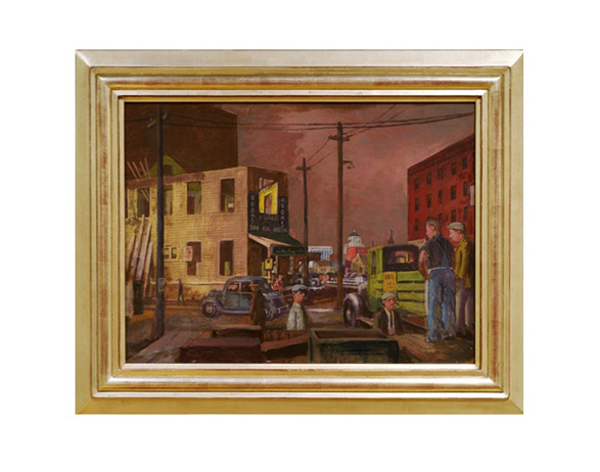
Gerrit V. Sinclair “Third Ward Milwaukee”, Oil on board, lemon gold frame c. 1940
GERRIT V. SINCLAIR (1890-1955) USA
Third Ward Milwaukee c. 1940
Oil on board, lemon gold frame
Signed: GV Sinclair (lower right corner on front of painting)
For more information see: Who Was Who in American Art (Madison, Conn.: Sound View Press, 1985) p. 571.
Painting H: 15” x W: 20”
Framed H: 20 7/16” x W: 25 7/16”
Price: $27,500
Gerrit V. Sinclair was born in Grand Haven, Michigan in 1890. He studied art at the School of the Art Institute of Chicago from 1910 to 1915. His most well known teachers at the Art Institute were John Vanderpoel and John Norton. In 1917 the artist enlisted in the Army Ambulance Corps and served in northern Italy and Austria. Scenes from his experience abroad are recorded in his works of the early 1920s. Following the war, Sinclair settled in Milwaukee, Wisconsin, where he became a member of the faculty of the Layton School of Art upon the school’s founding in 1920. He continued to teach at the Layton School and at the Oxbow Summer School of Art in Saugatuck, Michigan until his retirement in 1954. Sinclair is recognized both as an important artist and teacher from the Great Lakes region. During his lifetime Sinclair’s paintings were exhibited at the Salon d’Automne in Paris, the Salon Printemps in Paris, the Pennsylvania Academy of Fine Arts, the National Academy of Design, the Whitney Museum in New York, the New York Watercolor Club, the Brooklyn Museum, the Corcoran Gallery of Art in Washington D.C., the Carnegie Institute in Pittsburgh, the Art Institute of Chicago and in many other museums and galleries. He received numerous prizes and commissions for his work including a W.P.A. mural commission for the Federal Building in Wassau, Wisconsin. Sinclair was a member of Wisconsin Painters & Sculptors, Wisconsin Federation of the Arts and the Wisconsin Painting Museum. His style is a blend of realism and Impressionism but is clearly modern in its abstract concern for composition and color. Sinclair is best known for his regionalist paintings of rural and urban Wisconsin. His farm scene entitled ”Spring in Wisconsin” was exhibited at the 1939 World’s Fair in New York. Gerrit V. Sinclair died in Milwaukee, Wisconsin in 1955.
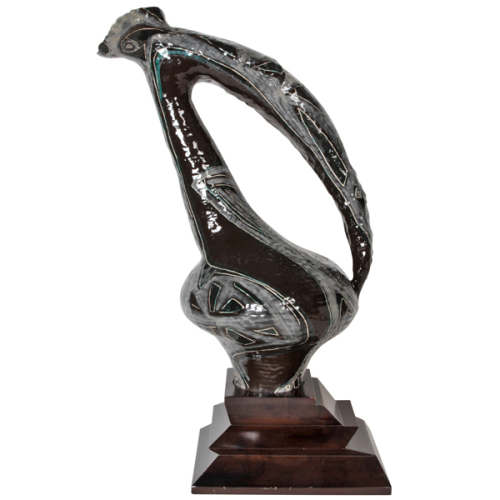
Salvatore Meli Important large scale Italian Sculpture / Ewer 1952
SALVATORE MELI (b. 1929) Italy
Important Sculpture / Ewer 1952
Glazed terra cotta, brown and dark green with white scraffito decoration, original stepped and angular wood base.
Signed: Meli 1952 Roma
For more info on Meli see: Design 1935-1965, What Modern was, ed. Martin Eidelberg (New York: Harry Abrams, 1991) p. 237.
Salvatore Meli belongs to that initial group of artists, including Guido Gambone and Lucio Fontana among others, who elevated Italian ceramics to a fine art during the post-war period. Meli conceived this vessel, first on paper, then by laboriously constructing the body in clay, coil by coil, to achieve the richly textured and dynamic form; the incised and painted decoration is in concert with the organic shape. The massive scale of this work defies function as a ewer but was created as a sculptural object. The original wooden base recalls Italian futurist sculpture forms of the early twentieth century.
H (with base): 23 1/2” x W: 13” x D: 9.5”
H (without base): 19 1/8”




 @hd_jewels