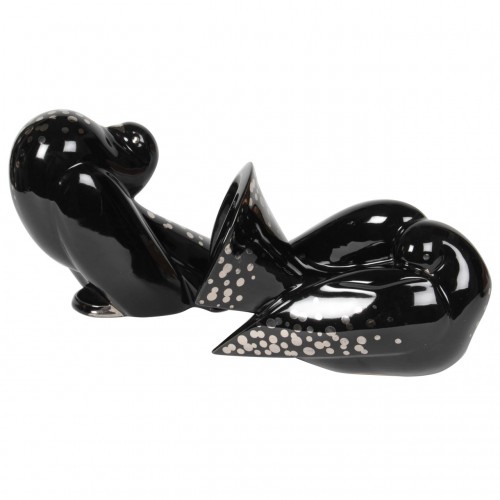
Jan et Joel Martel / Primavera French Art Deco Courting Fantail Pigeon Sculptures c.1930
JAN ET JOËL MARTEL (1896-1966) France
PRIMAVERA Paris
Pair of courting Faintail Pigeon Sculptures c.1925-30
Black glazed earthenware with silver / platinum decorative dot motif.
Marks: PRIMAVERA FRANCE, 12684
For related model: The Art Deco Style in Household Objects, Architecture, Scupture, Graphics, Jewelry, Theodore Menten (New York: Dover, 1972), p. 179.
For more information see: Joël et Jan Martel: sculpteurs 1896-1966, Christophe Vital, et al. (Paris: Gallimard / Electa, 1996), pp. 127-9
H: 8 1/16” x L: 9” x D at tail: 5 1/4”
H: 7 1/8” x L: 10” x D at tail: 5 1/4”
Jan & Joël Martel (the Martel Brothers/Twins, born in Nantes on 5 April 1896, both died in 1966)
The twin Martel sculptors were among the founding members of Union des Artistes Modernes, and their original works include ornamental sculptures, statues, monuments and fountains displaying characteristics typical of the Art Déco and Cubist periods. The brothers took part in a number of Paris exhibitions including the Salon des Indépendants, Salon d’Automne, Salon des Tuileries and the Exposition des Arts Décoratifs in 1925. In 1932, they created the Claude Debussy monument which sits on the boulevard Lannes in Paris. Between 1924-1926, Robert Mallet-Stevens designed a studio for the Martel twins at 10 Rue Mallet-Stevens in Paris’ 16th Arrondissement.
Christopher Dresser / Heath & Middleton Petite claret jug 1887
CHRISTOPHER DRESSER (1834-1904) UK
HEATH & MIDDLETON Birmingham, England
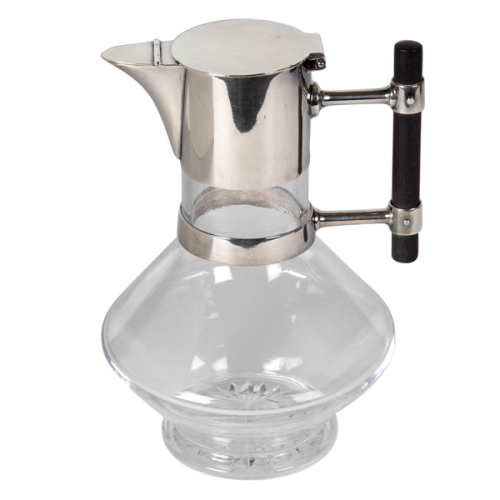
Petite claret jug 1887
Sterling silver mounts with hinged covers to both top and spout, glass, ebony handle
Marks: JTH & JHM in a four-lobed cartouche, London assay marks for 1887 (“M” in a shield), Vienna import mark (conjoined AV in a 6-sided cartouche)
Illustrated: Industrial Design Unikate Serienerzeugnisse, Die Neue Sammlung ein neuer Museumstyp des 20. Jahrhunderts, Hans Wichmann (Munich: Prestel-Verlag, 1985), p. 131; Christopher Dresser, ein Viktorianischer Designer, 1834-1904 (Cologne: Kunstgewerbemuseum der Stadt Köln, 1981), p. 73, ill. 86, cat. no. 23; Industrial Design, John Heskett (New York and Toronto: Oxford University Press, 1980), p. 24, illus. 9; Christopher Dresser 1834-1904, Michael Collins (London: Camden Arts Centre, 1979), p. 171, cat.no.12.
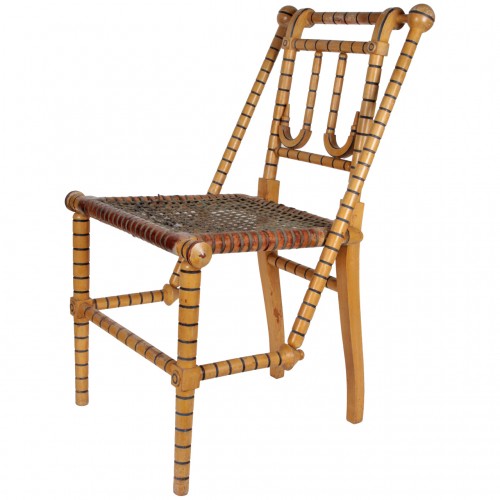
George Jakob Hunzinger New York 19th Century Rare Painted Chair 1876
GEORGE JAKOB HUNZINGER (1835-1898) Germany/ USA
Chair 1876
Yellow and blue painted elaborately turned wood, blue thread woven covered metal band mesh seat (original condition)
Marks: George Hunzinger Patent 1876
Illustrated: The Furniture of George Hunzinger, Invention and Innovation in Nineteenth-Century America, Barry R. Harwood (Brooklyn: Brooklyn Museum of Art, 1997) p.103.
H: 32″ x D: 17″ x W: 20″
GEORGE JAKOB HUNZINGER (1835-18989) USA
George Hunzinger emigrated in the 1850s from the Black Forest region of Germany where his family had worked as cabinetmakers since the 17th century. Settling in New York, he joined a community of 3,000 German furniture makers but soon distinguished himself as a maker of patent furniture and “fancy chairs”. Hunzinger’s innovative designs are often associated with the development of the Aesthetic Movement in America. By the 1870s, his chairs were sought after by many Americans as accent pieces for their parlors. The woven mesh or upholstery of these innovative chairs follows the original intention of the maker and the turned frame has an avant-garde, colorful and rather contemporary feeling painted in a combination of a rich ochre yellow and cobalt blue, a color combo that was highly prized for it’s eccentricity in Victorian America.


 @hd_jewels