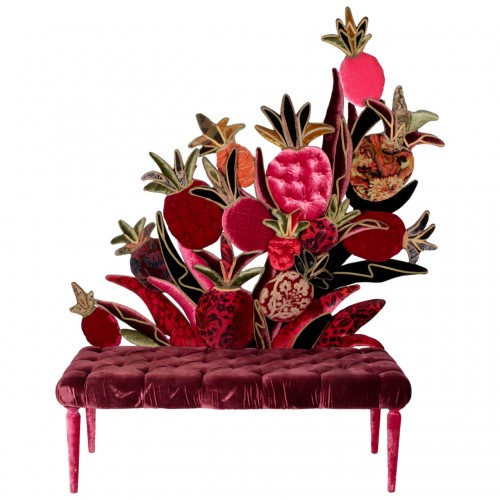
Exotic variety of silk and cut silk velvets sewn and sculpted in the form of a spray of various pineapple shapes on a tufted cushion seat and upholstered legs.
Marks: Tolomeo (written on the velvet), Tolomeo script signature (brass plaque)
Exhibited: Fondazioni Cerratelli, Pisa, Italy, Summer 2006
Model illustrated and biographical information on Carla Tolomeo: Il Fogliaccio, July 7th, 2006
For further information see: Carla Tolomeo Mai Sedersi Sugli Allori, Never rest on your laurels 1995-2004, Carla Tolomeo (Milano 2004)
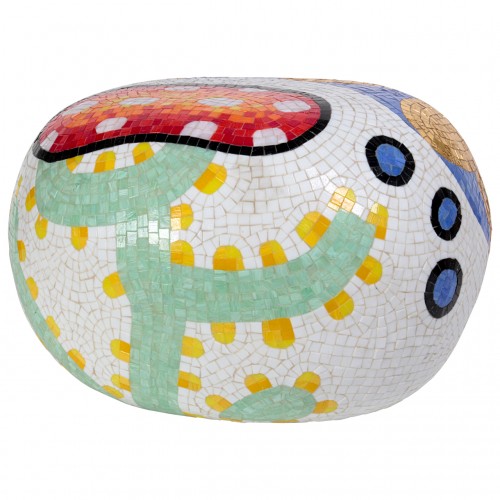
Marcel Wanders, One Morning They Woke Up, mosaic table/stool 2004
MARCEL WANDERS (1963-) The Netherlands
“One morning they woke up” mosaic occasional table or stool 2004
Gilt and lively colored glass mosaic, fiberglass body
H: 13″ x D: 17″
Price: $18,500
Marcel Wanders (1963) grew up in Boxtel, the Netherlands, and graduated at the School of the Arts Arnhem in 1988 with a cum laude certificate. He is now an independent industrial product designer operating out of Amsterdam where he has his own studio, Marcel Wanders studio. Marcel continues to work on diverse products and projects for Cappellini, Mandarina Duck, Magis, Droog Design and Moooi amongst others. For the latter he is associated as creative director. Marcel also co-operates in other design-related projects, such as the Vitra Summer Workshop where he was project leader for the second time. Also he was a juror for various prizes like the Rotterdam Design Prize (for which his own products were nominated several times) and the Kho Liang Ie prize. He lectured at SFMoMA, Limn the Design Academy and has taught at various design academies in the Netherlands. Marcel won the Rotterdam Design Prize (public prize) for the Knotted Chair, and received several other awards including the George Nelson Award (Interiors magazine) and Alterpoint Design Award 2000. In the 2001, Marcel has been nominated in the category ‘designer of the year’ in WIRED magazine’s 2001 wired rave awards. Designs of Marcel Wanders have been selected for the most important design collections and exhibitions in the world, like the Museum of Modern Art in New York and San Francisco, the Stedelijk Museum in Amsterdam, Museum Boijmans van Beuningen in Rotterdam, the Central Museum in Utrecht, and various Droog Design exhibitions. In the book ‘Wanders Wonders, design for a new age’ (1999) which accompanied a solo exhibition in Museum ‘t Kruithuis in Den Bosch, the most important products are shown, from the Knotted Chair to the Shadows lamps and from the Nomad Carpet to the Eggvase. Works of Marcel have been published in all leading design magazines.
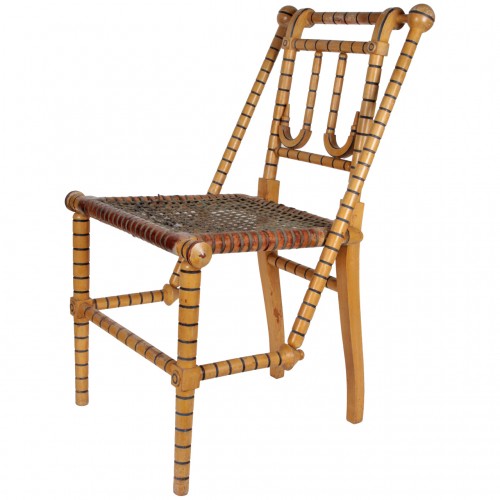
George Jakob Hunzinger New York 19th Century Rare Painted Chair 1876
GEORGE JAKOB HUNZINGER (1835-1898) Germany/ USA
Chair 1876
Yellow and blue painted elaborately turned wood, blue thread woven covered metal band mesh seat (original condition)
Marks: George Hunzinger Patent 1876
Illustrated: The Furniture of George Hunzinger, Invention and Innovation in Nineteenth-Century America, Barry R. Harwood (Brooklyn: Brooklyn Museum of Art, 1997) p.103.
H: 32″ x D: 17″ x W: 20″
GEORGE JAKOB HUNZINGER (1835-18989) USA
George Hunzinger emigrated in the 1850s from the Black Forest region of Germany where his family had worked as cabinetmakers since the 17th century. Settling in New York, he joined a community of 3,000 German furniture makers but soon distinguished himself as a maker of patent furniture and “fancy chairs”. Hunzinger’s innovative designs are often associated with the development of the Aesthetic Movement in America. By the 1870s, his chairs were sought after by many Americans as accent pieces for their parlors. The woven mesh or upholstery of these innovative chairs follows the original intention of the maker and the turned frame has an avant-garde, colorful and rather contemporary feeling painted in a combination of a rich ochre yellow and cobalt blue, a color combo that was highly prized for it’s eccentricity in Victorian America.
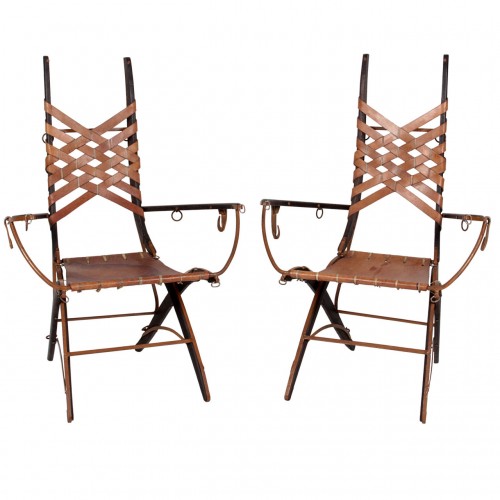
Alberto Marconetti / Italian Post-War Design Armchairs c. 1960’s
ALBERTO MARCONETTI Milan, Italy (active Argentina)
Armchairs (Two available) c. 1960’s
Oak, painted iron, leather strapwork and seat
Marks: by Alberto Marconetti (script signature)
H: 40 1/2” x W: 27” x D: 21”
Seat height: 19″
Price: $7,450 (each)
This pair of armchairs nods to the influence of such Italian designers as Carlo Bugatti and Carlo Mollino yet are their own unique creation. They have an unusual anthropomorphic quality in that the frame suggests a skeletal structure. In addition, the leather strapwork, iron loops and hooks allude to the equipage of the ancient Roman equestrian order.


 @hd_jewels