Product Description
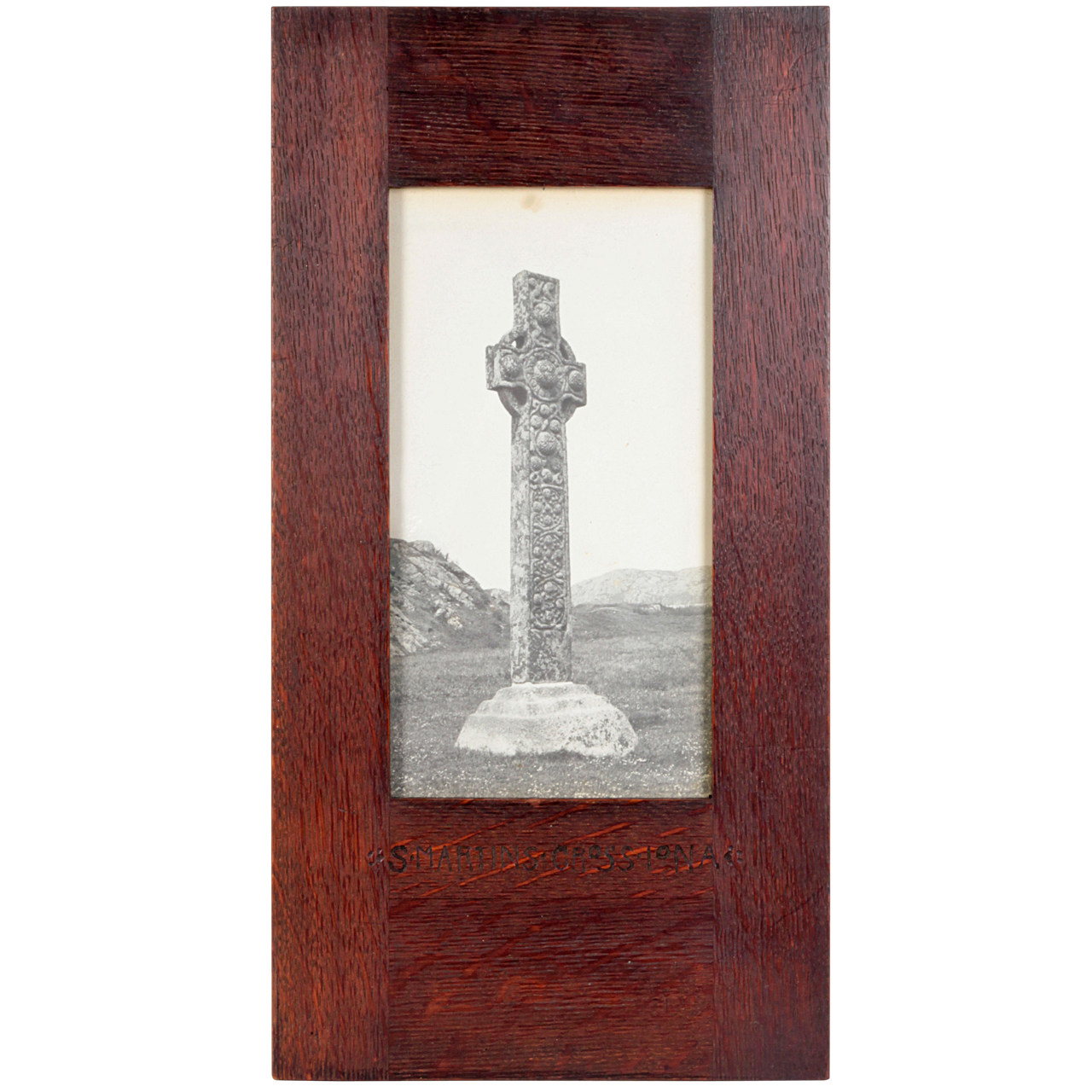
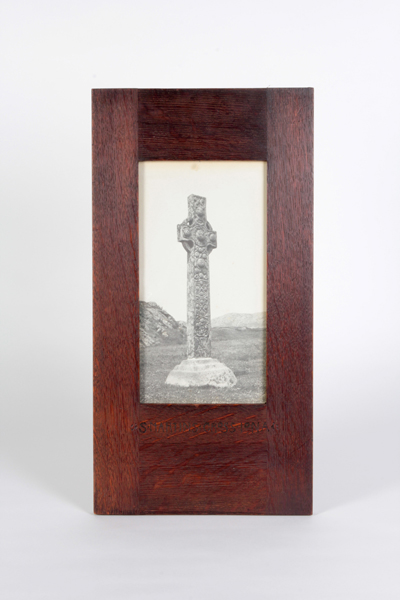
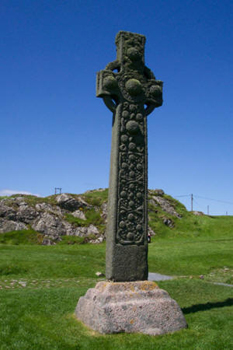
Sydney Pitcher “St. Martin’s Cross Iona” Arts & Crafts photograph c. 1900

SYDNEY PITCHER F.R.P.S. (d. 1950) England
ARTHUR H. PITCHER (Framer)
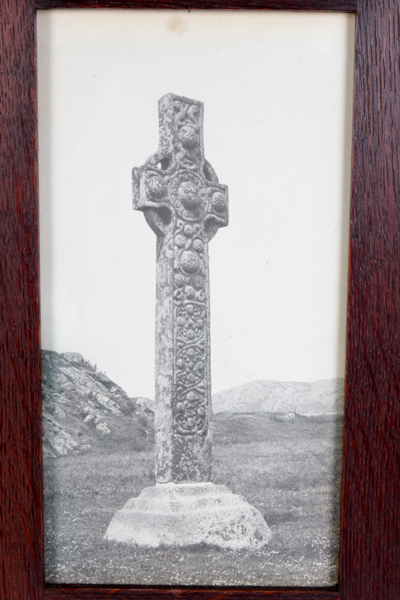
“St. Martin’s Cross Iona” c.1900
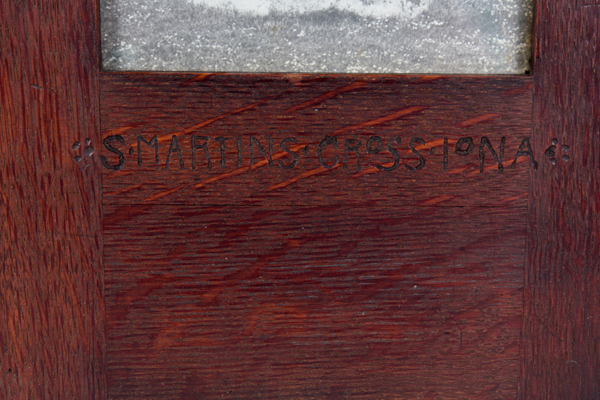
Carbon process photograph, hand carved oak frame with beautiful wood grain detail.
Marks: S MARTINS CROSS IONA (carved incised mark)
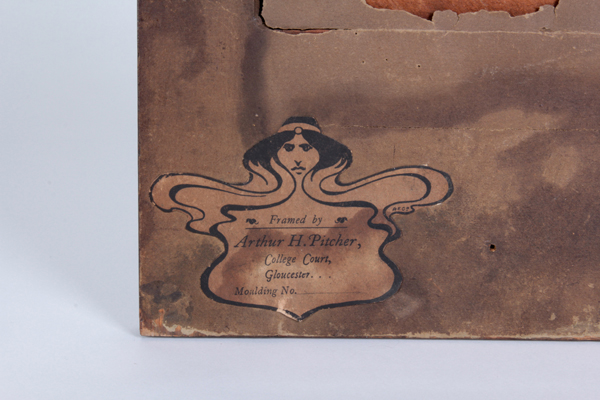
Art Nouveau paper label (on back): Framed by Arthur H. Pitcher, College Court, Gloucester, Moulding No…..
Photograph: H: 9 1/2″ x W: 5″
Frame: H: 16 3/4″ x W: 8 5/8″ D: 5/8″
Sydney A. Pitcher FRPS (active 1904-1939) was a photographer with an interest in monument and church architecture. He is listed in the 1927 Kelly’s Directory of the County of Gloucester as a commercial photographer, publisher and picture frame maker, operating from 5 & 7 College Court, Gloucester. Pitcher was involved primarily in the photography of Gloucestershire churches, but also took pictures of churches and cathedrals in neighbouring counties, and of medieval sculptures at Winchester College. He collaborated on the publication of Rushforth’s series of volumes The stained glass of Great Malvern Priory Church , Gloucester, 1916-1927.
He joined the Royal Photographic Society in 1904, was admitted as an Associate member in 1925, and became a Fellow in 1928.
Sydney Pitcher “St. Martin’s Cross Iona” Arts & Crafts photograph c. 1900
HENRY VAN DE VELDE (1863-1957) Belgium (design mount)
for “LA MAISON MODERNE” Paris, France
ALPHONSE-EDOUARD DEBAIN France (execution mount)
EUGÈNE BAUDIN (1853-1918) France (pottery)
Vase c. 1900
Matte-glazed pottery, cranberry bright turquoise and white highlights, elaborate Art Nouveau whiplash silver mount.
Marks: E Baudin, AD (silversmith monogram), French 950 silver assay mark
For more information on van de Velde ceramics see: Ceramics of the 20th Century, Tamara Préaud and Serge Gauthier (New York: Rizzoli, 1982) illus. no. 67, p.42; Art Nouveau and Art Deco Silver, Annelies Krekel-Aalberse (New York: Harry N. Abrams, Inc.,1989), pp. 63, 90, 264.
For other A-E. Debain designs see: The Paris Salons 1895-1914, Vol. V: Objets d’Art & Metalware, Alastair Duncan (Woodbridge, Suffolk: Antique Collectors’ Club, 1999), p. 208.
For related Van de Velde mount designs see: Jugendstil, Irmela Franzke (Munich: Battenberg Verlag, 1987), illus. 169, p. 87.
H: 8 1/4” x W: 4”
EDMOND LACHENAL (1855-1930) Paris, France
Green glazed pitcher / vase form c. 1900
Marks: E LACHENAL (impressed and glazed in a rectangle on base)
For information on Edmond Lachenal see:”Edmond Lachenal”, Fritz Minkus, Kunst und Kunsthandwerk, IV (1901) pp.390-98; La Céramique Art Nouveau, Edgar Pelichet and Michèle Duperrex (Lausanne: Les Éditions du Grand-Pont, Switzerland, 1976) pp. 66,71,74,78,83,112,115; “l’Atelier Lachenal à la galerie Georges Petit “ in Les Echoes d’Art” (1933), p. Vll; Art Nouveau: Belgium & France, exh. cat. Yvonne Brunhammer et al. (Houston, TX: Institute for the the Arts, Rice University, 1976), p. 48; Le Japonisme (Paris: Éditions de la Réunion des Musées Nationaux, 1988) cat no. 377, p. 321; Japonisme: the Japanese influence on western art in the 19th and 20th Centuries, Siegfried Wichmann (Parklane: New York, 1980) pp. 339, 349; cat. no. 920.
H: 9″ x W: 6 3/4″
HENDRIK PETRUS BERLAGE (1856 – 1934) Netherlands
BECHT & DYSERINCK for ‘t Binnenhuis
Rare Architectural Candelabrum c. 1900
Riveted and detailed “Eiffel Tower” like form in brass and copper with four feet, small cut out designs and two bobeche trays supporting five candles.
H: 14″ x W: 8 1/4″ x D: 8 1/4″
Hendrik Petrus Berlage, a Dutch architect and designer attended the Rijksakademie in Amsterdam and a year later switched to architecture. Berlage enrolled in 1875 in the architecture department of the Eidgenössische Technische Hochschule in Zurich. Through 1878 Berlage studied in Zurich under Gottfried Semper, whose teachings had a lasting influence on his work. After finishing these studies, Berlage spent three years traveling in Germany (1879) and Italy (1880-1881) before returning to his native Amsterdam. From 1881 Berlage was employed by the Amsterdam architect Theodor Sanders and from 1884 Berlage was a partner in the business until he opened his own practice in 1889. In 1884 he submitted a design for the projected Commodity Exchange (Beurs van Berlage) in Amsterdam, winning the competition in 1896. This building, completed in 1903, was Hendrik Paulus Berlage’s first important commission, which also solidified his reputation. Also in Amsterdam and at this same time, Berlage built the Diamond Guild building (1897-1900). In 1900 along with the architect and designer Jacob van den Bosch, Hendrik Paulus Berlage opened the gallery, “‘t Binnenhuis”. They sold their own designed furniture and objects they from 1900-1929. In 1900 Berlage was also commissioned to plan a southern extension of Amsterdam. This was Berlage’s most important contribution to urban planning and he worked on the project until 1915. In 1911 Berlage went to the US, where he saw the new buildings by Frank Lloyd Wright and Louis Sullivan. Berlage built his own house in The Hague and moved into it with his family in 1913. The Gemeentemuseum in The Hague (1919-1935) was Berlage’s last important building, however it was not completed until shortly after his death. Hendrik Petrus Berlage was the founder of the “Amsterdam School” and was a pioneer of modern architecture in the Netherlands. In his 1905 essay “Gedanken über Stil in der Baukunst”, Berlage fiercely criticized 19th-century historicizing architecture as pompous, reserving his praise for the austere simplicity of early period styles. His criticism was severe since he stated flatly that historicizing architecture was all appearance rather than reality, was not art; too much was imitation, more iron was used than stone, and so on. Hendrik Petrus Berlage was therefore an early critic of Historicism even though his Amsterdam Exchange still reveals Romanesque features.
BLACK STARR & FROST New York, NY
Art Nouveau Sterling and Mahogany Jewelry Box c.1900
Mahogany jewelry box with thick sterling silver decorative graphic mountings in an elaborate Art Nouveau whiplash design, original key
Marks: Eagle mark (Company logo) BLACK STARR & FROST, Sterling
For more information see: American Jewelry Manufacturers, Dorothy T. Rainwater (West Chester, Penn.: Schiffer, 1988)
H: 4 1/2″ x W: 10 1/2″ x D: 7″
SOLD
One of America’s oldest fine jewelers, Black, Starr and Frost traces its roots to 1810. In that year, Erastus Barton and Frederick Marquand opened Marquand and Barton near New York’s Maiden Lane. The firm added and lost partners numerous times and it also frequently moved locations in accordance with the addresses of its prestigious clientele. Its merchandise was eclectic and greatly varied including, lamps, jewelry, paintings, porcelain, and artistic objects. In 1876, the firm changed its name from Black, Ball, and Co. to Black, Starr, and Frost, and moved to 251 Fifth Avenue. Its inventory became focused on jewelry and silver objects, some imported from Europe, some produced in-house. For many decades, the renowned jewelry house, Black, Starr, and Frost was considered one of the great American jewelers. In 1876, it was invited to exhibit at the Centennial Exposition in Philadelphia along with renowned firms like Tiffany & Company, Whiting, and Gorham. In 1939, the firm was one of five American jewelers invited to exhibit at the New York’s World’s Fair. In 1929, it merged with Gorham to become Black, Starr, Frost – Gorham.