Product Description
Pierre Sterlé Paris, “Hummingbird” brooch, carved natural ruby in zoisite mounted in 18K gold set with diamonds set in platinum, original suede box, signed, c. 1950’s

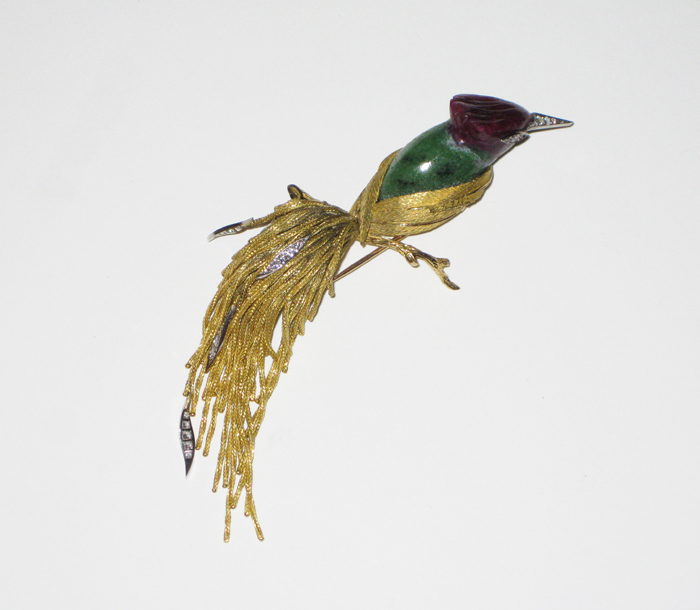
Pierre Sterlé Paris, “Hummingbird” brooch, carved natural ruby in zoisite mounted in 18K gold set with diamonds set in platinum, original suede box, signed, c. 1950’s
JAN DE SWART (1908-1987) Netherlands / USA
Mystery box c. 1970
Hand carved and assembled box form with a curiosity element of a large turquoise cabochon with raw hide wraps underneath the lid.
For more information see: Jan de Swart: A Day That Becomes a Lifetime, exhibition catalogue (California: Fine Arts Gallery at the San Fernando Valley State College, February 1972); Jan de Swart, Mike McGee and William G. Otton (Laguna Beach, California: Laguna Art Museum, 1986).
W: 16 1/2″ x H: 4 1/2″ x D: 5″
Price: $4,700
Constantly seeking and inventing new materials Jan de Swart was a true modernist. He was influenced by artists such as Isamu Noguchi, Harry Bertoia, Charles Eames, and later Sam Maloof and Wendell Castle. Although he had been creating small sculptures since his arrival in California from Holland in 1929, he had not been widely recognized until being introduced to John Entenza, publisher of Arts & Architecture magazine in 1947. Soon thereafter, he was able to create larger works and began collaborating with architects such as Whitney Smith and Victor Gruen on special commissions. His work is in the permanent collection of Los Angeles County Museum of Art, The Smithsonian, and the Ford Foundation. He was honored with the American Institute of Architects Gold Medal for Sculpture in 1965.
CHINESE ART DECO
Covered box c. 1930
Cloisonne enamel in a fantasy of archaic Chinese motifs in red, royal blue, black white and sand colored abstract designs on a bronze body with a turquoise enameled underside and interior.
H: 2 1/2″ x D: 6 1/4″ x W: 9″
FRENCH ART DECO
LA MARQUISE DE SEVIGNE Paris
Covered chocolate box 1932
Black and red oil cloth, nickle plated brass
Illustrated in La Marquise de Sevigne Paris vintage ad (see pairing)
Dia: 10″ x H: 3″
BLACK STARR & FROST New York, NY
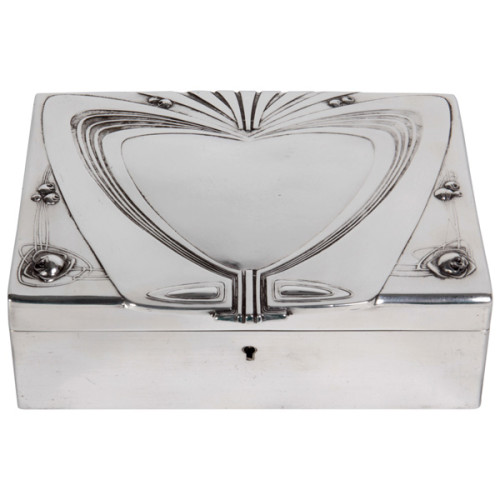
Art Nouveau Sterling and Mahogany Jewelry Box c.1900
Mahogany jewelry box with thick sterling silver decorative graphic mountings in an elaborate Art Nouveau whiplash design, original key
Marks: Eagle mark (Company logo) BLACK STARR & FROST, Sterling
For more information see: American Jewelry Manufacturers, Dorothy T. Rainwater (West Chester, Penn.: Schiffer, 1988)
H: 4 1/2″ x W: 10 1/2″ x D: 7″
SOLD
One of America’s oldest fine jewelers, Black, Starr and Frost traces its roots to 1810. In that year, Erastus Barton and Frederick Marquand opened Marquand and Barton near New York’s Maiden Lane. The firm added and lost partners numerous times and it also frequently moved locations in accordance with the addresses of its prestigious clientele. Its merchandise was eclectic and greatly varied including, lamps, jewelry, paintings, porcelain, and artistic objects. In 1876, the firm changed its name from Black, Ball, and Co. to Black, Starr, and Frost, and moved to 251 Fifth Avenue. Its inventory became focused on jewelry and silver objects, some imported from Europe, some produced in-house. For many decades, the renowned jewelry house, Black, Starr, and Frost was considered one of the great American jewelers. In 1876, it was invited to exhibit at the Centennial Exposition in Philadelphia along with renowned firms like Tiffany & Company, Whiting, and Gorham. In 1939, the firm was one of five American jewelers invited to exhibit at the New York’s World’s Fair. In 1929, it merged with Gorham to become Black, Starr, Frost – Gorham.