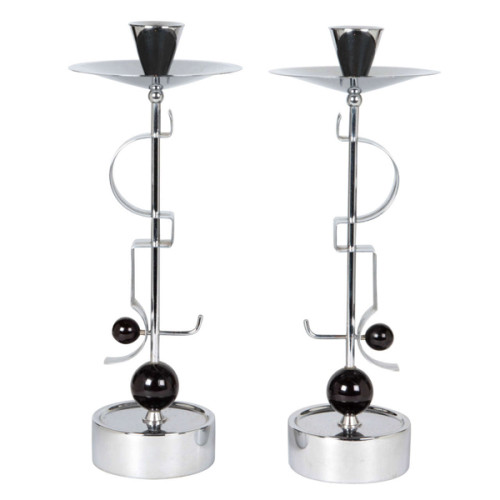
Breuhaus de Groot / WMF Germany Pair Art Deco of candlesticks c. 1930
FRITZ AUGUST BREUHAUS DE GROOT (1883-1960) Germany
WMF [WÜRTTEMBERGISCHE METALLWARENFABRIK] Geislingen, Germany
Pair of candlesticks c. 1930
Chrome and bakelite spheres
Marks: WMF mark, VERCHROMT
Related designs illustrated: Metallkunst: Kunst vom Jugendstil zur Moderne (1889-1939), Karl H. Bröhan, Band IV (Berlin: Bröhan-Museum, 1990) n. 608 p. 570; Modernist Design 1880-1940, Alastair Duncan, The Norwest Collection (Woodbridge, Suffolk: The Antique Collectors’ Club, 1998), p. 173; WMF Ikora Metall / Metalwork, Carlo Burschel and Heinz Scheiffele (Stuttgart, Germany: ARNOLDSCHE, 2006) p. 192
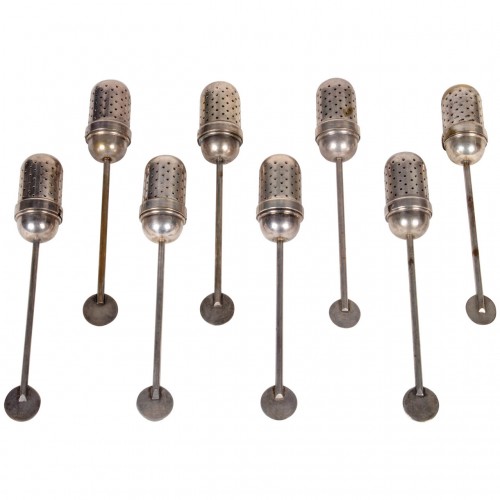
Christian Dell / Bauhaus “Tee-Ei” Tea infusers (Rare set of eight) 1924
CHRISTIAN DELL (1893-1974) Germany
BAUHAUS (1919-1933) Germany
“Tee-Ei” (tea ball) 1924 (rare set of 8)
Silvered brass.
***These are all in fine original, untouched condition.
Illustrated: Christian Dell: Silberschmied und Leuchtengestalter im 20. Jahrhundert, Beate Alice Hofmann, Museum Hanau (Hanau: Heller Druck,1996) illus. 15, p.56; Modernist Design 1880-1940, Alastair Duncan, The Norwest Collection (Woodbridge, Suffolk: The Antique Collectors’ Club, 1998), p. 173; Decorative Arts 1850-1950, Judy Rudoe, (London: British Museum Press, 1991) cover, p. 276; Die Metall Werkstatt am Bauhaus, (Berlin: Bauhaus-Archiv, Museum für Gestaltung, 1992) pp. 140-141 Silver of a New Era, (Rotterdam: Museum Boymans-van Beuningen, 1992) p. 157; cat. no. 140.
Length: 5 1/4″
Price: $9,600
Christian Dell, metal artist and industrial designer, played a formative role in shaping the Bauhaus style. Dell was the master of the metal workshop at the Bauhaus, 1922-25, in Weimar, working closely with László Moholy-Nagy.
Born the son of a locksmith in Offenbach in 1893, he had a great impact as a teacher on the curriculum of the Weimar metal workshop. He had done an apprenticeship as a silversmith in Hanau before and had also attended the drawing academy, followed by a stay at the Weimar School of Applied Art. Henry van de Velde, director of this institution, coined Christian Dell’s early works with his organic-flowing use of forms, a feature that can also be observed on Dell’s later works.
Metal workshop at the Bauhaus in Weimar:
From 1922, the former goldsmith, silversmith and coppersmith workshops of the Weimar phase became a laboratory for design where metal vessels and lamps were made. This is also where the designs for industry, as well as metal furniture, were ultimately created. In 1922, the silversmith Christian Dell took over as master of works. Following Itten’s departure in 1923, the workshop developed in a new direction with the Hungarian Constructivist László Moholy-Nagy. Instead of individual pieces, prototypes were now made for mass production. In order to manufacture the individual models, a production line was established.
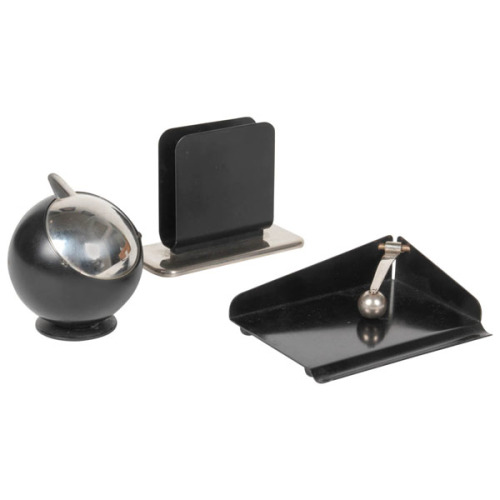
Black enameled and nickeled metal, hinged ball weight, ball feet
Marks: RUPPEL (in a circle), mehrfach geschützt
Illustrated: Die Metall Werkstatt am Bauhaus, (Berlin: Bauhaus-Archiv, Museum für Gestaltung, 1992) pp. 181-3;
H: 1 5/8” x W: 5 1/4” x D: 4”
Napkin holder c. 1930
Black enameled metal and nickeled base
Marks: RUPPEL (in a circle), mehrfach geschützt, 85/4440/37, Ruv 5 (numbers in red crayon)
H: 3 ¾” x W: 5” x D: 2 1/8”
For other works by Brandt for Metallwarenfabrik Ruppelwerk see: Die Metall Werkstatt am Bauhaus, (Berlin: Bauhaus-Archiv, Museum für Gestaltung, 1992) pp. 180-183; Die Metall Werkstatt am Bauhaus, (Berlin: Bauhaus-Archiv, Museum für Gestaltung, 1992) pp. 181-3; Avantgarde Design 1880-1930, Torsten Bröhan, Thomas Berg (Cologne: Benedikt Taschen, 1994) p. 105.
F.W. QUIST Esslingen, Germany
Ball ashtray “Smokny”
Nickel plated metal and black lacquered surface
Marks: Quist (on bottom)
H: 3 1/2″
The hardwarefactory F.W.Quist, Esslingen, Germany was founded 1868 as „Lackier- und Metallwaarenfabrik“ from the turner and metal-turner Jacob Schweizer, jun.. In the year 1872, the conversion of the business from a public company occurred, the “Actien-Plaqué Fabrik”. From 1890, the director and shareholders Friedrich Wilhelm Quist took over the business as alone-owner. In his succession four generations continued the business as family-businesses until 1981.
The business always stood for the manufacture more representatively props in the taste of the time. „Tischkultur, Gastlichkeit, Geschenkkultur dienten als Felder, einen gehobenen, verfeinerten Lebensstil zu dokumentieren und das unabhängig von der gesellschaftlichen Zugehörigkeit.“ (Served table-culture, hospitality, gift-culture as fields should document lifestyle, independently of the social affiliation) (Esslingen 2004, S.60)
So, the form of the 1970 as newness presented ball-ashtray was borrowed this famous „ball“ or „globe“ (presented for the first time, 1966 at the international furniture-fair in Cologne) and „bubble“ (1968) chairs by the finish designer Eero Aarnio. The completely new and unconventional shape, Aarnio developed on basis of the simplest geometrical form, the ball. It advanced to a cult-object of the following decade and didn’t lose anything modernity until today.


 @hd_jewels