Product Description
Leo-Victor Gardey (1879-1942) “Oak Leaves” ring, carved 18K gold set with a Heraldic amethyst jewel (approx. 14 carats TW), signed, c. 1900

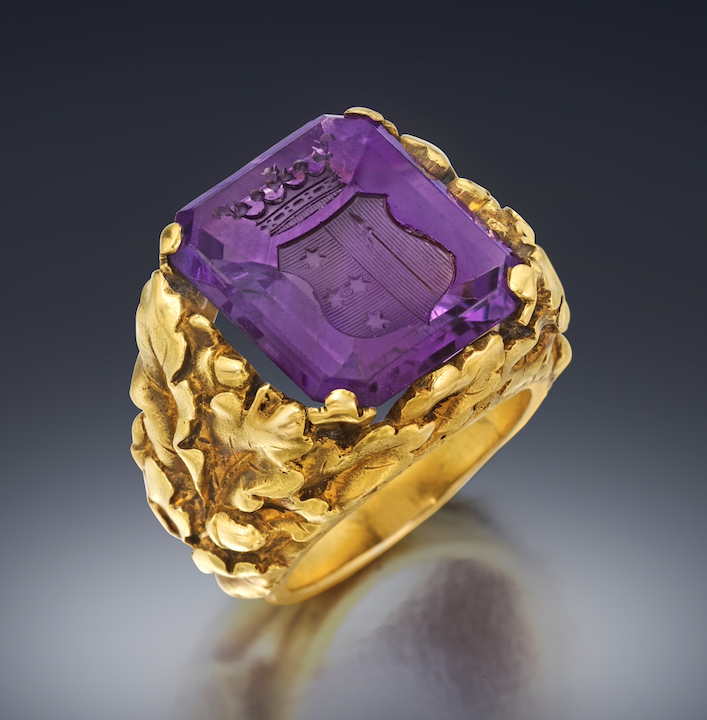
Leo-Victor Gardey (1879-1942) “Oak Leaves” ring, carved 18K gold set with a Heraldic amethyst jewel (approx. 14 carats TW), signed, c. 1900
PROF. MAX LÄUGER (1864-1952) Karlsruhe, Germany
Unique Jugendstil ceramic footed bowl inlaid with gold mosaic 1906
Light and dark green glazed earthenware inlaid with mosaic gold glass squares on four cylindrical feet.
Marks: ML, K (monogram)338 (incised), 4., MUSTER B.., GESCHTZ
For other mosaic inlaid works by Max Läuger see: Max Laeuger (1864-1952): sein graphisches, kunsthandwerkliches und keramisches Oeuvre, Elisabeth Kessler-Slotta (Saarbrücken: Saarbrücker Druckerei und Verlag, 1985) pp. 178/179; Europäisches Kunstgewerbe 1927, Stadtisches Kunstgewerbe-Museum zu Leipzig, (Leipzig: E.A. Seeman, 1928) p. 86; Deutsche Kunst und Dekoration vol. XII “Professor Max Laeuger Karlsruhe”, pp. 221-237; Modernism: Modernist Design 1880-1940 (The Norwest Collection, Norwest Corporation, Minneapolis), Alastair Duncan (Woodbridge, Suffolk, England: The Antique Collector’s Club, 1998), p. 86.
H: 5 3/4″ x Dia: 7 1/4″
Max Laeuger (or Läuger) was born in Lörrach on September 30, 1864. Laeuger was a self taught ceramicist, studied at the Karlsruhe Polytechnic a hundred miles to the north-west of Lörrach (now Karlsruhe University) and eventually became a professor at the university. In 1895 after travelling throughout Europe visiting the major cultural centers to study art he was appointed director of the art pottery department of Tonwerke Kanderne close to his home town. He stayed there until 1913 and later took up a similar position at Majolika-Manufaktur in Karlsruhe.
From 1921 he had his own workshop on the premises formerly owned by the company and produced designs there. The work produced fell into three categories, slip decorated wares designed by Laeuger but produced entirely by the factory, pieces made at the factory but decorated and glazed by Laeuger and one-off pieces by the professor made from beginning to end in his own workshop. All were marketed by Majolika-Manufaktur. Laeuger’s one-off pieces had the brushed initials ‘ML’ and the other works were marked ‘LAEUGER’ or ‘PROF. MAX LAEUGER’
Through the thirties and into the Second World War he worked on his own, but after his workshop was destroyed in 1944 he returned to Lörrach where he died on December 12, 1952. Laeuger was a major figure in German ceramics. His designs and his glazes had ‘organic’ characteristics that are his signature design and his work is much sought-after by collectors. Examples of Laeuger pieces are on display at the Badisches Landesmuseum in Karlsruhe.
FRITZ AUGUST BREUHAUS DE GROOT (1883-1960) Germany
WMF [WÜRTTEMBERGISCHE METALLWARENFABRIK] Geislingen
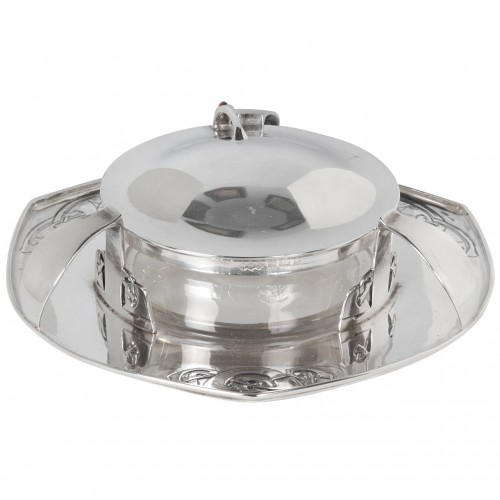
“Pokal” Covered footed cup ( model no. Br 6 )1928
Silverplated brass, model no. Br 6
Marks: WMF insignia (touchmark), x/o
Illustrated: Goldschmiedekunst 49, (1928) m. Abb; Deutsche Kunst und Dekoration 63, (1928/29) Abb S 353; Metallkunst: Kunst vom Jugendstil zur Moderne (1889-1939), Karl H. Bröhan, Band IV (Berlin: Bröhan-Museum, 1990) n. 610, p. 571; WMF Ikora Metall / Metalwork, Carlo Burschel and Heinz Scheiffele (Stuttgart, Germany: ARNOLDSCHE, 2006) pp.12,19,34.
H: 13 ¼” D base: 5 ¼” x D top: 5 ½”
JAIPUR, MUGHAL INDIA
Enameled and gem set gold Cup and Saucer c. mid-19th Century
High carat yellow gold (22-24 carat) cup and saucer set with a fine emerald, ruby and diamonds, the cup with a high foot with rounded sides and handle formed of two snakes intersecting at three points and biting the rim. The exterior is decorated with red, green, blue and white enamels with roundels containing combatant animals on a ground of floral sprays, the saucer with gently rounded sides decorated with lobed cartouches containing warriors combating tigers and birds, the underside with a series of oval panels containing peacocks and hummingbirds.
Provenance: a gift from a European diplomat in the 1930’s-40’s, and thence by descent.
Saucer: Dia: 5 1/4;
Cup: H: 2 3/4″ (with handle) x Dia: 2 5/8″
Similar animal decoration can be found in an epaulette attributed to Rajesthan, probably Jaipur, in the Khalili Collection (Pedro Moura Carvalho, Gems and Jewels of Mughal India, London, 2010, p. 225, no. 120. A related cup and saucer with similar animal depictions was sold at Christie’s (Islamic Art, Indian Miniatures, Rugs and Carpets, London, 21st October 1993, lot 350.
KARL BERGHOF Germany
J. P. KAYSER SOHN Krefeld, Germany
Vase 1904
Pewter squared vase with round flange top, open work details
Marks: Kayserzinn 4541 7 (in a raised oval)
Illustrated: Zinn des Jugendstils, Eckard Wagner (Cologne: Rheinland-Verlag, 1978), p. 63, cat. no. 148; J. P. Kayser Sohn Krefeld: Fabrik kunstgewerblicher Metallgegenstände, Musterbuch 1907 (Munich: Verlag Dry, 1982) p. 46.
***This is an extremely rare, other worldly Kayserzinn form.
H: 7” x Top W: 4 ¾” x Base: 4 x 4 square