Product Description
Leo-Victor Gardey (1879-1942) “Oak Leaves” ring, carved 18K gold set with a Heraldic amethyst jewel (approx. 14 carats TW), signed, c. 1900

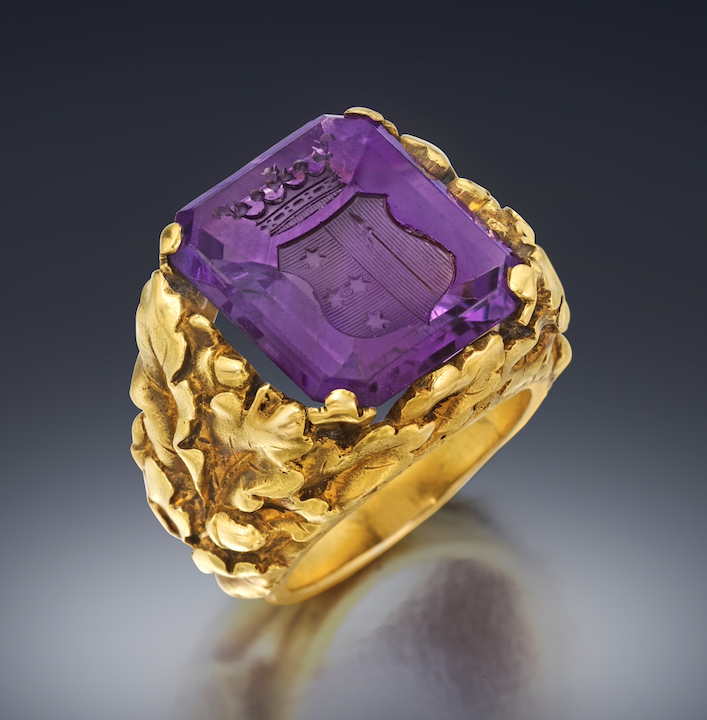
Leo-Victor Gardey (1879-1942) “Oak Leaves” ring, carved 18K gold set with a Heraldic amethyst jewel (approx. 14 carats TW), signed, c. 1900
ARCHIBALD KNOX (1864-1933) UK
LIBERTY & CO. London
Extremely rare and important grand clock by Archibald Knox for Liberty & Co. This is the largest of all of the Tudric models designed and is inset with abalone shell on the sides, the front corners and on the hands of the clock.
Marks: TUDRIC, 098
Illustrated: The Designs of Archibald Knox for Liberty & Co., A..J. Tilbrook (London: Ornament Press Ltd., 1976) pg. 88; The Liberty Style, (Japan: Hida Takayama Museum of Arts, 1999) fig. 168, p 114; Archibald Knox, ed. by Stephen A. Martin (London: Academy Editions, 1995) p. 88.
H: 15″ x W: 7″ x D: 5″
***This is the largest clock designed by Archibald Knox for
Liberty & Co. and one of only three models known.
JAIPUR, MUGHAL INDIA
Enameled and gem set gold Cup and Saucer c. mid-19th Century
High carat yellow gold (22-24 carat) cup and saucer set with a fine emerald, ruby and diamonds, the cup with a high foot with rounded sides and handle formed of two snakes intersecting at three points and biting the rim. The exterior is decorated with red, green, blue and white enamels with roundels containing combatant animals on a ground of floral sprays, the saucer with gently rounded sides decorated with lobed cartouches containing warriors combating tigers and birds, the underside with a series of oval panels containing peacocks and hummingbirds.
Provenance: a gift from a European diplomat in the 1930’s-40’s, and thence by descent.
Saucer: Dia: 5 1/4;
Cup: H: 2 3/4″ (with handle) x Dia: 2 5/8″
Similar animal decoration can be found in an epaulette attributed to Rajesthan, probably Jaipur, in the Khalili Collection (Pedro Moura Carvalho, Gems and Jewels of Mughal India, London, 2010, p. 225, no. 120. A related cup and saucer with similar animal depictions was sold at Christie’s (Islamic Art, Indian Miniatures, Rugs and Carpets, London, 21st October 1993, lot 350.
CHRISTIAN THOMSEN (1860-1921) Denmark
ROYAL COPENHAGEN
“Frog and Dragonfly” vase 1901
Glazed porcelain with a frog in 3-D sculptural relief looking at a dragonfly seated on a calla lily leaf looking up at the blossom.
Form number 280
Marks: ROYAL COPENHAGEN, CROWN, 465/250, 3 wavy lines (Royal Copenhagen) insignia, inscribed A. 250
For more information see: Musterbuch KPF, um 1930, Illustration number 204; Porzellan, Kunst und Design 1889 bis 1939, vom Jugendstil zum Funktionalismus (Berlin: Bröhan-Museum, 1993) p. 467, ill. 435; Sammlung Bröhan: Kunsthandwerk 2, Metall, Porzellan (Berlin: Bröhan Museum, 1977), pp. 222-285.
H: 9″ x Dia: 3 1/2″
Christian Thomsen was employed at the Royal Porcelain Manufactory (Royal Copenhagen) in 1898, and was employed there until his death in 1921. Thomsen is said to have had a huge impact on Royal Copenhagen’s success throughout the 20th century. A large part of the recognition by the Royal Porcelain Factory has enjoyed over the years, they can thank Christian Thomsen for. He produced more than 100 different figurines, especially he had a fondness for agricultural characters, children figurines, figurines inspired by Hans Christian Andersen’s fairy tales, fauns and trolls, and not least charming animals and bird figures.
MELLERIO PARIS Italy/ France
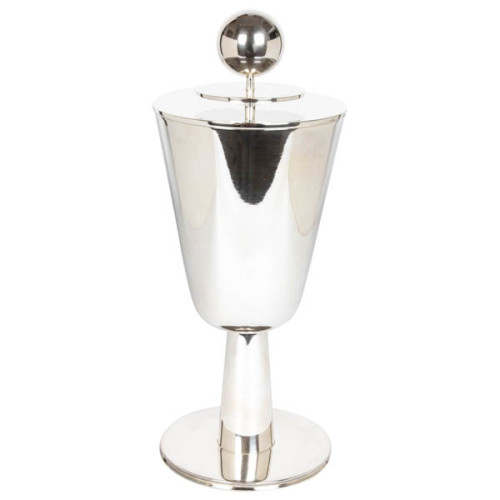
Gyroscope cigarette box c.1930
French silver (950 silver standard) in a structural form of a gyroscope with a lever for an interior lifting mechanism, gilding
Marks: Mellerio Paris, 3776 D, head of Minerva French guarantee mark for 950/1000
H: 5 1/4″ x Dia: 4 1/4″
The renowned Mellerio family and their jewelry can be traced back to Lombardy, Italy as early as the 16th century. Some family members moved to Paris and became royal jewelers for Louis XIII. The revolutions of 1789 and 1848 interrupted their business and they moved to Madrid where they became the jewelers favored by Queen Isabel II. Later in the 19th century they returned to Paris where once again they prospered and participated in several international expositions including London (1862), Paris (1867, 1878 and 1900), and Vienna (1873). In the 20th century they exhibited at the renowned Paris 1925 Exposition des Arts Décoratifs in Paris and then in New York at the 1939 World’s Fair.