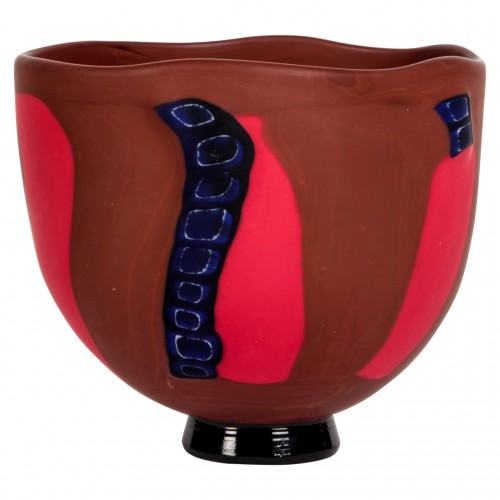
Overall matte finish art glass vase with an elaborate mosaic technique inset with red rectangular patchwork sections and blue murrina jewels all on a chocolate brown body with a black glass foot
Marks: Tsuchida Yasuhiko 99, 77
For more information see: Tsuchida Yasuhiko, exh. cat., Franco Schiavon (Murano, Italy: Palazzo del Vetro, 2000).
Provenance: Pauly & Co. Venice
H: 4 3/4″ x Dia: 5 1/8″
Price: $5,450
Yasuhiko Tsuchida was born in Osaka, Japan in 1969. In 1988, soon after graduating TSUJI Culinary Institute, he left Japan to explore food and art in Paris. Since 1992, he has lived in Venice, Italy. Tsuchida has been making glass work in Murano Island since 1995, and next year assumed the office of art director at Schiavone Glass Co. Ltd. In 1996 he presented a glass sculpture entitled “Bamboo Collection”
with Japanese motif of bamboo. The work was highly acclaimed, which gave him a chance to start to hold solo exhibitions around the world. In 2000, Tsuchida became a member of the board of directors at Venetian Glass Institute, and a chief director there in 2003. In 2004, he won Honorary Technique Prize in Düsseldorf, Germany, and in 2008, received Award of Contribution to Cultural
Promotion from Grosseto city, Toscana. In the same year, he
represented Japan at International Open Exhibition of Sculpture, and won the Grand-Prix. In 2010, Tsuchida was invited to the Issei Miyake “IM10” Project Competition, and held a solo exhibition at Lorusso Gallery, Andria, Italy. Tsuchida continues to exhibit in many solo shows around the world.
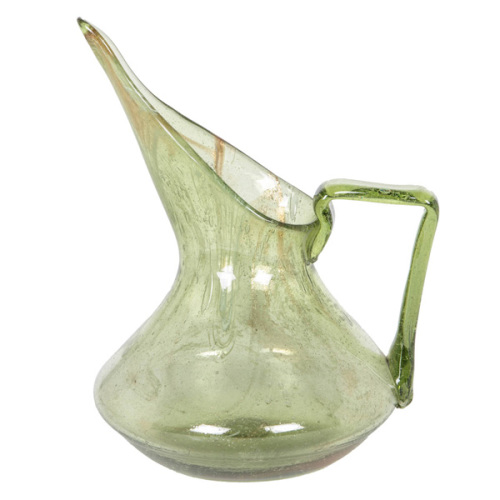
Christopher Dresser / James Couper & Sons Aventurine blown glass “Clutha” pitcher c. 1895
CHRISTOPHER DRESSER (1834-1904) UK
JAMES COUPER & SONS Glasgow, Scotland
“Clutha” pitcher c. 1895
Aventurine blown glass with iridescent gold streaks and internal bubbles
Illustrated: “Liberty & Co.” Yuletide Gifts catalogue, 1895, “Clutha” Glass; Truth, Beauty, Power: Dr. Christopher Dresser 1834-1904, exhib. cat. Historical Design, Inc. (New York, 1998) p. 72
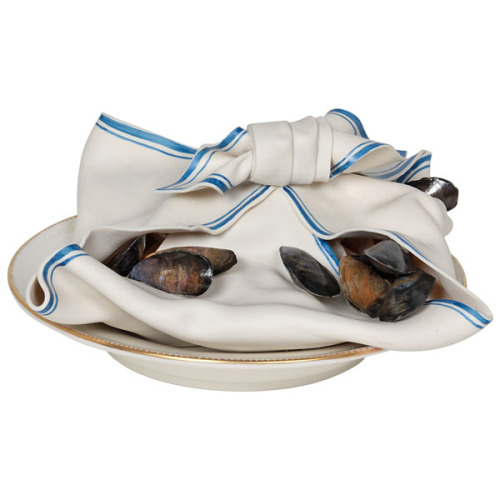
Didier Gardillou Trompe L’Oeil Porcelaine “Plat des moules et serviette” c. 2008
DIDIER GARDILLOU France
Trompe L’Oeil Porcelain “Plat des moules et serviette” c. 2008
High fired porcelain with a matte and shiny glaze, blue border detail on the napkin and realistically painted mussels.
Marks: DG (Didier Gardillou) monogram
H: 4 1/2″ x D: 10″ x W: 11″
Price: $5,450
Didier Gardillou is a master porcelain artist who creates Trompe L’Oeil masterpieces. He revived the antique craft of the porcelain florist. This technique and style first appeared in France in the 1740’s at the Manufactory of Vincennes, which in time would move and become known as the Royal Manufactory of Sèvres Porcelain.





 @hd_jewels