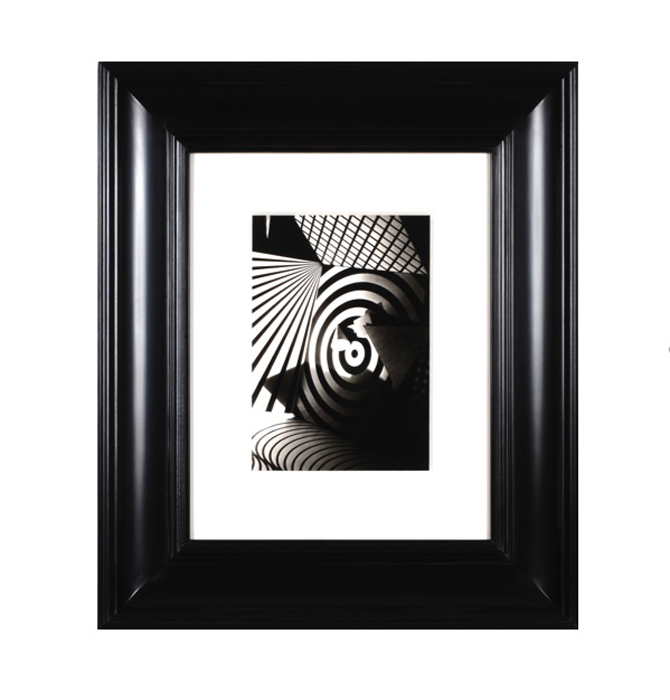
György Kepes, Abstraction, Gelatin silver print 1942
GYÖRGY KEPES (1906-2001) Hungary/USA
Abstraction 1942
Silver gelatin print
Signed: Gyorgy Kepes 1942 (in ink on back)
Framed size: H: 18 13/16” x W: 16”
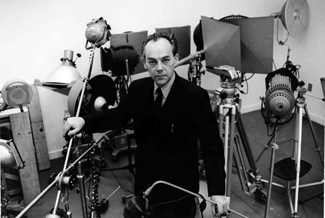
György Kepes was a Hungarian-born painter, designer, educator and art theorist. After emigrating to the U.S. in 1937, he taught design at the New Bauhaus (later the School of Design, then Institute of Design, then Illinois Institute of Design or IIT) in Chicago. In 1947 He founded the Center for Advanced Visual Studies at the Massachusetts Institute of Technology (MIT) where he taught until his retirement in 1974.
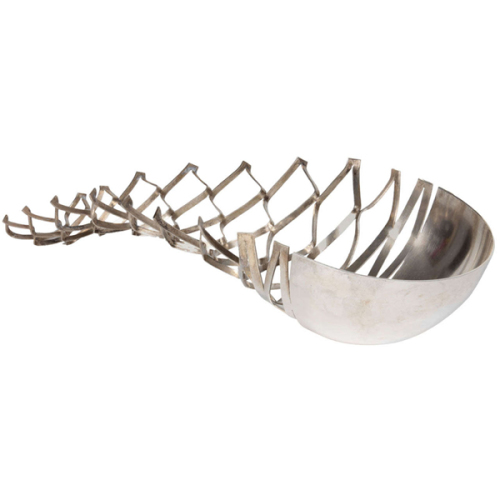
Ane Christensen Contemporary British Sterling Silver Bowl 1999
ANE CHRISTENSEN (b.1972) born in Copenhagen, Denmark/ based in London, UK
Bowl 1999
Sterling silver
Marks: AKC, 925, Z, British hallmarks
H: 2 ½” x L: 12”
Price: $5,950
The starting point for all of metalworker Ane Christensen’s tableware is a single sheet of metal. Her aim is to develop a three dimensional object from a flat sheet without adding or removing any elements. Japanese paper packaging influences Ane’s work, but a more important influence is the half finished or half demolished structures of building sites that she says can hold unexpected sculptural qualities.
Ane graduated from the Royal College of Art and has since been involved in exhibitions in London, Denmark and Copenhagen, including more recently at Collect, V&A.
Ane makes pieces in a variety of metals including silver, stainless steel and powder coated copper.
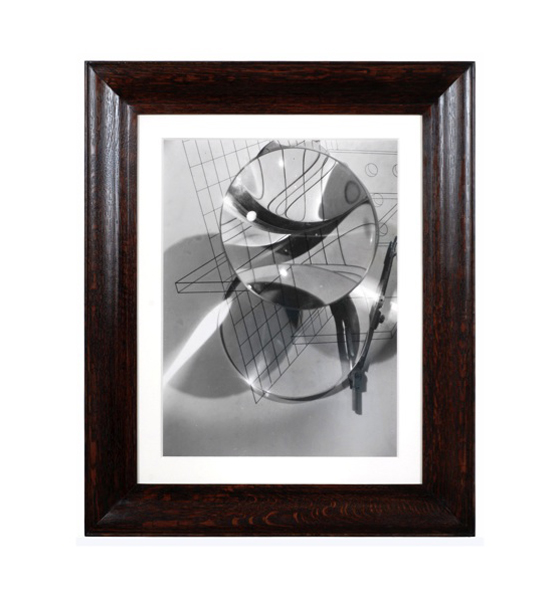
György Kepes, Lens Refraction, Gelatin silver print, 1939
GYÖRGY KEPES (1906-2001) Hungary/USA
Lens Refraction 1939
Signed: 6 (in a circle, on back); Gyorgy Kepes 1939 (in pencil on back)
Illustrated: New Bauhaus, 50 Jahre: Bauhausnachfolge in Chicago (Berlin: Bauhaus-Archiv and Argon Verlag GmbH: 1987), p. 185
Framed size: H: 27 1/8” x W: 22 ¼”
György Kepes was a Hungarian-born painter, designer, educator and art theorist. After emigrating to the U.S. in 1937, he taught design at the New Bauhaus (later the School of Design, then Institute of Design, then Illinois Institute of Design or IIT) in Chicago. In 1947 He founded the Center for Advanced Visual Studies at the Massachusetts Institute of Technology (MIT) where he taught until his retirement in 1974.
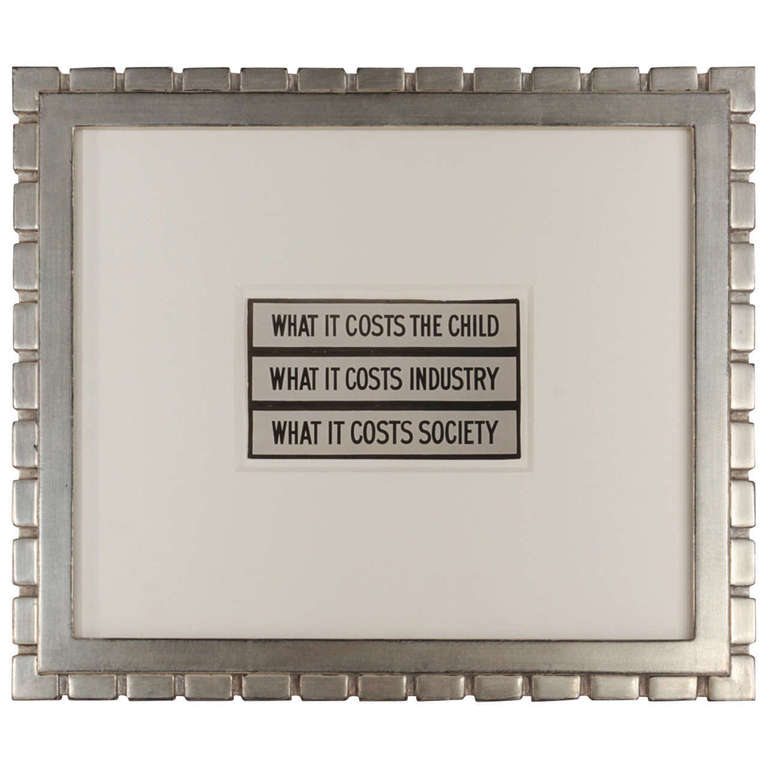
Lewis Hine, What It Costs The Child/Industry/Society, Silver gelatin print c. 1913-14
LEWIS HINE (1874-1940) USA
What It Costs The Child/Industry/Society c. 1913/14
Silver gelatin print
Signed in script on back
Framed size: H: 14 1/8” x W: 16 3/16”
Price: $20,000
***The same image is in the collection of the Metropolitan Museum of Art, New York.
Lewis Wickes Hine, photographer, sociologist and humanist, is best known for his insightful portraits of immigrants at Ellis Island and his unflinching views of housing and labor conditions in the United States. Studying and eventually teaching at the Ethical Culture School in New York City, Hine infused his humanist concerns into a style of documentary photography that set the standard for delivering a social message through his medium.
The Artist's Joke surveys the rich and diverse uses of satire by avant-garde and contemporary artists. The texts collected in this new reader from London's Whitechapel Gallery examine what Andre Breton called the “lightning bolt” of the unsettlingly comic, as seen in the anarchic wordplay of Duchamp, Picasso, the Dadaists, and Surrealists; Pop's fetish for kitsch and the comic strip; Bruce Nauman's sinister clowns and twisted puns; Richard Prince's joke paintings; art ambushed by feminist wit, from the Dadaism of Hannah Hoch in the 1920s to the politicized conceptualism of Jenny Holzer and Barbara Kruger in the 1980s; the serenely uncanny in Mike Kelley's installations and the risibly grotesque in Paul McCarthy's; and the strangely comic scenarios of artists as various as Maurizio Cattelan, Andrea Fraser, Raymond Pettibon, and David Shrigley. Artists' writings are accompanied and contextualized by the work of critics and thinkers including Freud, Bergson, Helene Cixous, Slavoj Zizek, Lewis Wickes Hine, Jorg Heiser, Jo Anna Isaak, and Ralph Rugoff.
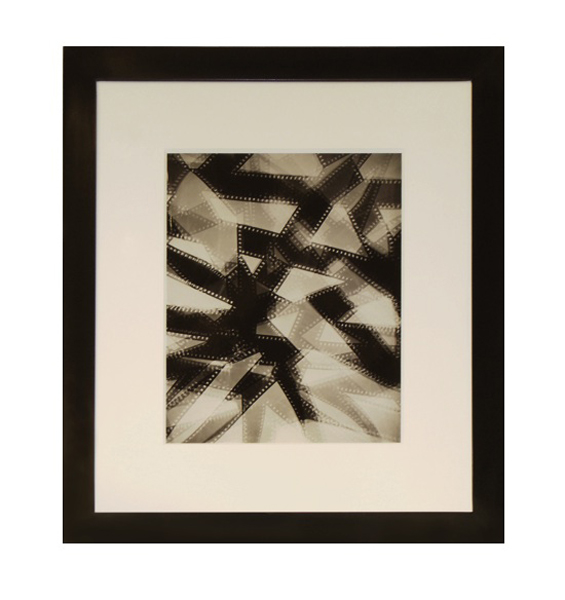
Allen Porter, Filmstrips, Photogram vintage gelatin silver print 1947
ALLEN PORTER (b.1926) USA
Filmstrips 1947
Photogram vintage gelatin silver print
Size: (unframed): H: 11” x W: 14”
Size: (frame): H: 20” x W: 23”
After attending art programs at the Art Institute of Chicago and the Chicago Academy of Fine Arts, Porter enrolled at the ID upon his return from military service in WWII. His course of study included graphic design and photography. His photograms were produced while working with famed ID photography instructors Frank Levstik and Ferenc Berko. Shortly after leaving the ID in 1949, Porter established a design office in Los Angeles during the height of the California modern design movement. He incorporated his innovative light work into design projects for important clients like Gruen Lighting and Carroll Sagar & Associates.


 @hd_jewels