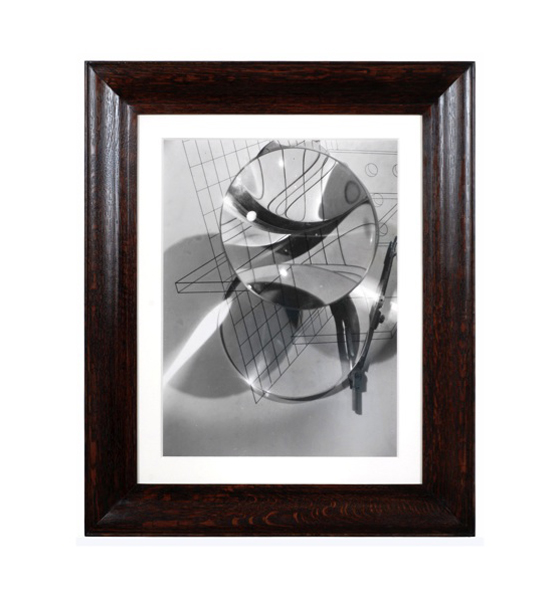
György Kepes, Lens Refraction, Gelatin silver print, 1939
More Information
György Kepes, Lens Refraction, Gelatin silver print, 1939
GYÖRGY KEPES (1906-2001) Hungary/USA
Lens Refraction 1939
Signed: 6 (in a circle, on back); Gyorgy Kepes 1939 (in pencil on back)
Illustrated: New Bauhaus, 50 Jahre: Bauhausnachfolge in Chicago (Berlin: Bauhaus-Archiv and Argon Verlag GmbH: 1987), p. 185
Framed size: H: 27 1/8” x W: 22 ¼”
György Kepes was a Hungarian-born painter, designer, educator and art theorist. After emigrating to the U.S. in 1937, he taught design at the New Bauhaus (later the School of Design, then Institute of Design, then Illinois Institute of Design or IIT) in Chicago. In 1947 He founded the Center for Advanced Visual Studies at the Massachusetts Institute of Technology (MIT) where he taught until his retirement in 1974.
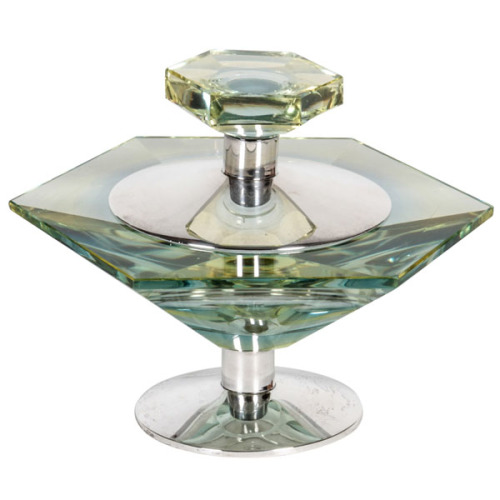
Hexagonal green-tinted lead crystal covered dish / tazza with lid in a stepped jewel-like form mounted with a silver lid and footed base silver
Marks: WMF logo, moon, crown, 800
For more information see: Wilhelm Wagenfeld und die Moderne Glasindustrie,Walter Scheiffele (Stuttgart: Verlag Gerd Hatje, 1994); WMF Ikora Metall / Metalwork, Carlo Burschel and Heinz Scheiffele (Stuttgart, Germany: ARNOLDSCHE, 2006).
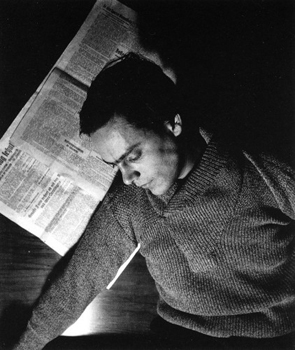
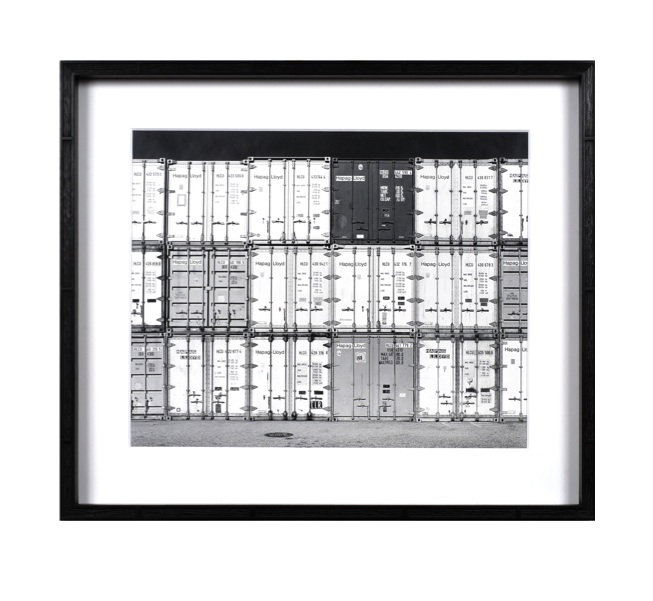
Grant Mudford, Containers, Gelatin silver print, 1979
GRANT MUDFORD (1944- ) Australia
Containers 1979
Gelatin silver print
Signed and dated on back
Framed size: H: 26 ½” x W: 30 ¾”
“Since he moved to Los Angeles from Australia in the late 1970s, Grant Mudford has composed photographs that crisply examine the streamlined geometries of West Coast architecture and landscape. Mudford has zeroed in on the abstract formal relationships lurking within the designs of gas stations, strip malls and apartment buildings. The geometrical arrangements highlighted in his photographs of the masterful modernist structures of Rudolf Schindler and Craig Ellwood have disclosed a link between their midcentury architecture and the contemporaneous hard-edge abstractions of L.A. painters John McLaughlin and Lorser Feitelson.” – Art in America, “Grand Mudford at Rosamund Felsen, September 2003




 @hd_jewels