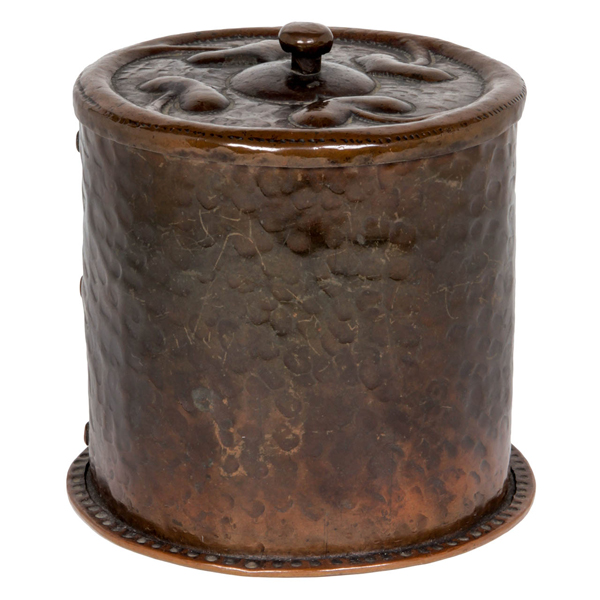
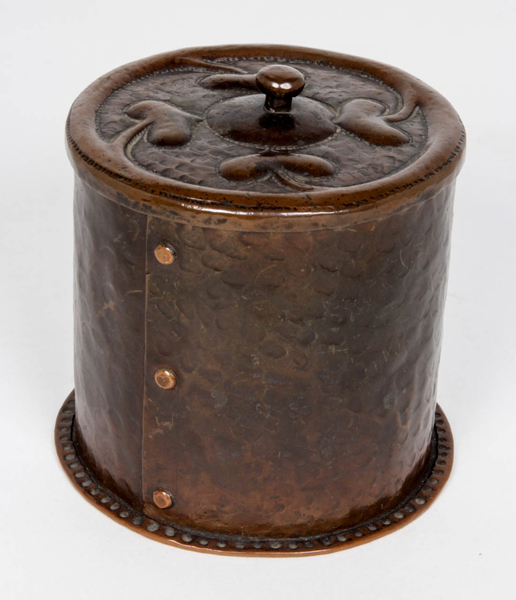
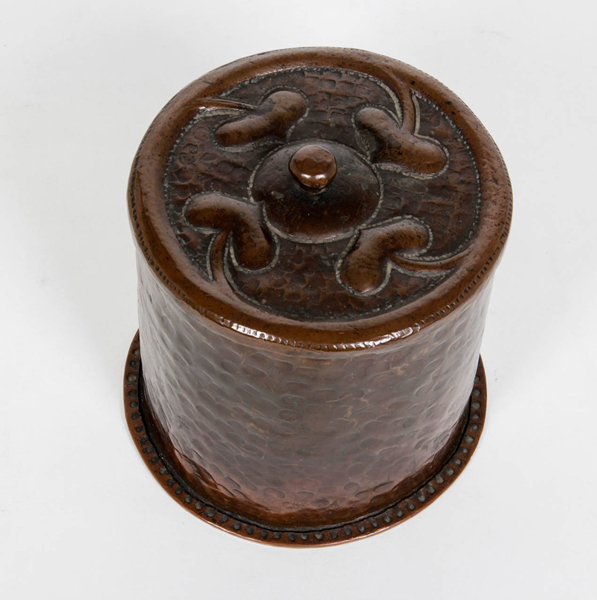
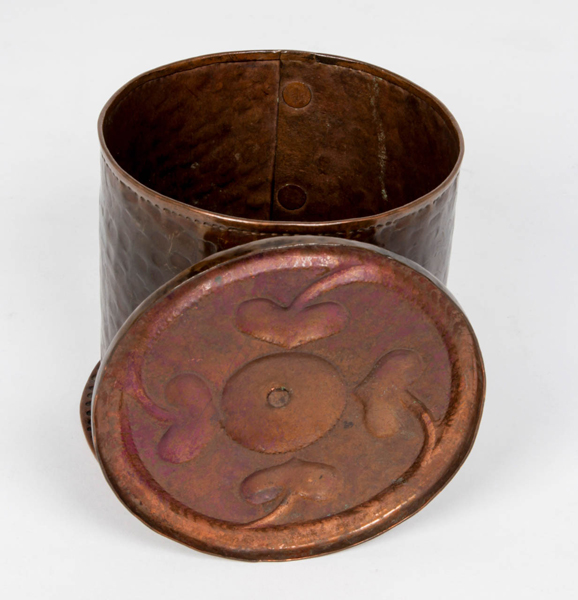
John Pearson / British Arts & Crafts Handwrought copper tea caddy c. 1900
More Information
John Pearson / British Arts & Crafts Handwrought copper tea caddy c. 1900
JOHN PEARSON (19th century) UK
Tea caddy c. 1900
Handwrought copper with rivets, repoussé lid with 4 heart-shaped leaves, rich red brown original patina
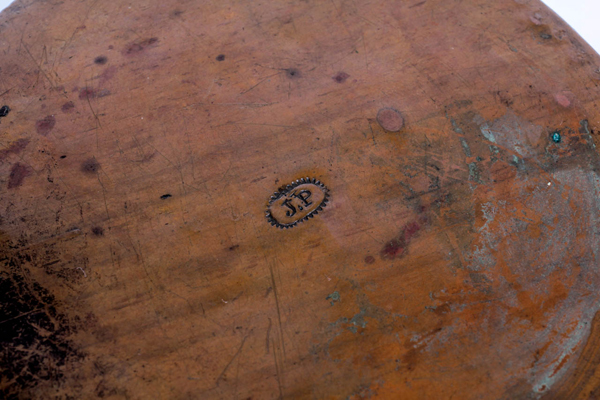
Marked: JP in an oval cartouche (on bottom)
H: 4 1/2″ x D: 4 1/4″
For more information on Pearson see: CR Ashbee: architect, designer & romantic socialist, Alan Crawford (New Haven, CT: Yale University Press, 1985), pp. 32-33, 46, 313-316; Reflections: arts and crafts metalwork in England and the United States (New York: Kurland – Zabar, 1990), pp. 32-33.
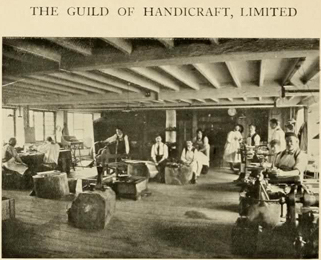
Pearson was an original member of CR Ashbee’s Guild of Handicraft starting in 1888. He later resigned to join the Newlyn Industrial Class. He also worked for the designer & ceramicist William De Morgan which is where many of his fanciful themes in repousse are inspired. He is considered one of the finest repousse metalsmiths of the period. His shop remained active until after the turn of the century, most pieces are dated.
Maurice Bouval French Art Nouveau Nymph Silvered Bronze Candleholder c. 1900
MAURICE BOUVAL (born Toulouse, died 1920) France
M. COLIN France
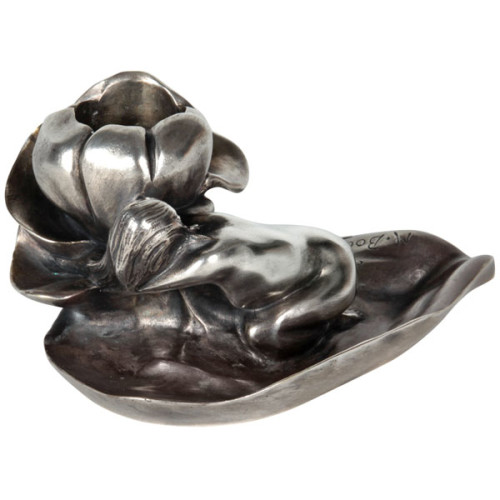
“Nymph Embracing a Blossom” candle holder c.1900
Silvered cast bronze in the form of a nymph on a leaf embracing a blossom
Marks: M. Bouval (script signature) and COLIN, (Foundry) written above
For other examples of Bouval’s work see: The Paris Salons 1895-1914, Vol. V: Objets d’Art & Metalware, Alastair Duncan (Woodbridge, Suffolk: Antique Collectors’ Club, 1999), p. 127; Ecole to Deco, Small Sculptures from a Private Collection, Stephen C. McGough ed. (Oberlin, Ohio: Allen Memorial Art Museum, 1979) pp. 33-4; Art Nouveau Sculpture, Alastair Duncan (New York: Rizzoli, 1978) pp. 30-1.
Japanese Meiji Period “Koi” Cloisonné enamel box. c. 1900
JAPANESE MEIJI PERIOD (1868-1912) Japan
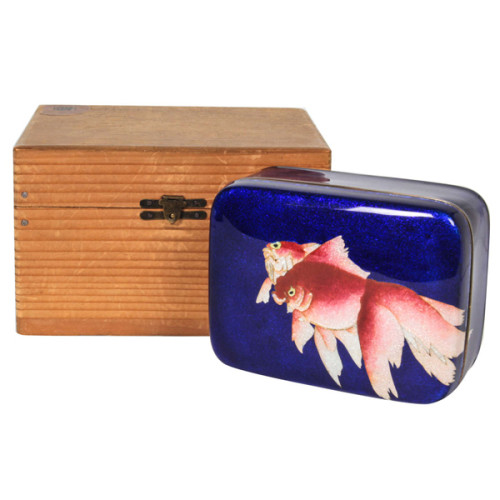
“Koi” covered box c.1900
Cloisonné with silver wire and wireless orange enamel with silver foil backing and cobalt blue enameled background with silver foil and enameled underside, red woven silk interior.
Original wood hinged box with padded cotton interior, attached paper label of an unidentified artist cipher (see box cover).
Dimensions of wood box:
H: 3 5/8″ x W: 5 3/4″ x D: 4 3/4″
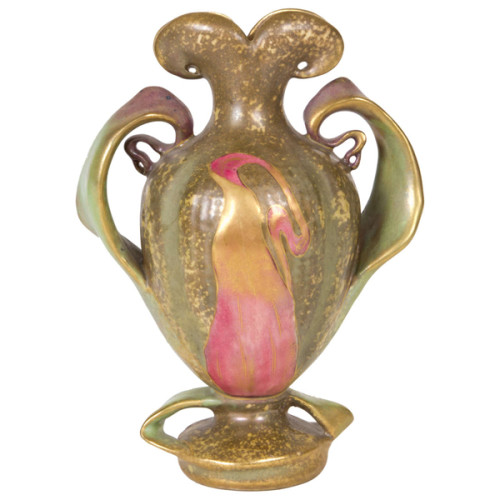
Amphora Art Pottery / Art Nouveau Organic vase c. 1900
AMPHORA ART POTTERY Turn-Teplitz, Austria
Organic vase c. 1900
Glazed earthenware
Marks: AMPHORA (in oval), AUSTRIA (in an oval), 8026, 41
For more information see: Deutsche Kunst und Dekoration, ( March 1901) pp. 346-349; Sammlung Bröhan: Kunsthandwerk, Glas, Holz, Keramik,Vol. 1 Band II (Berlin: Bröhan Museum, 1976), pp. 284-293.


 @hd_jewels