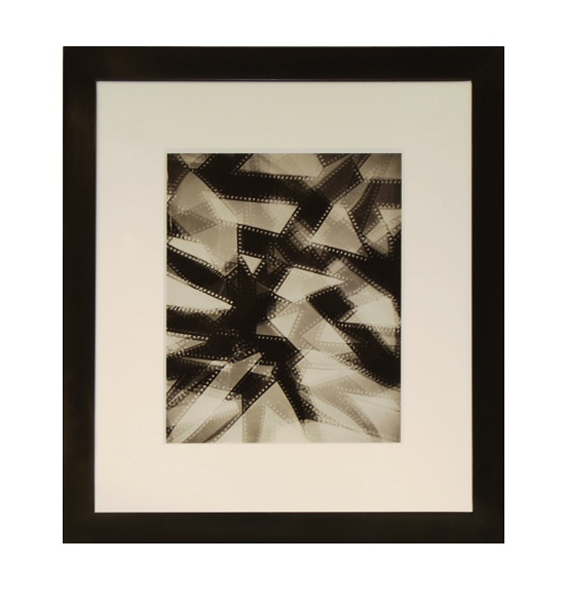
Allen Porter, Filmstrips, Photogram vintage gelatin silver print 1947
More Information
Allen Porter, Filmstrips, Photogram vintage gelatin silver print 1947
ALLEN PORTER (b.1926) USA
Filmstrips 1947
Photogram vintage gelatin silver print
Size: (unframed): H: 11” x W: 14”
Size: (frame): H: 20” x W: 23”
After attending art programs at the Art Institute of Chicago and the Chicago Academy of Fine Arts, Porter enrolled at the ID upon his return from military service in WWII. His course of study included graphic design and photography. His photograms were produced while working with famed ID photography instructors Frank Levstik and Ferenc Berko. Shortly after leaving the ID in 1949, Porter established a design office in Los Angeles during the height of the California modern design movement. He incorporated his innovative light work into design projects for important clients like Gruen Lighting and Carroll Sagar & Associates.
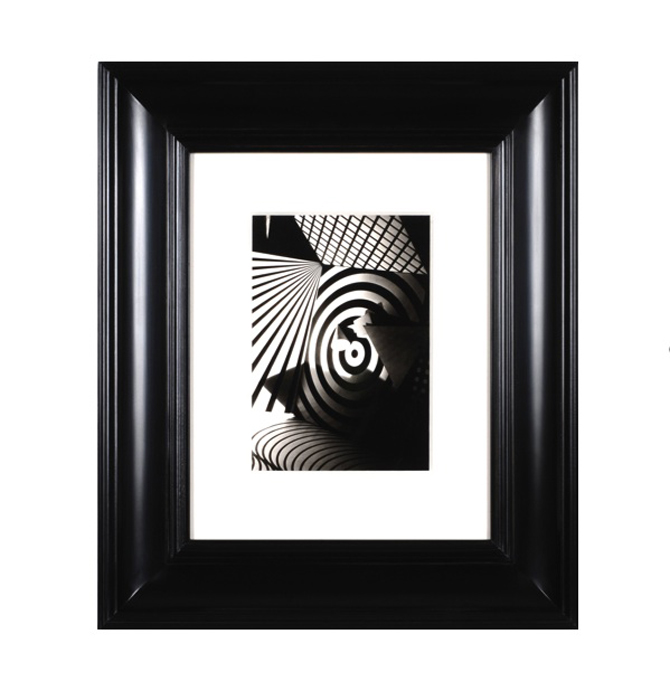
György Kepes, Abstraction, Gelatin silver print 1942
GYÖRGY KEPES (1906-2001) Hungary/USA
Abstraction 1942
Silver gelatin print
Signed: Gyorgy Kepes 1942 (in ink on back)
Framed size: H: 18 13/16” x W: 16”
György Kepes was a Hungarian-born painter, designer, educator and art theorist. After emigrating to the U.S. in 1937, he taught design at the New Bauhaus (later the School of Design, then Institute of Design, then Illinois Institute of Design or IIT) in Chicago. In 1947 He founded the Center for Advanced Visual Studies at the Massachusetts Institute of Technology (MIT) where he taught until his retirement in 1974.
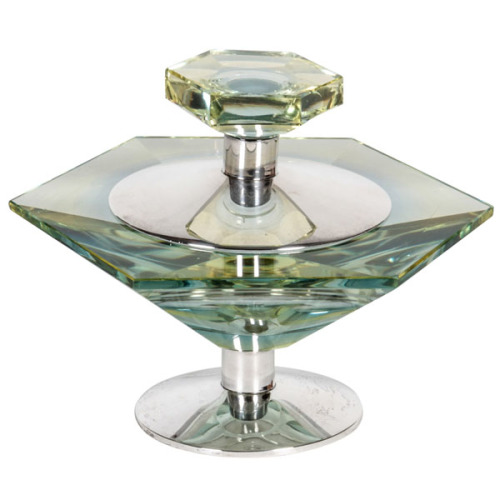
Hexagonal green-tinted lead crystal covered dish / tazza with lid in a stepped jewel-like form mounted with a silver lid and footed base silver
Marks: WMF logo, moon, crown, 800
For more information see: Wilhelm Wagenfeld und die Moderne Glasindustrie,Walter Scheiffele (Stuttgart: Verlag Gerd Hatje, 1994); WMF Ikora Metall / Metalwork, Carlo Burschel and Heinz Scheiffele (Stuttgart, Germany: ARNOLDSCHE, 2006).
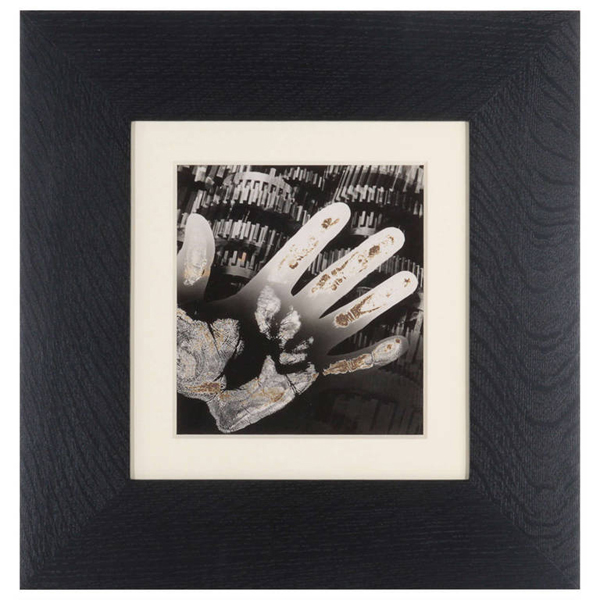
Edmund Kesting, Gears with hand, Photogram / Solarization c.1929
EDMUND KESTING (1882-1970) Germany
Gears with hand c.1929
Photogram / Solarization
Signed: Edmund Kesting 3644-280 (in pencil)
Provenance: Private Collection New York; Gene Prakapas Gallery New York 1970’s
Photogram: H: 7 9/16” x W: 6 15/16”
Frame: H: 15 9/16” x W: 14 15/16”
Price: $19,500
During the 1920s, Kesting was at the center of the avant-garde movement in Germany, where he befriended Kurt Schwitters and Laszlo Moholy-Nagy. He first trained as a painter at the Akademie der Kunst in Dresden from 1911 to 1916. In the early 1920s, after service in World War I, he turned to collage and photography. An exhibitor at Herwarth Walden's Der Sturm gallery (Berlin), which supported German expressionism and the Blue Rider group, Kesting also operated several private art schools. The last, Der Weg (The Way), was closed by the Nazis in 1933. Kesting’s interest in the photographic portrait began in 1930, and often resulted in bold experimentation (Photomontages, superimpositions and solarizations) that provided some of the strongest examples of German expressionist portraiture in photography. In contrast to the objective naturalism of August Sander, his work is informed by the “Sturm und Drang” of the period – the storm and stress of the political, economic, and social unrest in Germany. After the war in 1948, Kesting taught at the Kunsthochschule in Berlin-Weissensee. – (partially excerpted from James Borcoman, Magicians of Light, National Gallery of Canada, 1993)
Works by Edmund Kesting can be found in the collections of the Museum of Modern Art in New York and the Los Angeles County Museum of Art.
Solarization — is a phenomenon in photography in which the image recorded on a negative or on a photographic print is wholly or partially reversed in tone. Dark areas appear light or light areas appear dark. The term is synonymous with the Sabattier effect when referring to negatives, but is technically incorrect when used to refer to prints. In short, the mechanism is due to halogen ions released within the halide grain by exposure diffusing to the grain surface in amounts sufficient to destroy the latent image.


 @hd_jewels