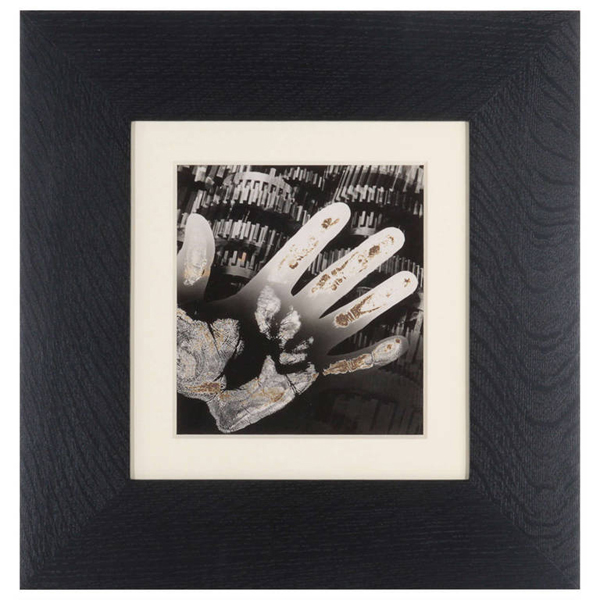
Edmund Kesting "Gears with hand" Photogram / Solarization c.1929
More Information
Edmund Kesting, Gears with hand, Photogram / Solarization c.1929
EDMUND KESTING (1882-1970) Germany
Gears with hand c.1929
Photogram / Solarization
Signed: Edmund Kesting 3644-280 (in pencil)
Provenance: Private Collection New York; Gene Prakapas Gallery New York 1970’s
Photogram: H: 7 9/16” x W: 6 15/16”
Frame: H: 15 9/16” x W: 14 15/16”
Price: $19,500
During the 1920s, Kesting was at the center of the avant-garde movement in Germany, where he befriended Kurt Schwitters and Laszlo Moholy-Nagy. He first trained as a painter at the Akademie der Kunst in Dresden from 1911 to 1916. In the early 1920s, after service in World War I, he turned to collage and photography. An exhibitor at Herwarth Walden's Der Sturm gallery (Berlin), which supported German expressionism and the Blue Rider group, Kesting also operated several private art schools. The last, Der Weg (The Way), was closed by the Nazis in 1933. Kesting’s interest in the photographic portrait began in 1930, and often resulted in bold experimentation (Photomontages, superimpositions and solarizations) that provided some of the strongest examples of German expressionist portraiture in photography. In contrast to the objective naturalism of August Sander, his work is informed by the “Sturm und Drang” of the period – the storm and stress of the political, economic, and social unrest in Germany. After the war in 1948, Kesting taught at the Kunsthochschule in Berlin-Weissensee. – (partially excerpted from James Borcoman, Magicians of Light, National Gallery of Canada, 1993)
Works by Edmund Kesting can be found in the collections of the Museum of Modern Art in New York and the Los Angeles County Museum of Art.
Solarization — is a phenomenon in photography in which the image recorded on a negative or on a photographic print is wholly or partially reversed in tone. Dark areas appear light or light areas appear dark. The term is synonymous with the Sabattier effect when referring to negatives, but is technically incorrect when used to refer to prints. In short, the mechanism is due to halogen ions released within the halide grain by exposure diffusing to the grain surface in amounts sufficient to destroy the latent image.
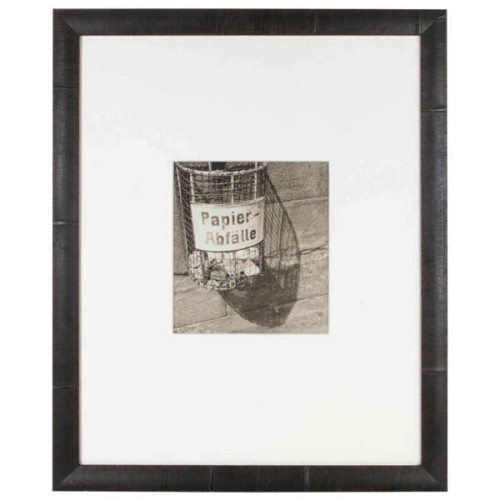
Donald Deskey, Papier-Abfälle, Gelatin silver print, c.1925-30
DONALD DESKEY (1894-1989) USA
Papier-Abfälle c.1925-30
Provenance: The Estate of Donald Deskey
H: 9 7/8” x W: 7 15/16”
Framed: H: 22” x W: 18”
Donald Deskey was a native of Blue Earth, Minnesota. He studied architecture at the University of California, but did not follow that profession, becoming instead an artist and a pioneer in the field of Industrial design. In Paris he attended the 1925 Exposition Internationale des Arts Décoratifs et Industriels Modernes, which influenced his approach to design. He established a design consulting firm in New York City, and later the firm of Deskey-Vollmer (in partnership with Phillip Vollmer) which specialized in furniture and textile design. His designs in this era progressed from Art Deco to Streamline Moderne.
He first gained note as a designer when he created window displays for the Franklin Simon Department Store in Manhattan in 1926. In the 1930's, he won the competition to design the interiors for Radio City Music Hall. In the 1940's he started the graphic design firm Donald Deskey Associates and made some of the most recognizable icons of the day. He designed the Crest toothpaste packaging, as well as the Tide bullseye. His company is still in operation in Cincinnati. A collection of his work is held by the Cooper-Hewitt, National Design Museum. He is regarded the American pioneer of industrial design, and contemporary American graphic design.
Illustrated: New Bauhaus, 50 Jahre: Bauhausnachfolge in Chicago (Berlin: Bauhaus-Archiv and Argon Verlag GmbH: 1987), p. 177
H: 18 5/8” x 22 ½” (framed)
Nathan Lerner’s long career was inextricably bound up in the history of visual culture in Chicago. Born in 1913 to immigrants from Ukraine, he began studying painting at the Art Institute of Chicago at the age of 16, taking up the camera to perfect his compositional skills. At 22 he began doing a kind of photojournalism, developing his well-known series on ”Maxwell Street,” an immigrant neighborhood hit hard by the Depression, and also photographing the southern Illinois mining area. In 1936 when the New Bauhaus was established in Chicago by Lazlo Moholy-Nagy, Lerner became one of its first scholarship students and turned increasingly to photographic experimentation. He began making semi-abstract, strongly Constructivist images involving luminous projections, solarization, photograms and other methods, and his interest in manipulating light led him to invent the first ”light box.” In 1939 he became the assistant of Gyorgy Kepes, head of the school’s light workshop; together, they wrote ”The Creative Use of Light” (1941). With Charles Niedringhaus in 1942 he developed a machine for forming plywood that was used in making most of the school’s furniture. After working as a civilian light expert for the Navy in New York during World War II, Lerner returned to the school, now called the Institute of Design, and was named education director after Moholy-Nagy’s death in 1946. He left in 1949, opening a design office that became nationally known for its furniture, building systems and glass and plastic containers (including bottles for Revlon and Neutrogena and the Honeybear honey container). In 1968 Lerner married Kiyoko Asia, a classical pianist from Japan, and over the next two decades made numerous trips to Japan, where he took his first color photographs, as well as Mexico. He had his first solo exhibition of photography in 1973 and thereafter exhibited regularly in galleries and museums in the United States, Europe and Japan. His work is included in photography and design collections around the world. (Roberta Smith, New York Times, February 15, 1997).
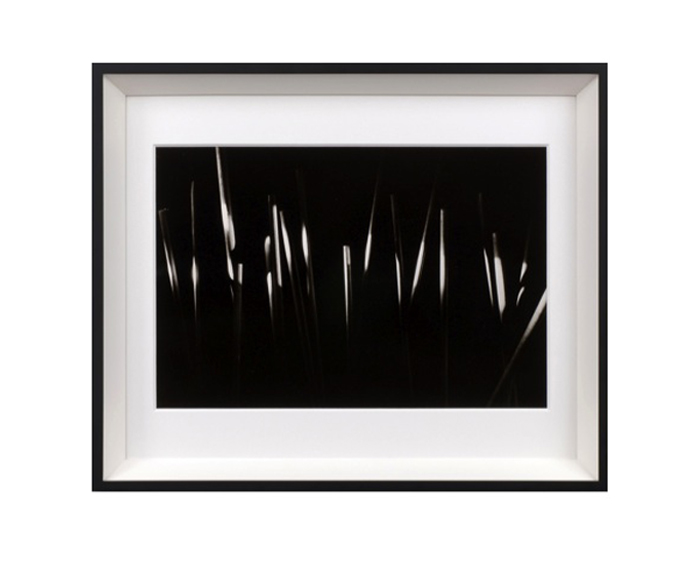
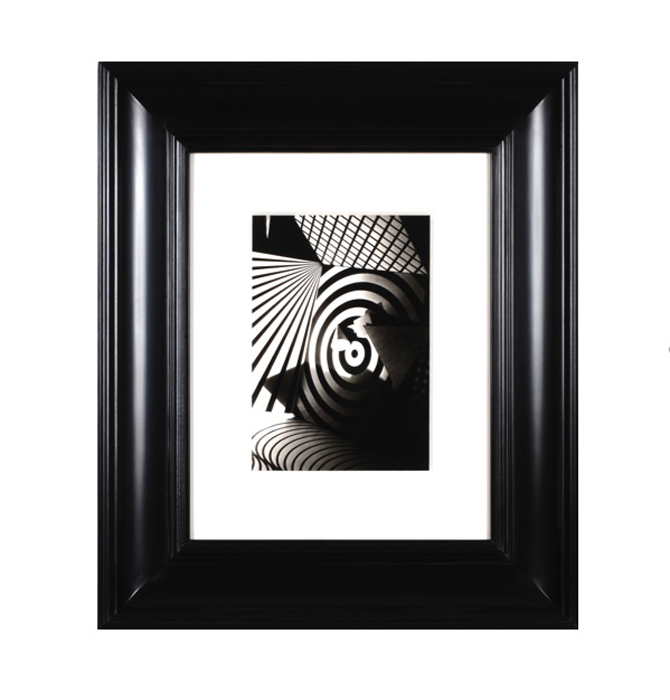
György Kepes, Abstraction, Gelatin silver print 1942
GYÖRGY KEPES (1906-2001) Hungary/USA
Abstraction 1942
Silver gelatin print
Signed: Gyorgy Kepes 1942 (in ink on back)
Framed size: H: 18 13/16” x W: 16”
György Kepes was a Hungarian-born painter, designer, educator and art theorist. After emigrating to the U.S. in 1937, he taught design at the New Bauhaus (later the School of Design, then Institute of Design, then Illinois Institute of Design or IIT) in Chicago. In 1947 He founded the Center for Advanced Visual Studies at the Massachusetts Institute of Technology (MIT) where he taught until his retirement in 1974.
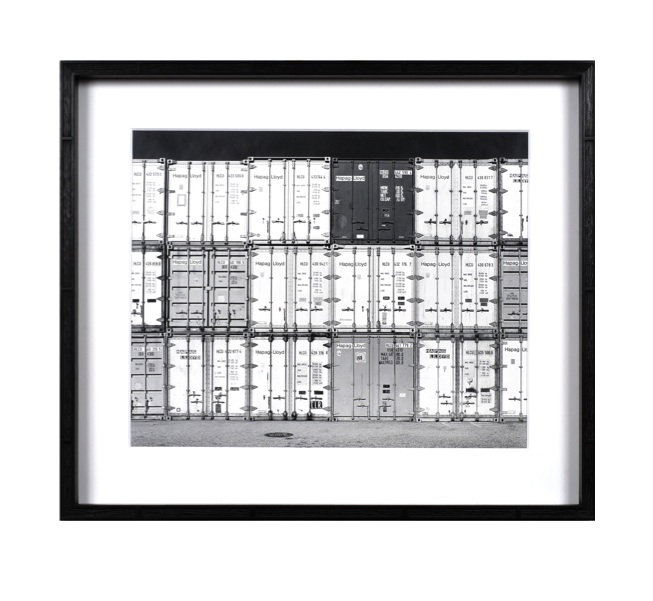
Grant Mudford, Containers, Gelatin silver print, 1979
GRANT MUDFORD (1944- ) Australia
Containers 1979
Gelatin silver print
Signed and dated on back
Framed size: H: 26 ½” x W: 30 ¾”
“Since he moved to Los Angeles from Australia in the late 1970s, Grant Mudford has composed photographs that crisply examine the streamlined geometries of West Coast architecture and landscape. Mudford has zeroed in on the abstract formal relationships lurking within the designs of gas stations, strip malls and apartment buildings. The geometrical arrangements highlighted in his photographs of the masterful modernist structures of Rudolf Schindler and Craig Ellwood have disclosed a link between their midcentury architecture and the contemporaneous hard-edge abstractions of L.A. painters John McLaughlin and Lorser Feitelson.” – Art in America, “Grand Mudford at Rosamund Felsen, September 2003




 @hd_jewels