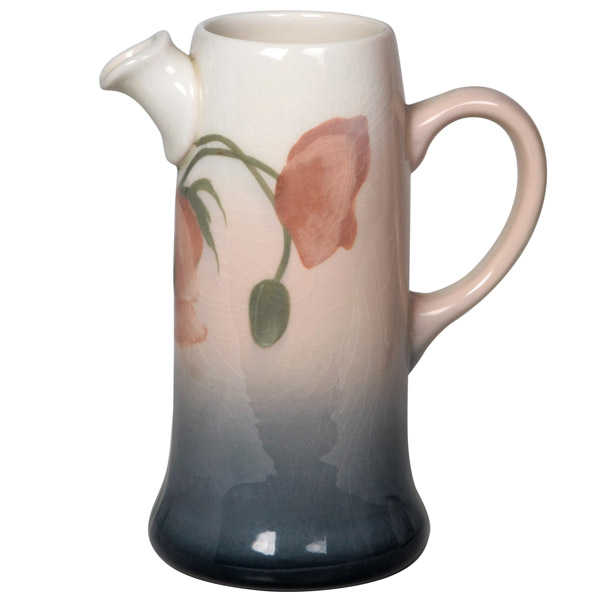
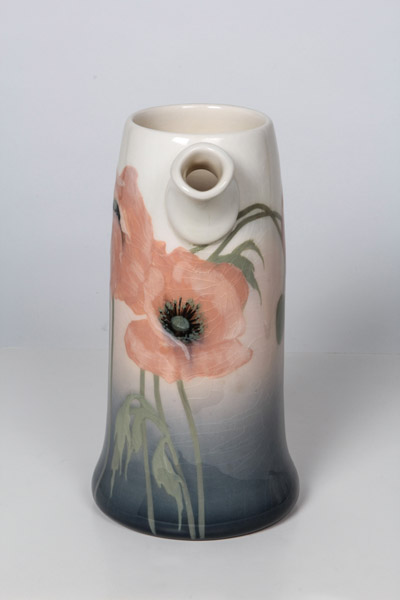
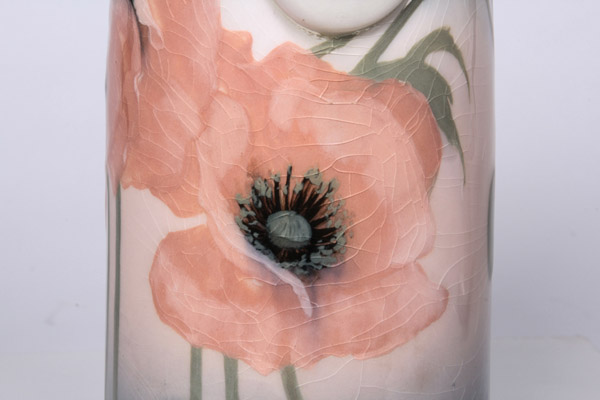
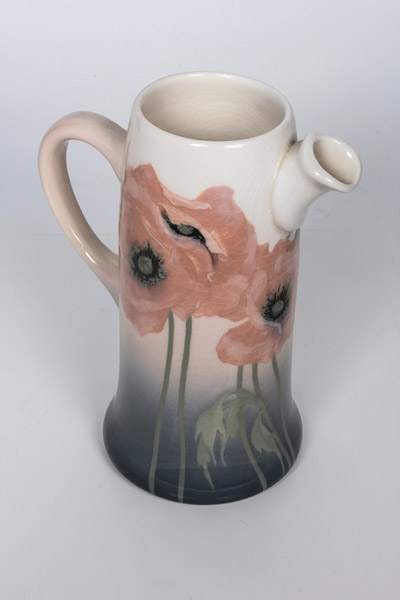
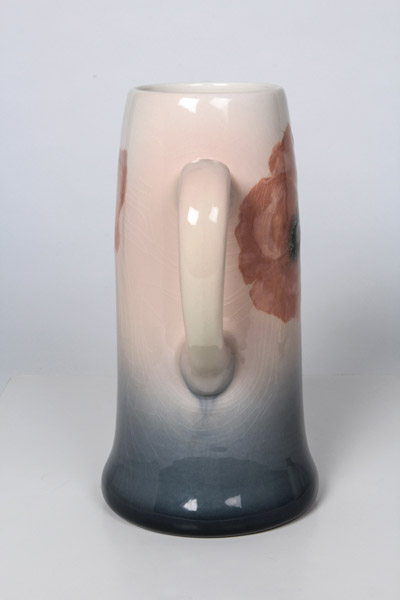
Sara Sax / Rookwood Pottery Arts & Crafts Art Nouveau "Poppy" pitcher 1906
More Information
Sara Sax / Rookwood Pottery Arts & Crafts Art Nouveau “Poppy” pitcher 1906
SARA SAX (1870-1949)
ROOKWOOD POTTERY Cincinnati, OH
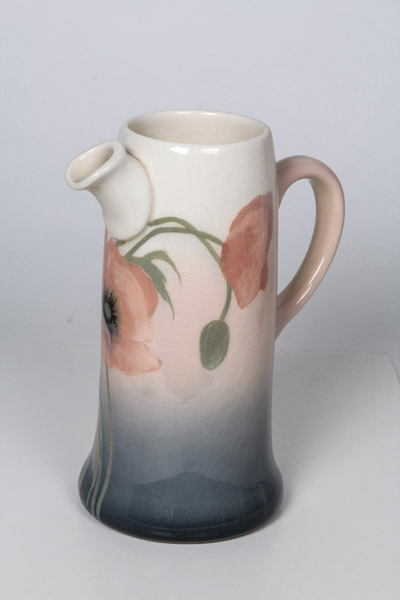
“Poppy” pitcher 1906
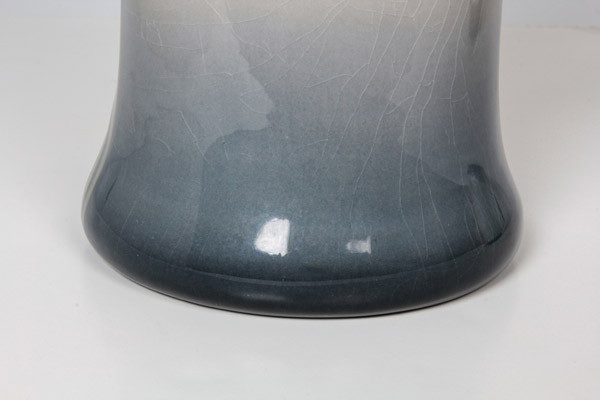
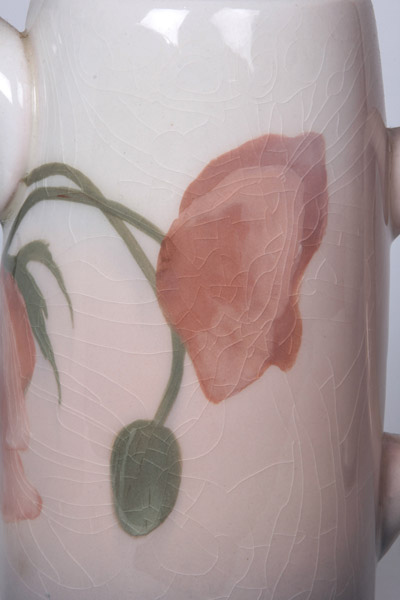
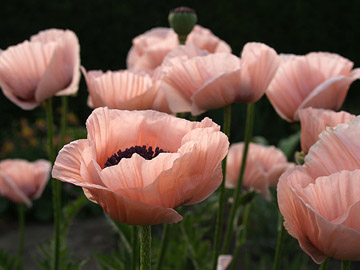
High fire ceramic with “Iris” glaze depicting five salmon pink poppies in various stages of blooming all on a rare handled pitcher form.
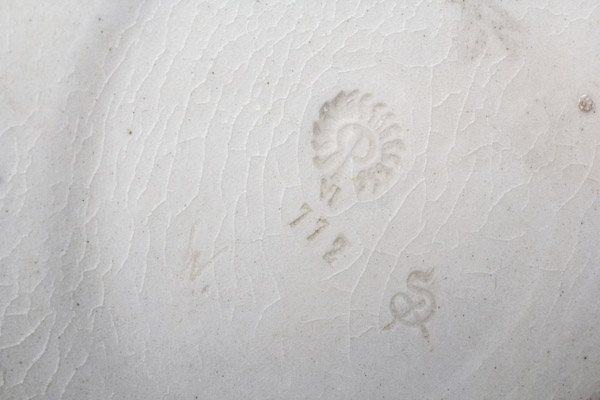
Marks: RP insignia, VI (1906), SAX (intertwined for Sara Sax), 772
For more information on Rookwood see: The Book of Rookwood Pottery, Herbert Peck (New York: Bonanza, 1968) pp. 60, 63, 64, 112, 140, 146, & 156 ; American Ceramics: The Collection of Everson Museum of Art, ed. Barbara Perry (New York: Rizzoli International Publications, Inc., 1989) p.108.
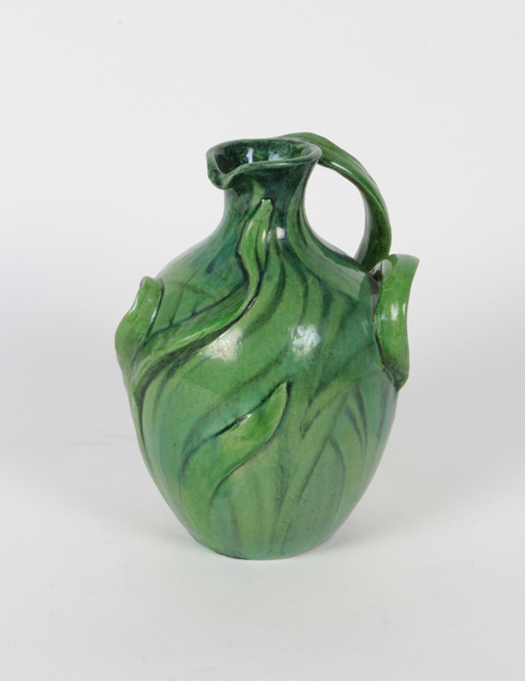
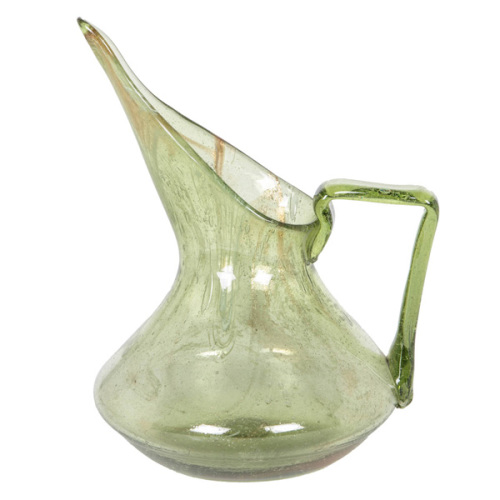
Edmond Lachenal French Art Nouveau Green glazed pitcher / vase form c. 1900
EDMOND LACHENAL (1855-1930) Paris, France
Green glazed pitcher / vase form c. 1900
Marks: E LACHENAL (impressed and glazed in a rectangle on base)
For information on Edmond Lachenal see:”Edmond Lachenal”, Fritz Minkus, Kunst und Kunsthandwerk, IV (1901) pp.390-98; La Céramique Art Nouveau, Edgar Pelichet and Michèle Duperrex (Lausanne: Les Éditions du Grand-Pont, Switzerland, 1976) pp. 66,71,74,78,83,112,115; “l’Atelier Lachenal à la galerie Georges Petit “ in Les Echoes d’Art” (1933), p. Vll; Art Nouveau: Belgium & France, exh. cat. Yvonne Brunhammer et al. (Houston, TX: Institute for the the Arts, Rice University, 1976), p. 48; Le Japonisme (Paris: Éditions de la Réunion des Musées Nationaux, 1988) cat no. 377, p. 321; Japonisme: the Japanese influence on western art in the 19th and 20th Centuries, Siegfried Wichmann (Parklane: New York, 1980) pp. 339, 349; cat. no. 920.
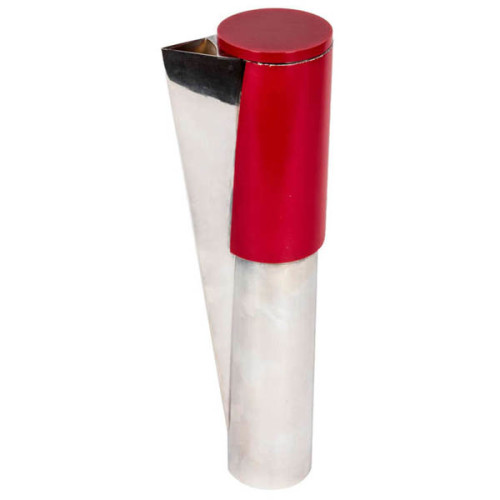
Staffan Nilsson / Scandinavian Modern Sterling Pitcher 1992
STAFFAN NILSSON (b. 1949) Sweden
Pitcher 1992
Sterling silver, red acrylic
Marks: SNN P 925 S10
Staffan Nilsson’s work was included in the exhibition “Form and Function, Contemporary Swedish Silver,” the Swedish American Museum, Chicago, Oct. 12 – December 2, 2000.
H: 11 ½ “
Price: $8,000
*** A related teapot in sterling silver with a red acrylic handle can be found in the permanent collection of the Shanghai Museum and it is an innovative use red acrylic and sterling silver.
Christopher Dresser / James Couper & Sons Aventurine blown glass “Clutha” pitcher c. 1895
CHRISTOPHER DRESSER (1834-1904) UK
JAMES COUPER & SONS Glasgow, Scotland
“Clutha” pitcher c. 1895
Aventurine blown glass with iridescent gold streaks and internal bubbles
Illustrated: “Liberty & Co.” Yuletide Gifts catalogue, 1895, “Clutha” Glass; Truth, Beauty, Power: Dr. Christopher Dresser 1834-1904, exhib. cat. Historical Design, Inc. (New York, 1998) p. 72
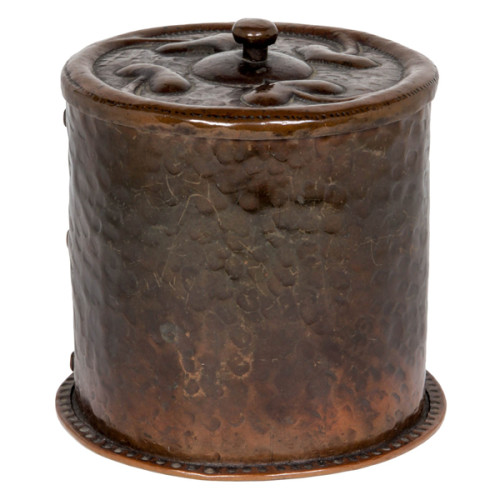
John Pearson / British Arts & Crafts Handwrought copper tea caddy c. 1900
JOHN PEARSON (19th century) UK
Tea caddy c. 1900
Handwrought copper with rivets, repoussé lid with 4 heart-shaped leaves, rich red brown original patina
Marked: JP in an oval cartouche (on bottom)
H: 4 1/2″ x D: 4 1/4″
For more information on Pearson see: CR Ashbee: architect, designer & romantic socialist, Alan Crawford (New Haven, CT: Yale University Press, 1985), pp. 32-33, 46, 313-316; Reflections: arts and crafts metalwork in England and the United States (New York: Kurland – Zabar, 1990), pp. 32-33.
Pearson was an original member of CR Ashbee’s Guild of Handicraft starting in 1888. He later resigned to join the Newlyn Industrial Class. He also worked for the designer & ceramicist William De Morgan which is where many of his fanciful themes in repousse are inspired. He is considered one of the finest repousse metalsmiths of the period. His shop remained active until after the turn of the century, most pieces are dated.


 @hd_jewels