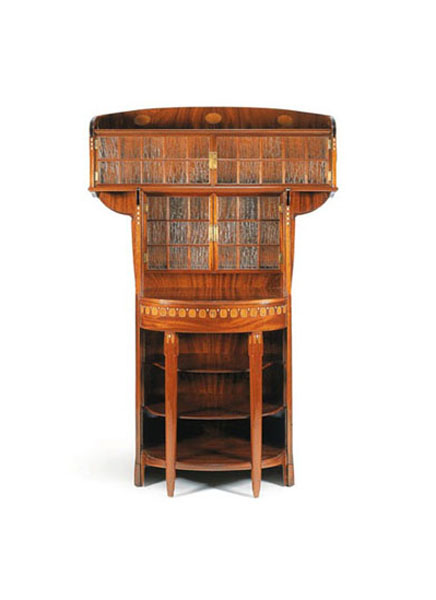
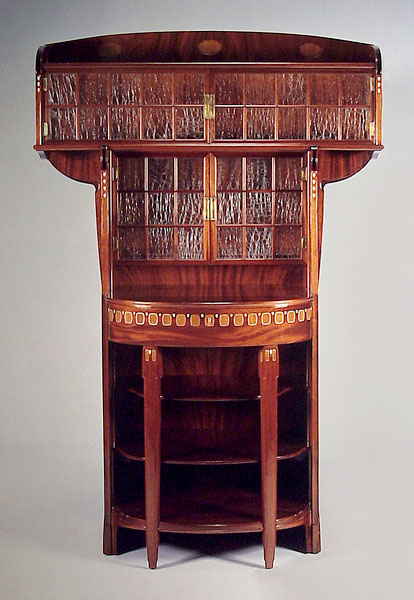
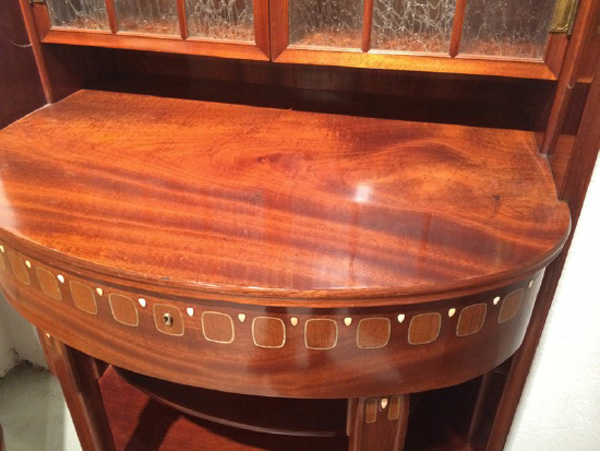
Alfred Grenander / W. Kummel 1904 St. Louis Exhibition cabinet, unique 1904
More Information
Alfred Grenander / W. Kummel 1904 St. Louis Exhibition cabinet, unique 1904
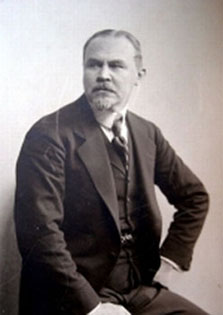
ALFRED GRENANDER (1863-1931) Sweden / Germany
W. KUMMEL Berlin, Germany (cabinetmaker)
Cabinet (unique) c. 1904
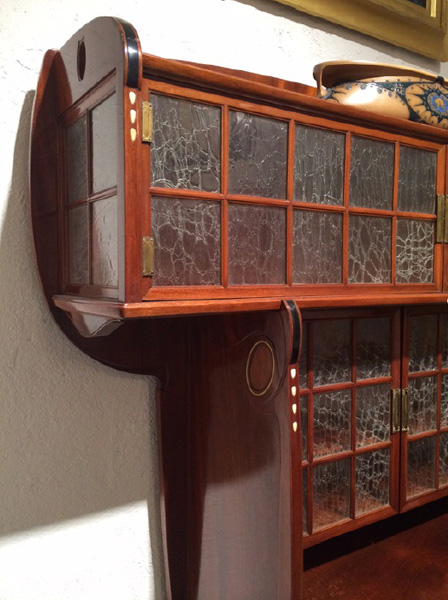
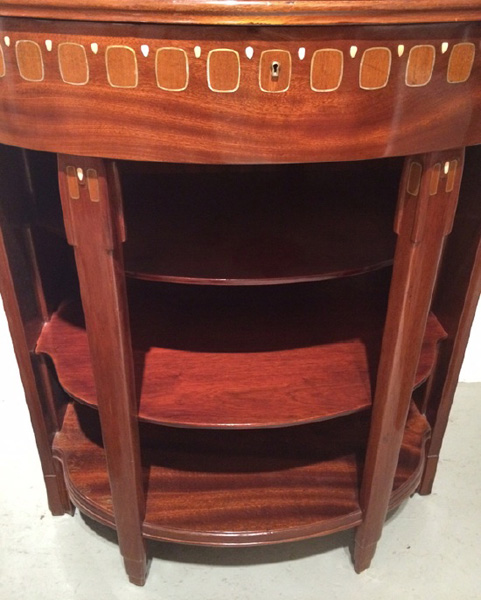
Flamed mahogany, ebony, ivory and fruitwood inlays, brass hardware and details, textured glass
Marks: American import label (from Germany) for the St. Louis exhibition
Exhibited: The 1904 St. Louis Exhibition, German Section in the Herrenzimmer
Illustration of Grenander room: Deutsches Kunstgewerbe St. Louis 1904, Hugo Nachtlicht, 1904, p. 80.
Commentary on Grenander’s display at St. Louis Exhibition: Deutsche Kunst und Dekoration, Band XV Oktober 1904-Marz 1905, “Die Wohnungskunst auf der Welt –Austellung in St. Louis”, Dr. Hermann Muthesius, p. 213-16.
Related bookcase-cabinet illustrated: Deutsche Kunst und Dekoration, Band XVI April-September 1905, p. 426.
For other works by Grenander see: Deutsche Kunst und Dekoration, Band XVI April-September 1905, p. 395-407, 426, 427, 671-73, 694, 695; Das Deutsche Kunstgewerbe 1906, 111. Deutsche Kunstgewerbe-Austellung Dresden 1906, (München, Verlagsanstalt P. Bruckmann A.G., 1906) p. 129-133, 232, 261
H: 79 1/2” x W: 57” x D: 23”
Price: $95,000
Alfred Grenander was born in June 1863 in Skövde, Sweden, and came to Berlin in 1885 to study. The city became his home, and he built his first buildings here together with his brother-in-law Otto Spalding. In 1897 Grenander began teaching at the Unterrichtsanstalt des Berliner Kunstgewerbemuseums (college attached to Berlin’s Museum of Arts and Crafts). His involvement with underground railway architecture began in 1900 and came to dominate his life’s work, with more than 80 buildings. He died on 14 July 1931 in Berlin.
From the turn of the century through the early 1930s, Alfred Grenander provided the emerging metropolis of Berlin with an extensive net of subway stations. He was an architect, draughtsman, and city planner; as well as a remarkable furniture designer. Grenander was the celebrated German representative at the 1904 World’s Fair in St. Louis, where he was being honored as “the renewer of German art.” This mahogany cabinet inlaid with pewter, ebony and ivory was exhibited in the elegant Herrenzimmer of the German pavilion at the Louisiana Purchase Exposition, St. Louis, Missouri, 1904, was bought in 1904 by a Kansas City, Missouri family and the piece descended in the family.
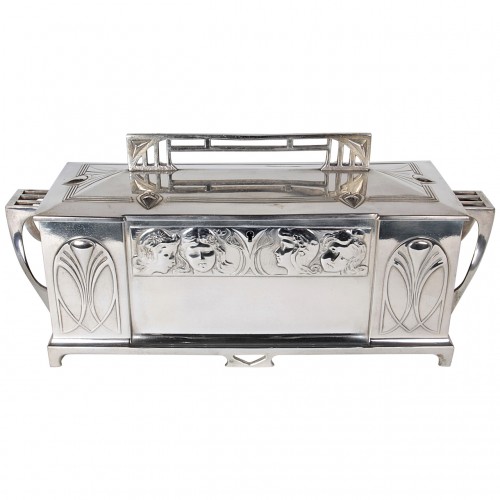
WMF Jugendstil Art Nouveau Four Seasons Jewelry box c. 1900
WMF [Württembergische Metallwarenfabrik] Germany
“Four Seasons” Art Nouveau Jewelry box c. 1900
Silver plate with Jugendstil design buttress handles and open work handle with a frieze of Art Nouveau maidens representing the four seasons, velvet lined with two original keys.
Marks: WMF mark, I/O (in a box), E
For more information see: WMF: Glas, Keramik, Metall, 1925-1950, Jörg Schwandt (Berlin: Kunstgewerbemuseum, Staatliches Museum Preussischer Kulturbesitz, 1981); Metallkunst, Band IV (Berlin: Brohan-Preussischer Kulturbesitz, 1981) pp. 546-579.
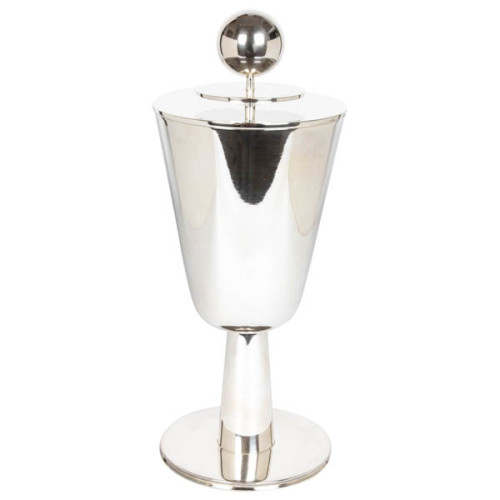
Breuhaus de Groot / WMF Ikora Germany Art Deco Rare “Pokal” Covered Footed Cup 1928
FRITZ AUGUST BREUHAUS DE GROOT (1883-1960) Germany
WMF [WÜRTTEMBERGISCHE METALLWARENFABRIK] Geislingen
“Pokal” Covered footed cup ( model no. Br 6 )1928
Silverplated brass, model no. Br 6
Marks: WMF insignia (touchmark), x/o
Illustrated: Goldschmiedekunst 49, (1928) m. Abb; Deutsche Kunst und Dekoration 63, (1928/29) Abb S 353; Metallkunst: Kunst vom Jugendstil zur Moderne (1889-1939), Karl H. Bröhan, Band IV (Berlin: Bröhan-Museum, 1990) n. 610, p. 571; WMF Ikora Metall / Metalwork, Carlo Burschel and Heinz Scheiffele (Stuttgart, Germany: ARNOLDSCHE, 2006) pp.12,19,34.
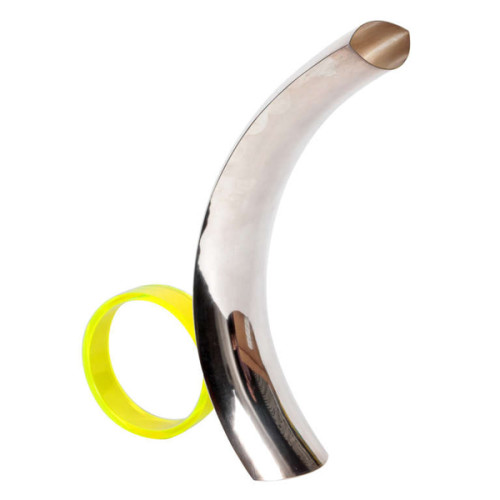
Wolfgang Gessl Unique sterling silver Arc pitcher with acrylic handle 1990
WOLFGANG GESSL (b. 1949) Austria
Arc pitcher – unique 1990
Hand wrought silver in a rounded arching form with a cylindrical luminous yellow-green acrylic handle
Marks: Wolfgang Gessl (script impressed signature), WO.GE (in a rectangle), Swedish assay mark for Stockholm, 925 (silver guarantee in a rectangle), Q10 (in a rectangle)
Illustrated: Gold and Silversmith Wolfgang Gessl: Exceeding Geometry, Kerstin Wickman, p. 17, cover.
H: 13 1/2″ x W: 10 ¼” x D: 4 ½”
Price: $27,500
Wolfgang Gessl was born in 1949 in Vienna, Austria and trained as a goldsmith with Professor Hans Angerbauer. Upon moving to Sweden, Gessl studied under the eminent silversmith Sigurd Persson at Konstfack, the National University of Art, Craft and Design in Stockholm, Sweden.
Wolfgang Gessl has had fifteen solo exhibitions including shows at The National Museum, Stockholm and The Royal College of Art in London. His metalwork has been widely exhibited in Sweden, Europe and the U.S and his pieces can be found in many private collections throughout the world. He has taught at Konstfack for more than twenty-four years, and continues to live and work in Stockholm.
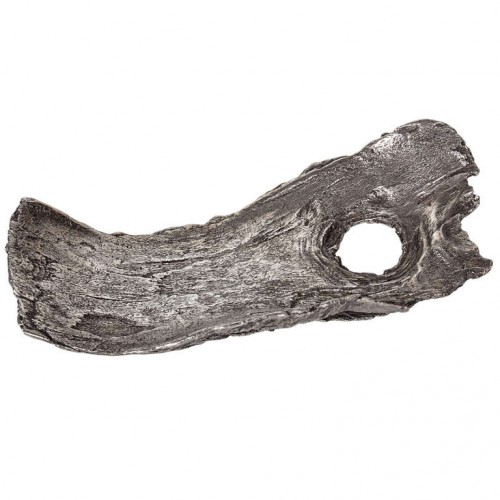
Solid cast silver in a naturalistic form of a piece of tree bark with an inherent hole.
***The weight is in excess of 250 troy ounces of silver
Exhibited: Inside Design Now: National Design Triennial, Cooper-Hewitt, National Design Museum, New York, 2003.
Illustrated: Michele Oka Doner, Natural Seduction, S. Ramljak, M. Lapidus, A. C. Danto (New York: Hudson hills Press, 2003) pp. 170-171; Inside Design Now: National Design Triennial, Donald Albrecht, Ellen Lupton, et al. (New York: Cooper-Hewitt, National Design Museum, 2003), p. 146.
H: 3 1/2″ x L: 16″ x D: 7″
Michele Oka Doner is an internationally acclaimed New York-based artist and designer whose work translates natural forms–plant fronds, berries, shells, and life observed beneath the lens of the microscope–into objects of extraordinary power and seduction rendered in bronze, precious metals and stones, concrete handmade papers, ceramic, and now, glass. Since first appearing on the national scene in 1970 as the youngest artist showcased in the defining landmark museum exhibition Objects USA. Oka Doner has built a career encompassing monumental sculptures, public art, jewelry, and functional objects that range from fireplace tools to evening bags. Oka Doner was born in Miami Beach in 1945. Though she received her formal education and advanced degrees at the University of Michigan in Ann Arbor, the artist has always cited as her primary laboratory the turbulent natural treasures of Southern Florida's oceans, tidal pools, beaches, gardens and tropical forests–boundless living resource libraries she visits on a monthly basis to gaze upon and gather samples that later inspire pieces of every size and type. Oka Doner has said that she strives with her work to “play the role of the translator and editor of life forces creating objects that go far beyond static formal beauty to encourage contemplation and wonder.” Informed by her ongoing research into scientific literature and poetry, as well as her expeditions in the natural world, Oka Doner uses the tools of physical expression to invite us along on her wanderings through the realm of the infinite. Oka Doner is also admired for her numerous site-specific, permanent public art commissions including such projects as the golden tiled Radiant Site at New York's Herald Square Subway Station (1990) and A Walk on the Beach, a half-mile long expanse of terrazzo and bronze floor continually unfolding at Concourse A of Miami International Airport (1995 to present). Oka Doner's sculptures and functional objects are included in many prestigous private and public collections, including those of The Metropolitan Museum of Art and the Smithsonian's Cooper-Hewitt National Design Museum in New York City, the Art of Institute of Chicago and the Virginia Museum of Fine Arts, among others. She has participated in scores of distinguished exhibitions internationally and has been recipient of numerous grants and awards, including honors from the Kress Foundation and the New York State Council for the Arts. In 2004 she received the coveted Award of Excellence from the United Nations Society of Writers and Artists.


 @hd_jewels