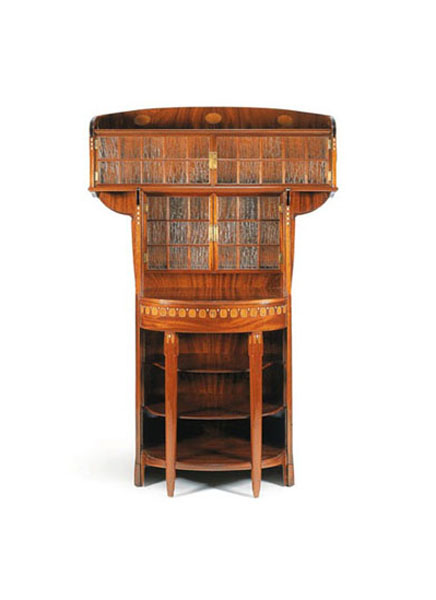
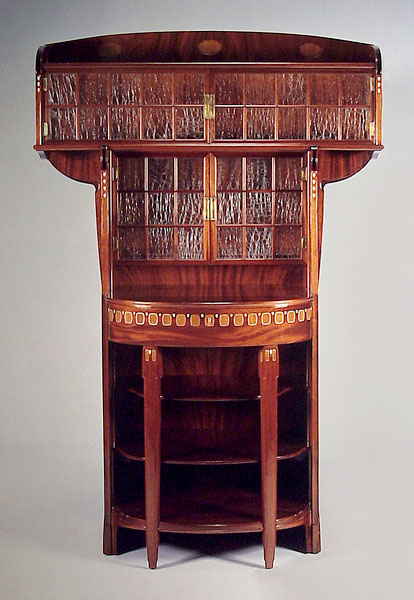
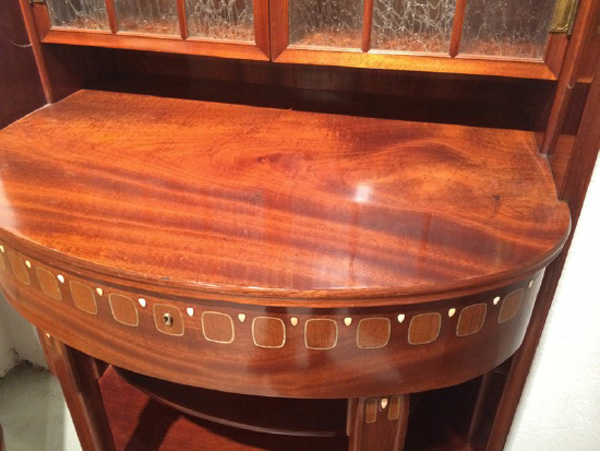
Alfred Grenander / W. Kummel 1904 St. Louis Exhibition cabinet, unique 1904
More Information
Alfred Grenander / W. Kummel 1904 St. Louis Exhibition cabinet, unique 1904
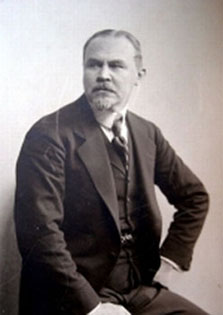
ALFRED GRENANDER (1863-1931) Sweden / Germany
W. KUMMEL Berlin, Germany (cabinetmaker)
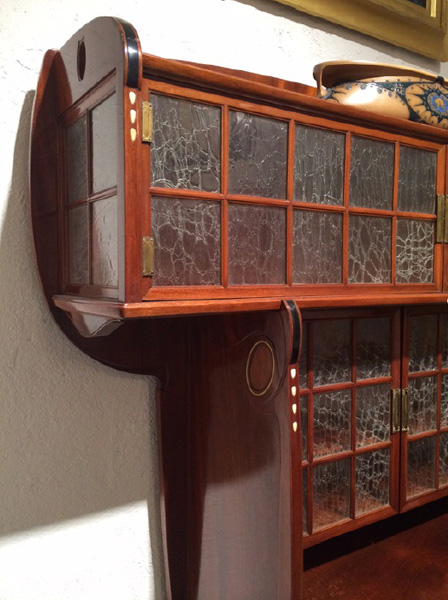
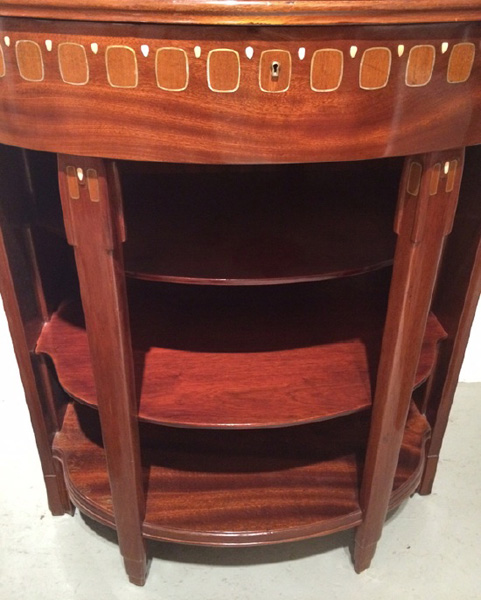
Cabinet (unique) c. 1904
Flamed mahogany, ebony, ivory and fruitwood inlays, brass hardware and details, textured glass
Marks: American import label (from Germany) for the St. Louis exhibition
Exhibited: The 1904 St. Louis Exhibition, German Section in the Herrenzimmer
Illustration of Grenander room: Deutsches Kunstgewerbe St. Louis 1904, Hugo Nachtlicht, 1904, p. 80.
Commentary on Grenander’s display at St. Louis Exhibition: Deutsche Kunst und Dekoration, Band XV Oktober 1904-Marz 1905, “Die Wohnungskunst auf der Welt –Austellung in St. Louis”, Dr. Hermann Muthesius, p. 213-16.
Related bookcase-cabinet illustrated: Deutsche Kunst und Dekoration, Band XVI April-September 1905, p. 426.
For other works by Grenander see: Deutsche Kunst und Dekoration, Band XVI April-September 1905, p. 395-407, 426, 427, 671-73, 694, 695; Das Deutsche Kunstgewerbe 1906, 111. Deutsche Kunstgewerbe-Austellung Dresden 1906, (München, Verlagsanstalt P. Bruckmann A.G., 1906) p. 129-133, 232, 261
H: 79 1/2” x W: 57” x D: 23”
Price: $95,000
Alfred Grenander was born in June 1863 in Skövde, Sweden, and came to Berlin in 1885 to study. The city became his home, and he built his first buildings here together with his brother-in-law Otto Spalding. In 1897 Grenander began teaching at the Unterrichtsanstalt des Berliner Kunstgewerbemuseums (college attached to Berlin’s Museum of Arts and Crafts). His involvement with underground railway architecture began in 1900 and came to dominate his life’s work, with more than 80 buildings. He died on 14 July 1931 in Berlin.
From the turn of the century through the early 1930s, Alfred Grenander provided the emerging metropolis of Berlin with an extensive net of subway stations. He was an architect, draughtsman, and city planner; as well as a remarkable furniture designer. Grenander was the celebrated German representative at the 1904 World’s Fair in St. Louis, where he was being honored as “the renewer of German art.” This mahogany cabinet inlaid with pewter, ebony and ivory was exhibited in the elegant Herrenzimmer of the German pavilion at the Louisiana Purchase Exposition, St. Louis, Missouri, 1904, was bought in 1904 by a Kansas City, Missouri family and the piece descended in the family.
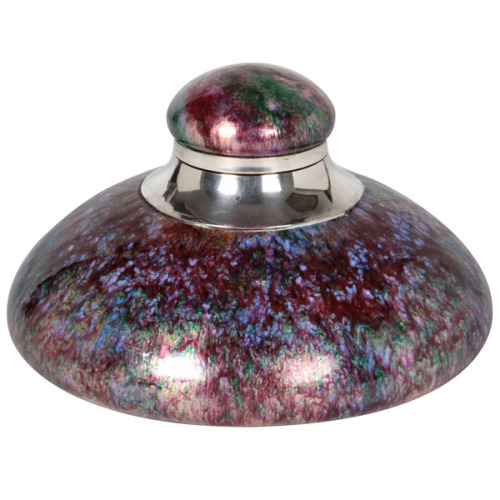
Paul Haustein Germany Rare Jugendstil enamel and silver inkwell c.1900
PAUL HAUSTEIN (1880-1944) Germany
HERMANN BEHRND (b. 1849) SILBERWARENFABRIK (silver) Dresden, Germany
JAKAB RAPOPORT (enamelist) Budapest, Hungary
Inkwell c. 1900
Multicolored burgundy, purple, blue and green enamel with silver mounts, glass insert
Marks: Moon, crown, 800, HB (Hermann Behrnd mark)
Same model with variant mount illustrated: Deutsche Goldschmiede-Zeitung, n.d. (circa 1903-05), p. 23
For related works and more information see: Art Nouveau in Munich: Masters of Jugendstil, ed. Kathryn Bloom Hiesinger (Philadelphia: Philadelphia Museum of Art, 1988) pp. 67-69; Jugendstil in Dresden, Aufbruch in die Moderne, Gisela Haase et al., exh. cat. (Dresden: Staatliche Kunstsammlungen Dresden; Wolfratshausen: Edition Minerva, 1999).
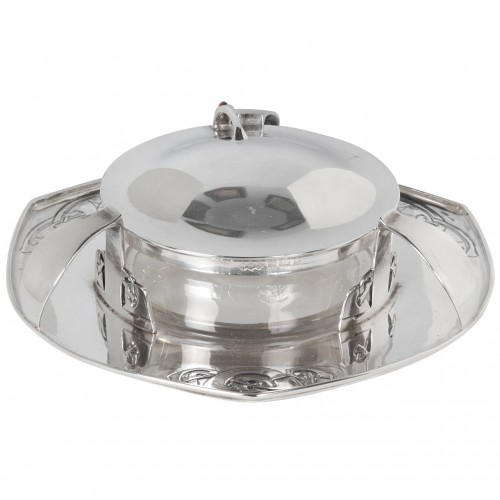
Archibald Knox / Liberty & Co. Rare Sterling and Opal caviar server 1904
ARCHIBALD KNOX (1864-1933) UK
LIBERTY & COMPANY London, UK
Cymric tri-handled covered server 1904
Sterling silver with repoussé Celtic knot motifs and three buttress handles; the handle of the domed lid inset with a jelly opal, cylindrical crystal bowl.
Marks: No. 5199, Liberty & Co., CYMRIC and Birmingham assay marks for 1904 (all the marks appear both on the underside of the base and on the cover)
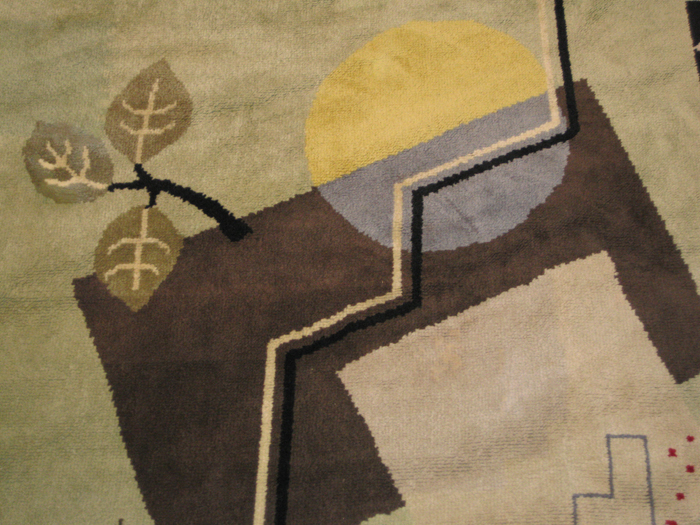
Ingegerd Torhamn Art Deco / Modernist rug c. 1930 (Exhibited: Stockholm Exhibition 1930)
INGEGERD TORHAMN (1898-1994) Sweden
Modernist rug c. 1930
Hand-knotted wool
Signed: it (Ingegerd Torhamn) lower left
Exhibited: Stockholm Exhibition 1930, Stockholmsutställningen 1930, Villa 42; V.I.P. in Swedish Design, Kalmar Konstmuseum 1996.
Illustrated: Katalog Över Bostadsavdelningen: Stockholms Utställningen 1930 (illustrated in situ) Stockholm Exhibition1930 (Stockholm: Tryckt Hos Bröderna Lagerström, Boktryckare, 1930) p. 149
Drawing illustrated: V.I.P. in Swedish Design: Axel Larsso, Ingegerd Torhamn, Inga Linden & Paula Sokolow, Arkiv for Svensk Formgivning, Kalmar Konstmuseum
For more information see: Svenska Textilier 1930, Stockholm 1930, Nils G. Wollin, plate nr. 50
Dimensions: 7’2” square
One of the ten rugs of her designs (including this rug as part of the music room) exhibited at the important Stockholm Exhibition of 1930 is now in the permanent collection of the Nationalmuseum in Stockholm.


 @hd_jewels