Product Description
Andy Warhol, “Andy Warhol: Published on the Occasion of The Andy Warhol Exhibition at Moderna Museet in Stockholm February to March 1968” 1970

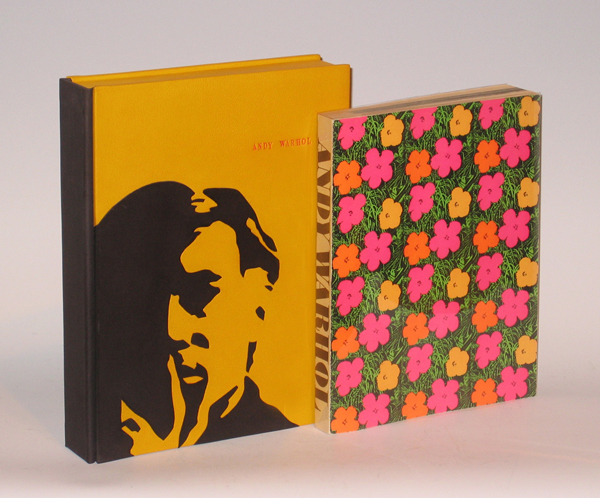
ANDY WARHOL (1928-1987) New York, NY
“Andy Warhol: Published on the Occasion of The Andy Warhol Exhibition at Moderna Museet in Stockholm February to March 1968” 1970

Published by Moderna Museet Stockholm, Boston Book and Art, Boston, MA, 1970. Printed in Sweden.
Dimensions:
Book: H: 10 3/4” x W: 8 5/16”
Custom leather box: H: 12 1/8” x W: 9 7/16” x D: 2”
Custom cloth case: H: 13” x W: 10” x D: 2 11/16”
One of the rarest of Warhol exhibition catalogs. This is the 3rd edition of the catalog that was published for a major exhibition of the late artists work that was held in Stockholm. There is no text except for some of Warhol’s famous quotes and 100’s of black & white photos of his work and wonderful photos of his superstars, life and work at the factory and stills and candids from his influential underground films. The covers are illustrated with full color photos of his famous flower silk screens.
Andy Warhol, “Andy Warhol: Published on the Occasion of The Andy Warhol Exhibition at Moderna Museet in Stockholm February to March 1968” 1970
ALBERTO MARCONETTI Milan, Italy (active Argentina)
Armchairs (Two available) c. 1960’s
Oak, painted iron, leather strapwork and seat
Marks: by Alberto Marconetti (script signature)
H: 40 1/2” x W: 27” x D: 21”
Seat height: 19″
Price: $7,450 (each)
This pair of armchairs nods to the influence of such Italian designers as Carlo Bugatti and Carlo Mollino yet are their own unique creation. They have an unusual anthropomorphic quality in that the frame suggests a skeletal structure. In addition, the leather strapwork, iron loops and hooks allude to the equipage of the ancient Roman equestrian order.
BRASSAÏ (1899-1984) Austria-Hungary
“Transmutations 1934-35” 1967
Published by Lacoste: Galerie Les Contards, France.
12 gelatin silver prints each flush-mounted to a presentation folder with printed sequential number and title, with colophon contained in a linen covered, velvet lined clamshell folio with gilt lettering on the spine.
Signed and numbered 32 in ink on the colophon. This work is from an edition of 100. The titles include: I. Femme-fruit; II. Sevillane denudee; III. Odalisque; IV. Femme-mandoline; V. Femme-amphore; VI. Fille de Joie se Deshabillant; VII. Visage mineral; VIII. Tentation de Saint Antoine; IX. Jeune fille revant; X. Offrande; XI. Femme aux voiles; XII. Fete foraine.
Dimensions:
Book: H: 15 ½” x W: 12” x D: 1 ½”
Custom leather box: H: 17 ¾” x W: 13 ½” x D: 4 ½”
Custom silk slipcase: H: 18 ¾” x W: 14 ¼” x D: 6”
HENRI MATISSE (1869-1954) France
“Verve” Vol. IX No. 35 & 36 1958
Revue artistique et littéraire paraissant quatre fois par an
Created and editioned at the Mourlot Studio, Paris.
Published by E. Tériade, Paris 1958.
Dimensions:
Book: H 14 1/2” x W: 10 11/16”
Custom leather box: H: 15 13/16” x W: 11 5/8” x D: 2 1/16”
Custom linen case: H: 16 3/4” x 12 5/16” x D: 2 5/8”
Andrea Branzi (1938 – ) Zabro, Italy.
“Cucus” chair c.1985
Lacquered wood, tree branches
Illustrated: Domestic Animals: The Neoprimative Style Andrea and Nicoletta Branzi, (London, 1987) n.p.; Designed by Architects in the 1980s, Julie Capella and Quim Larrea, Barcelona, 1987, p. 37; Anne Bony, Paris Les années 80, 1995, p. 520; Charlotte and Peter Fiell, 1000 Chairs, Cologne, 2000, p. 588
H: 42 3/4″ x W: 19 3/4″ x D: 24″
Price: $19,000
The “Cucus” chair was part of the “Domestic Animals” series
designed in 1985/86 by Andrea Branzi for Zabro.
Andrea Branzi's “Domestic Animals” series was designed in 1985 and 1986 for the Italian firm Zabro. Designs were later also manufactured by Zanotta. Andrea Branzi created “Domestic Animals” in collaboration with Nicoletta Branzi, who produced limited edition art clothing for this series. The “Neoprimitive” style in which this collection has been rendered utilizes natural materials such as sticks to create an object that brings archetypal symbols into the home to produce emotional effects. These objects combine technology and nature and the symbols and codes that these entail demonstrating that “a hybrid love between different creatures is possible.” (Branzi, Domestic Animals, 1987, n.p.) With these objects Branzi aims to “domesticate” technological inventions so as to make them a positive presence in man's life.
“The difference between a domestic animal and a trained (or tamed) one lies in the fact that the latter is the outcome of an unnatural and violent attitude, while the domestic animal establishes the dream of a loving relationship with man.” (Branzi, Domestic Animals, 1987, n.p.)
Andrea Branzi, architect and designer, born in Florence in 1938, where he graduated in 1967, lives and works in Milano. From 1964 to 1974 he was a partner of Archizoom Associati, first vanguard group internationally known, whose projects are preserved at Centro Studi e Archivio della Comunicazione in Parma and at Centre Georges Pompidou in Paris.
Since 1967 he works in the fields of industrial and research design, architecture, urban planning, education and cultural promotion.He is Professor at the Third Faculty of Architecture and Industrial Design of Politecnico di Milano.