Alberto Marconetti / Italian Post-War Design Armchairs c. 1960’s
ALBERTO MARCONETTI Milan, Italy (active Argentina)
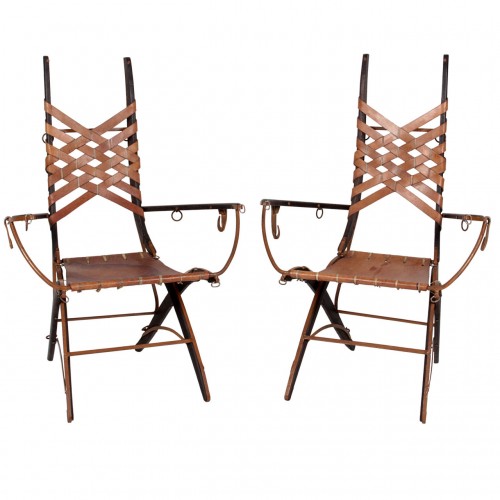
Armchairs (Two available) c. 1960’s
Oak, painted iron, leather strapwork and seat
Marks: by Alberto Marconetti (script signature)
H: 40 1/2” x W: 27” x D: 21”
Seat height: 19″
Price: $7,450 (each)
This pair of armchairs nods to the influence of such Italian designers as Carlo Bugatti and Carlo Mollino yet are their own unique creation. They have an unusual anthropomorphic quality in that the frame suggests a skeletal structure. In addition, the leather strapwork, iron loops and hooks allude to the equipage of the ancient Roman equestrian order.
Jan et Joel Martel / Primavera French Art Deco Courting Fantail Pigeon Sculptures c.1930
JAN ET JOËL MARTEL (1896-1966) France
PRIMAVERA Paris
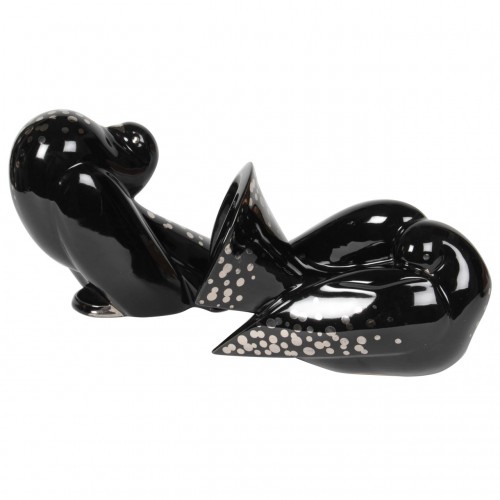
Pair of courting Faintail Pigeon Sculptures c.1925-30
Black glazed earthenware with silver / platinum decorative dot motif.
Marks: PRIMAVERA FRANCE, 12684
For related model: The Art Deco Style in Household Objects, Architecture, Scupture, Graphics, Jewelry, Theodore Menten (New York: Dover, 1972), p. 179.
For more information see: Joël et Jan Martel: sculpteurs 1896-1966, Christophe Vital, et al. (Paris: Gallimard / Electa, 1996), pp. 127-9
H: 8 1/16” x L: 9” x D at tail: 5 1/4”
H: 7 1/8” x L: 10” x D at tail: 5 1/4”
Jan & Joël Martel (the Martel Brothers/Twins, born in Nantes on 5 April 1896, both died in 1966)
The twin Martel sculptors were among the founding members of Union des Artistes Modernes, and their original works include ornamental sculptures, statues, monuments and fountains displaying characteristics typical of the Art Déco and Cubist periods. The brothers took part in a number of Paris exhibitions including the Salon des Indépendants, Salon d’Automne, Salon des Tuileries and the Exposition des Arts Décoratifs in 1925. In 1932, they created the Claude Debussy monument which sits on the boulevard Lannes in Paris. Between 1924-1926, Robert Mallet-Stevens designed a studio for the Martel twins at 10 Rue Mallet-Stevens in Paris’ 16th Arrondissement.
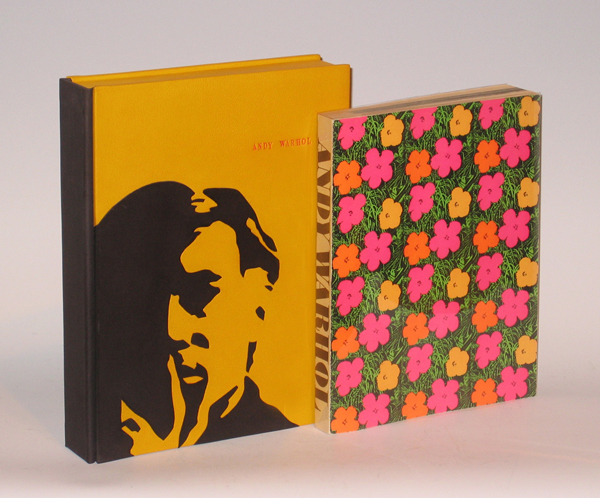
Andy Warhol, “Andy Warhol: Published on the Occasion of The Andy Warhol Exhibition at Moderna Museet in Stockholm February to March 1968” 1970
ANDY WARHOL (1928-1987) New York, NY
“Andy Warhol: Published on the Occasion of The Andy Warhol Exhibition at Moderna Museet in Stockholm February to March 1968” 1970
Published by Moderna Museet Stockholm, Boston Book and Art, Boston, MA, 1970. Printed in Sweden.
Dimensions:
Book: H: 10 3/4” x W: 8 5/16”
Custom leather box: H: 12 1/8” x W: 9 7/16” x D: 2”
Custom cloth case: H: 13” x W: 10” x D: 2 11/16”
One of the rarest of Warhol exhibition catalogs. This is the 3rd edition of the catalog that was published for a major exhibition of the late artists work that was held in Stockholm. There is no text except for some of Warhol’s famous quotes and 100’s of black & white photos of his work and wonderful photos of his superstars, life and work at the factory and stills and candids from his influential underground films. The covers are illustrated with full color photos of his famous flower silk screens.
LAURE ALBIN-GUILLOT (1879-1962) France
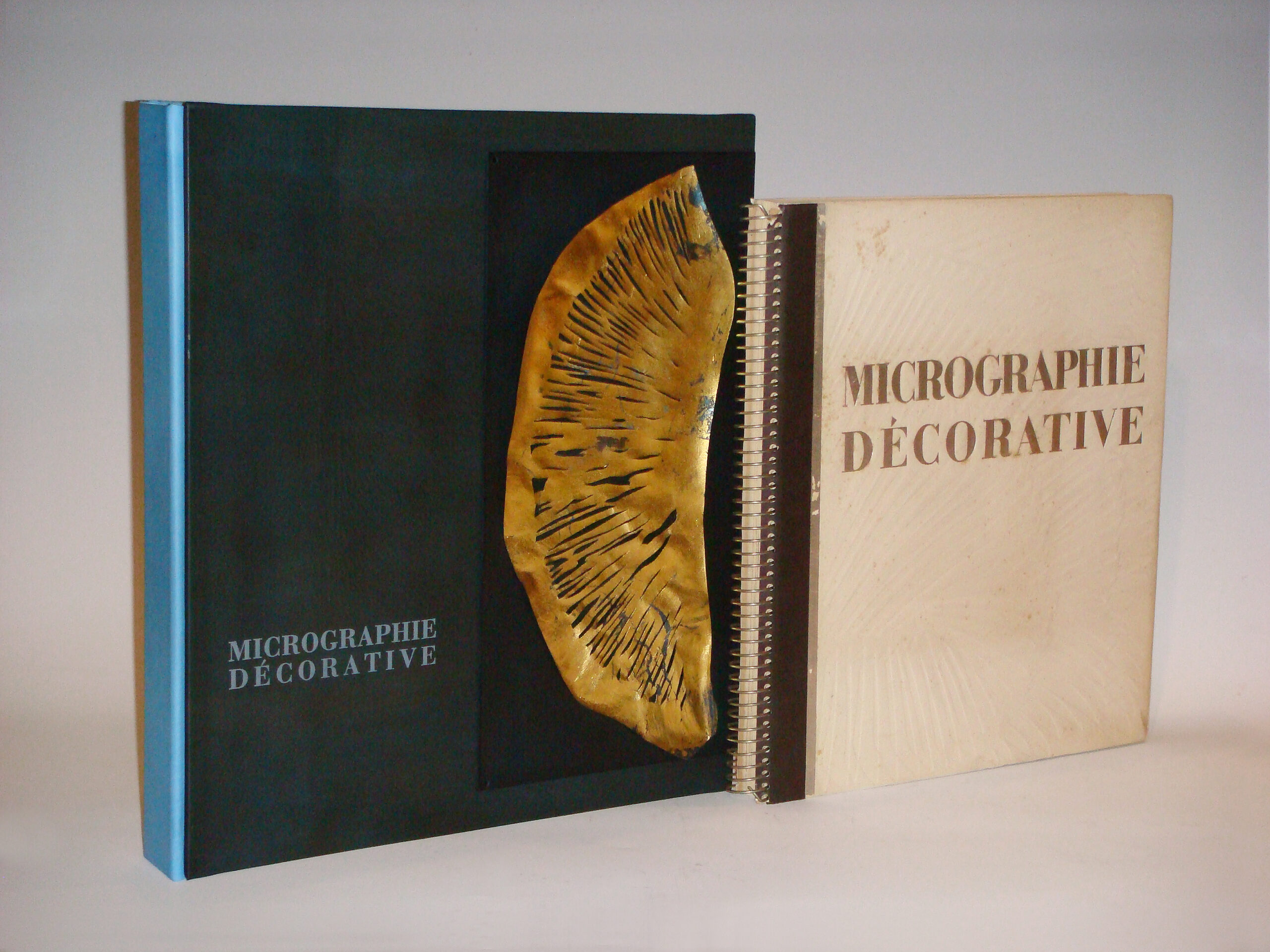
Micrographie Decorative 1931
Preface by M. Paul Leon, 20 photogravure plates in a variety of inks and papers, including silver and gold foil, all tipped-in and matted, text in French, limited to 300 numbered copies, folio, spiral-bound bds.
Published by Draeger Freres, Paris.
Micrographie Décorative was created as a tribute to Laure's husband after his death.
Dimensions:
Book: H: 16 ¾” x W: 15” x D: 1 3/8”
Custom leather box 2008: H: 19” x W: 16 5/8” x D: 2 5/8”
Custom silk slipcase: H: 20 1/8” x W: 17 ¼” x D: 4”
Albin-Guillot, Laure (née Meffredi; 1879-1962), French photographer who became interested in photography soon after her marriage in 1897 to the physician/scientist Dr Albin Guillot. At first, her husband's circle of friends, which included architects, writers, and politicians, provided her with portrait subjects. During the 1920s and 1930s she was engaged by the design precepts of the New Vision, and produced more sharply focused close-ups of objects for clients like Bon Marché and Renault. At the same time, she continued to create soft-focus pictorialist nudes that appeared in artistic photography journals and as illustrations in volumes of poetry. Many of her images were exhibited during the 1920s and reproduced in Arts et métiers graphiques. At a time when many photographers were indifferent to the quality of prints intended for reproduction, Albin-Guillot sought to invest hers with artistry and individuality. Engrossed by her husband's lifelong research in micrography, in 1931, in collaboration with Pierre Fresson, she published in his memory a volume of 24 photomicrographs of crystals, exquisitely printed on various coloured and metallic papers. Later, she and Fresson also collaborated on similar works, which were used as decoration on the liner Normandie.


 @hd_jewels