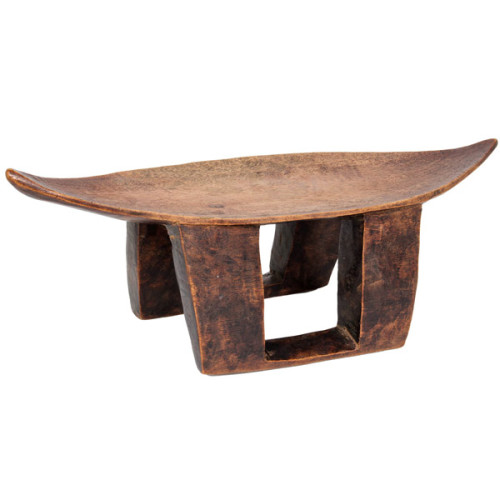
Somalia African Tribal Wood Headrest, Early to mid 20th Century
SOMALIA
Head rest early to mid 20th Century
Carved wood with rich natural patina
H: 4 3/4″ x W: 13″
Headrests are used by both Somali men and women while resting or sleeping. It is popularly believed that the headrest serves a protective function by elevating the head off the ground during sleep, thereby preventing any possible attack by snakes or scorpions. Men’s headrests, such as this one, generally feature a smaller base that makes them somewhat unstable to sleep on, while the rectangular bases of women’s headrests are usually more stable. Scholars suggest that this instability is purposeful as it prevents the user from falling into a deep sleep while guarding the herds at night. It is in this sense that the headrest itself has become a symbol of vigilance among Somali nomads. Headrests also play an important role in the nuptial ceremonies of Somali nomads. On his wedding night, the groom places the tubash (a sum of money) under the bride’s headrest. The morning after the marriage is consummated, the bride will use this money to purchase an amber necklace, the symbol of her new status.
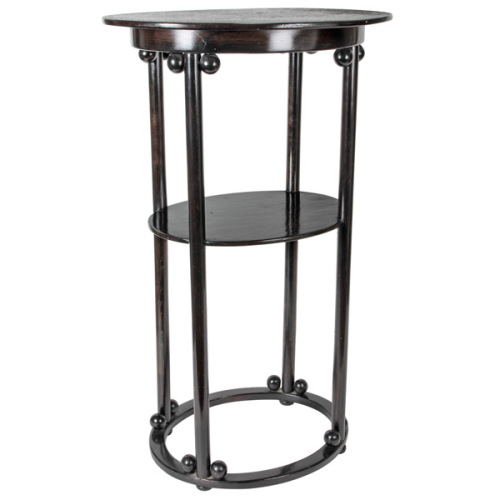
Josef Hoffmann Table for J & J Kohn, Vienna Secession c.1915
JOSEF HOFFMANN (1870-1956) Austria
JACOB & JOSEF KOHN Vienna, Austria
Oval occasional table c.1915
Model no. 960/4
Ebony stained beech
Marked: original Jacob & Josef Kohn paper label
Illustrated: Jacob & Josef Kohn: Bentwood Furniture, der Katalog von 1916 (München: Verlag Dry, 1985), p. 69;
Against the Grain: Bentwood Furniture from the Collection of Fern and Manfred Steinfeld, Ghenete Zelleke, Eva B. Ottilinger and Nina Stritzler (Chicago: The Art Institute of Chicago, 1993) p. 88.
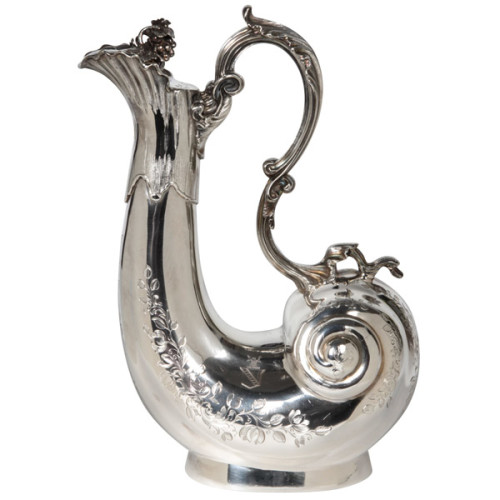
Silver-plate highly stylized classical ewer with various etched and applied floral details and an elegantly modeled double arch handle form
Marks: Heraldic Coat-of-Arms
H: 11″ x W: 8″ x D: 5″
This is a Rococo Revival inspired wine ewer that shows the design transition of the last quarter of the 19th Century and leading up to the curvaceous designs of the Art Nouveau Era. The classical form of this ewer has an ancient precedent as well.



 @hd_jewels