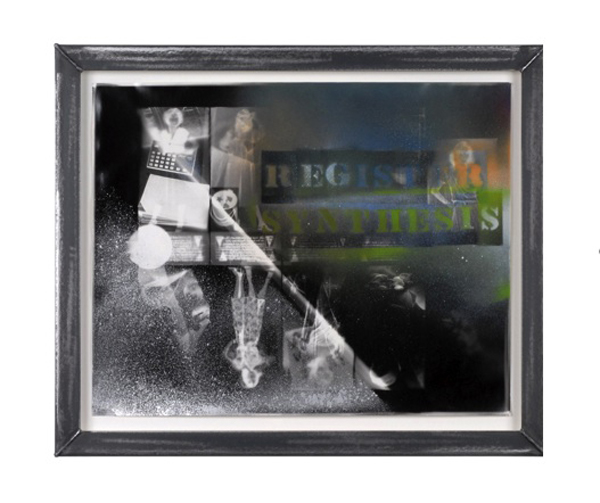
Thomas F. Barrow, Register Synthesis, Gelatin silver print photogram with applied spray paint, 1978
THOMAS F. BARROW (b. 1938) Kansas City, MO
Register Synthesis Photogram 1978
Gelatin silver print photogram with applied spray paint
Signed: Register Synthesis – 1978 – Thomas F. Barrow (in ink on back)
Exhibited: J.J. Brookings & Co. (San Jose, CA): Thomas F. Barrow: Inventories and Transformations, A Twenty Year Retrospective, Nov. 6 – Dec. 16, 1986. This exhibit occurred simultaneously with the following two museum shows: the San Francisco Museum of Modern Art (Nov. 6, 1986 – Jan 11, 1987) and the Los Angeles County Museum of Art (Feb. 26 – May 10, 1987).
Related photograph illustrated: Aperture: The New Vision: Forty Years of Photography, no. 87 (New York: Aperture Foundation, Inc., 1987), cover image.
Framed size: H: 19 5/8” x W: 23 7/16”
Thomas Barrow, American was born in Kansas City, Missouri. He studied at the Art Institute of Design in Chicago, Illinois and received his M.A. in 1967. At the George Eastman House, Barrow was the Assistant Director from 1971 to 1972 and served as the Associate Director of the University of New Mexico Art Museum from 1973 to 1976. Barrow started teaching photography in 1976 in the Art Department of the University of New Mexico and by 1985 he became the Acting Director of the University Art Museum. His Midwestern academic pedigree includes studying with Aaron Siskind at the Art Institute of Design in Chicago and with filmmaker Jack Ellis at Northwestern University in Evanston, IL. Barrow has received two NEA Photographers Fellowships in 1973 and 1978.
Barrow has produced a series of silver-gelatin photograms and then applied spray paint to the prints. These combine the feeling of a split-toned black and white print and at the same time appear as color-print photograms. He has produced a series of photograms entitled Disjunctive Forms. His images appear as surreal assemblages of various found and created objects superimposed with stencil text. Barrow works in the “academic” tradition—his pictures are deliberately and consistently experimental, highly intellectualized, scholarly in their concerns, and chock-full of references to the work of other artists.
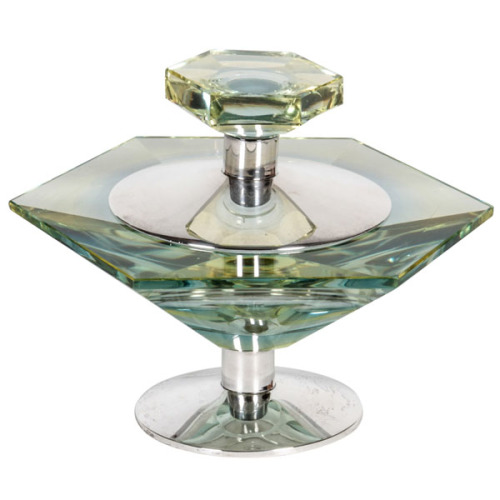
Hexagonal green-tinted lead crystal covered dish / tazza with lid in a stepped jewel-like form mounted with a silver lid and footed base silver
Marks: WMF logo, moon, crown, 800
For more information see: Wilhelm Wagenfeld und die Moderne Glasindustrie,Walter Scheiffele (Stuttgart: Verlag Gerd Hatje, 1994); WMF Ikora Metall / Metalwork, Carlo Burschel and Heinz Scheiffele (Stuttgart, Germany: ARNOLDSCHE, 2006).



 @hd_jewels