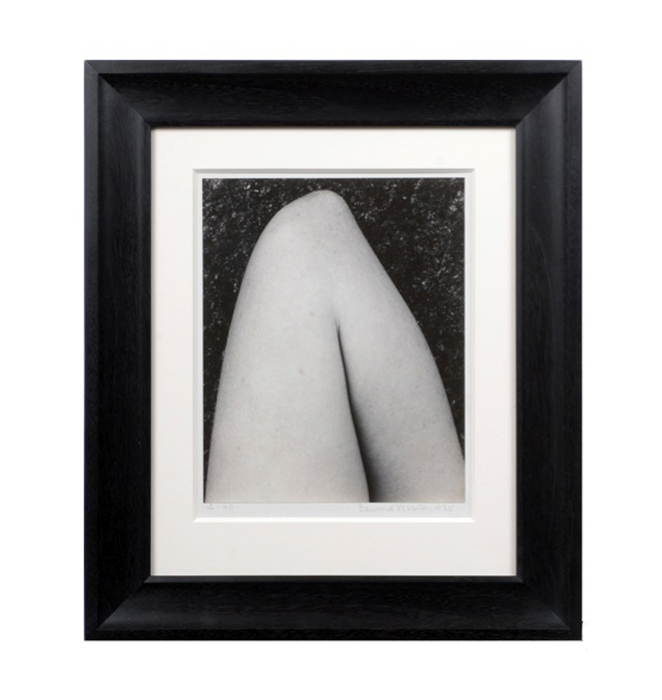
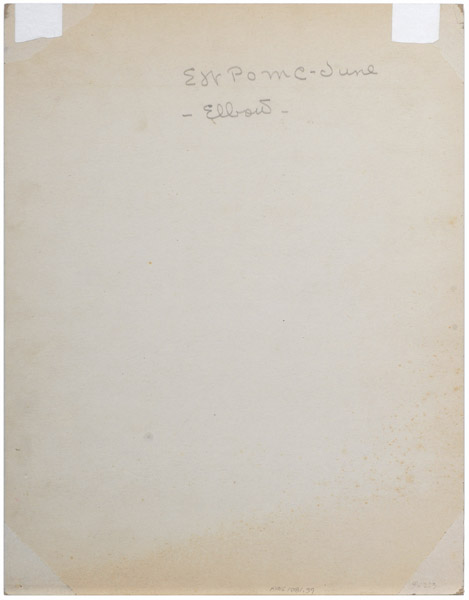
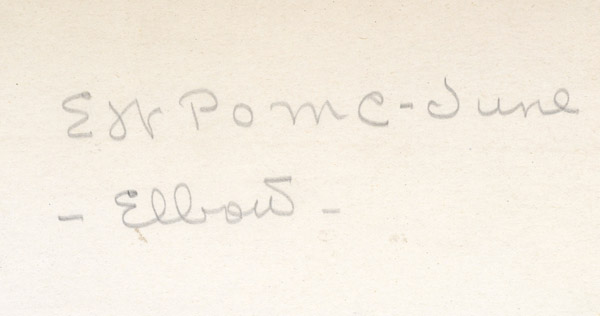
Signed: 12-40. Edward Weston 1935 (pencil below photo)
Framed H: 17” x W: 14 9/16”
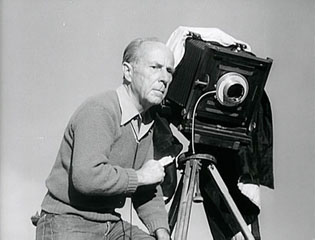
Edward Henry Weston was an American photographer, and co-founder of Group f/64. Most of his work was done using an 8 by 10 inch view camera. Weston was renowned as one of the masters of 20th century photography. His legacy includes several thousand carefully composed, superbly printed photographs that have influenced photographers around the world for 60 years. Photographing natural landscapes and forms such as artichoke, shells, and rocks, using large-format cameras and available light. The subtle use of tones and the sculptural formal design of his works have become the standards by which much later photographic practice has been judged.
Ansel Adams has written: “Weston is, in the real sense, one of the few creative artists of today. He has recreated the matter-forms and forces of nature; he has made these forms eloquent of the fundamental unity of the world. His work illuminates man’s inner journey toward perfection of the spirit.”
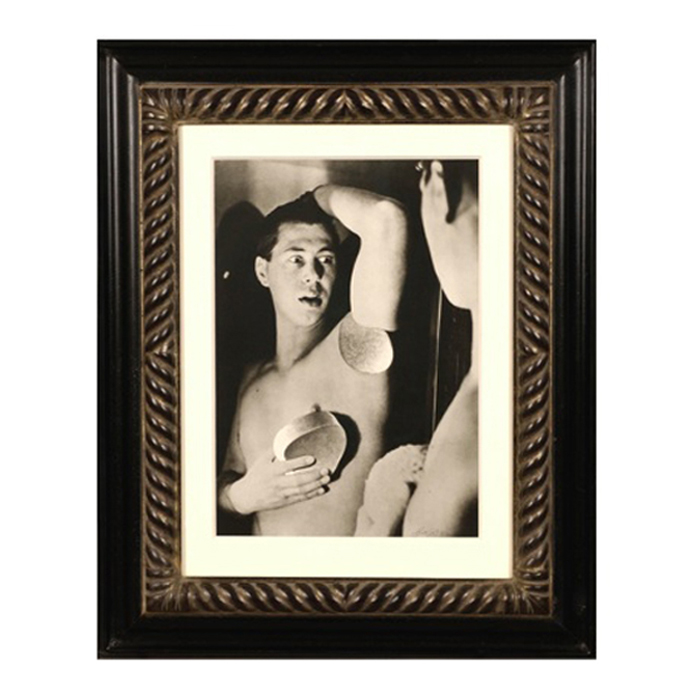
Herbert Bayer, Self Portrait, Gelatin silver print , 1932, printed later
HERBERT BAYER (1900-1985) Austria
Self portrait 1932 (printed later)
Silver gelatin print
Edition: 28/40
Signed: bayer 32 (in ink on bottom right corner)
Provenance: Kennedy Gallery, New York
H: 13 7/16” x W: 9 ½”
Framed size: H: 21 ½” x W: 17 ½”
Price: $16,000
Herbert Bayer (1900 – 1985) was an Austrian graphic designer, painter, photographer, and architect. Bayer apprenticed under the artist Georg Schmidthammer in Linz. Leaving the workshop to study at the Darmstadt Artists’ Colony, he became interested in Walter Gropius’s Bauhaus manifesto. After Bayer had studied for four years at the Bauhaus under such teachers as Wassily Kandinsky and László Moholy-Nagy, Gropius appointed Bayer director of printing and advertising. In the spirit of reductive minimalism, Bayer developed a crisp visual style and adopted use of all-lowercase, sans serif typefaces for most Bauhaus publications. Bayer is one of several typographers of the period including Kurt Schwitters and Jan Tschichold who experimented with the creation of a simplified more phonetic-based alphabet. Bayer designed the 1925 geometric sans-serif typeface, universal, now issued in digital form as Architype Bayer that bears comparison with the stylistically related typeface Architype Schwitters.
In 1928, Bayer left the Bauhaus to become art director of Vogue magazine’s Berlin office. He remained in Germany far later than most other progressives. In 1936 he designed a brochure for the Deutschland Ausstellung, an exhibition for tourists in Berlin during the 1936 Olympic Games. In 1938 he left Germany and settled in New York City where he had a long and distinguished career in nearly every aspect of the graphic arts. In 1946 Bayer relocated again. Hired by industrialist and visionary Walter Paepcke, Bayer moved to Aspen, Colorado as Paepcke promoted skiing as a popular sport. Bayer’s architectural work in the town included co-designing the Aspen Institute and restoring the Wheeler Opera House, but his production of promotional posters identified skiing with wit, excitement, and glamour. Bayer would remain associated with Aspen until the mid-1970s. Bayer gave the Denver Art Museum a collection of around 8,000 of his works. In 1959, he designed his “fonetik alfabet”, a phonetic alphabet, for English. It was sans-serif and without capital letters. He had special symbols for the endings -ed, -ory, -ing, and -ion, as well as the digraphs “ch”, “sh”, and “ng”. An underline indicated the doubling of a consonant in traditional orthography.
Size: H: 19” x W: 16 ½”; Size (with mat): H: 24” x W: 20”
Framed: H: 26 5/8” x W: 23 7/8”
Price: $6,500
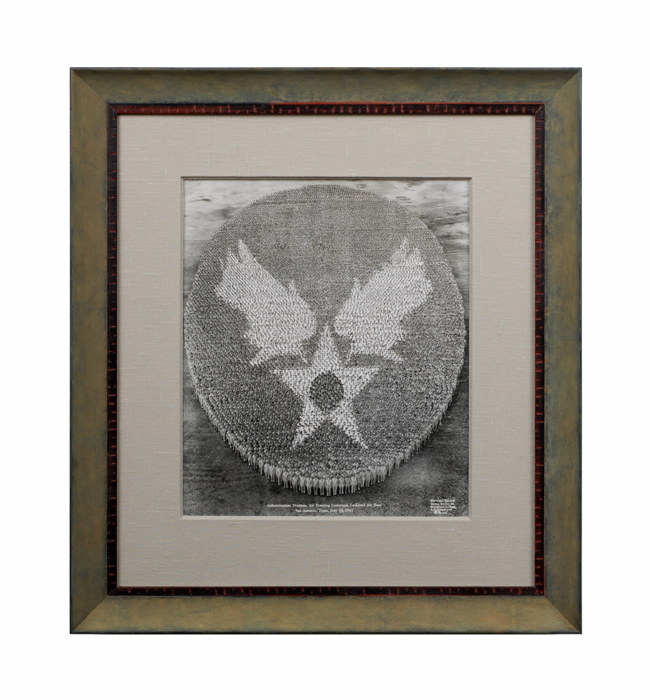
Known as the “unofficial photographer of America’s military,” Goldbeck conducted three-year tours to all of the major military bases in and outside of the United States until demand diminished for military group photos after World War II. He pushed the limits of his craft by working with larger and larger groups in striking designs. For his record setting group shot, in which 21,765 men were arranged to represent the Air Force insignia, he spent more than six weeks building a 200-foot tower and making blueprints of the formation and attire of his subjects. The photograph was subsequently featured in Life magazine and became the most frequently reproduced of his prints.
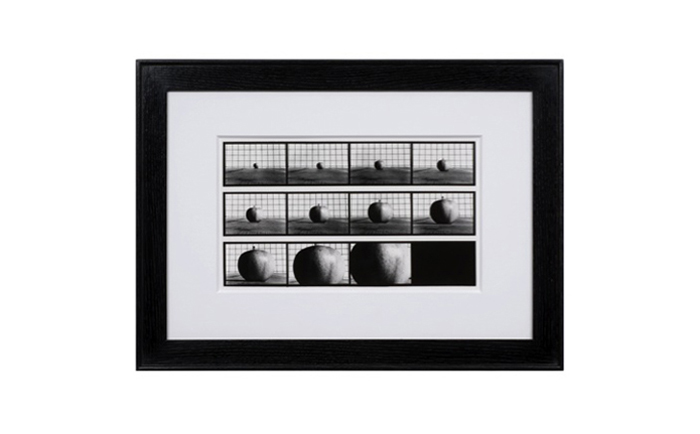
Marion Faller & Hollis Frampton, Apple Advancing, Gelatin silver print, 1975
MARION FALLER USA
HOLLIS FRAMPTON USA
Apple Advancing 1975
Signed: 782. Apple advancing [var. “Northern Spy”] from “Sixteen Studies from Vegetable Locomotion,” 1975 by Marion Faller & Hollis Frampton) on back of photograph; Marion Faller Hollis Frampton (in script on the bottom of the back of the photograph)
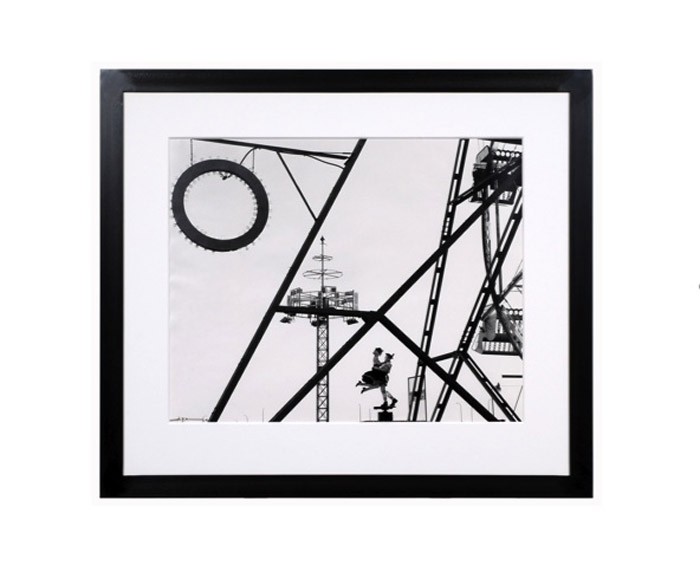
Grant Mudford, Long Beach, Gelatin Silver Print 1979
GRANT MUDFORD (1944- ) Australia
Long Beach 1979
Gelatin silver print
Signed: Long Beach 1979, LB-24/2 (in pencil on back); Grant Mudford 1980 (script in ink)
Framed size: H: 28 ¼” x W: 32 7/16”
Price: $29,000
“Since he moved to Los Angeles from Australia in the late 1970s, Grant Mudford has composed photographs that crisply examine the streamlined geometries of West Coast architecture and landscape. Mudford has zeroed in on the abstract formal relationships lurking within the designs of gas stations, strip malls and apartment buildings. The geometrical arrangements highlighted in his photographs of the masterful modernist structures of Rudolf Schindler and Craig Ellwood have disclosed a link between their midcentury architecture and the contemporaneous hard-edge abstractions of L.A. painters John McLaughlin and Lorser Feitelson.” – Art in America, “Grand Mudford at Rosamund Felsen, September 2003


 @hd_jewels