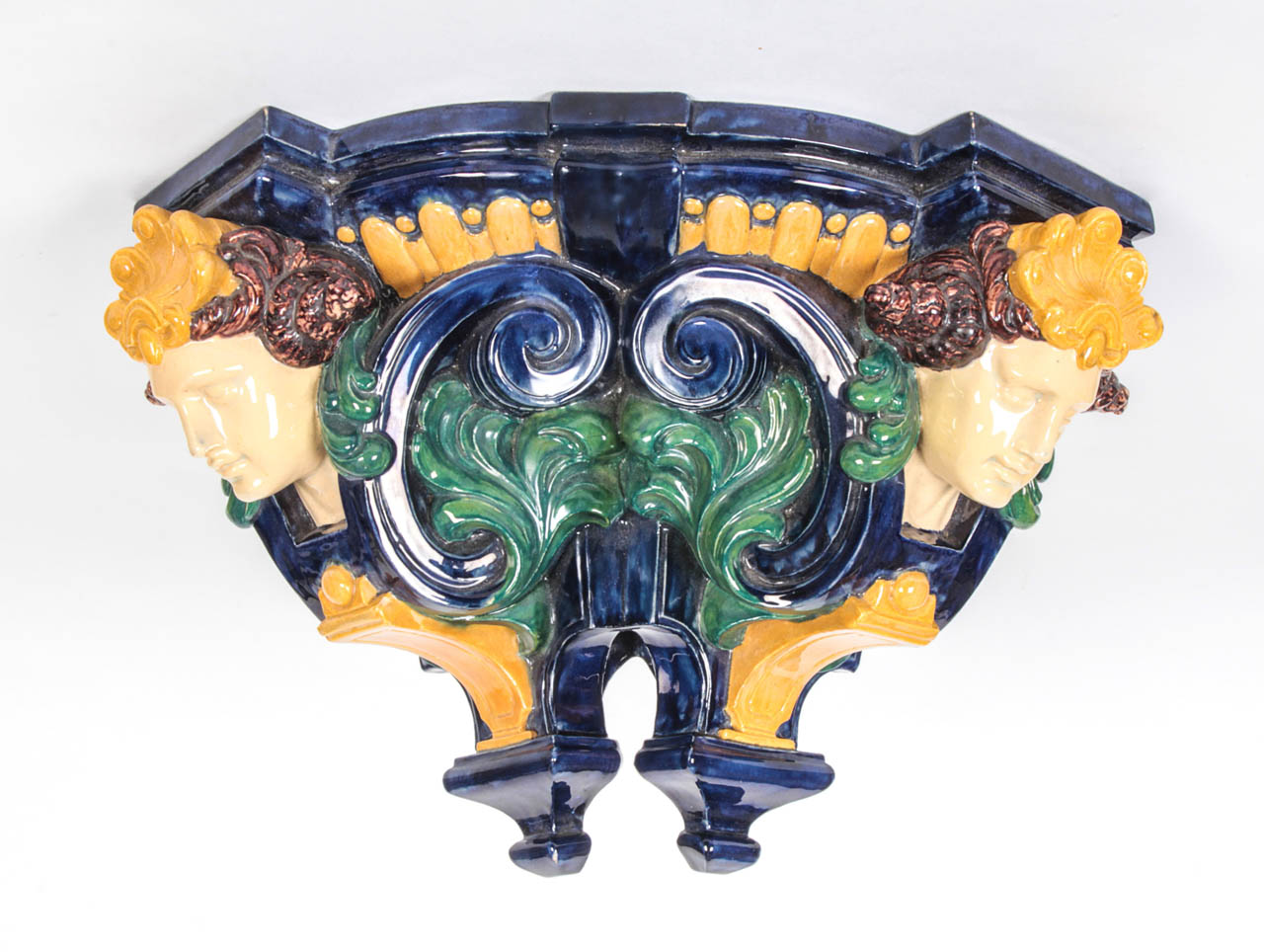
Eugene Schopin French Renaissance Revival Style Majolica Wall Shelf c.1872
More Information
Eugene Schopin, French Renaissance Revival Style Majolica Wall Shelf c.1872
Eugene Schopin (1831-1893) Montigny-sur-Loing, France.
Renaissance-Revival style Majolica wall shelf, circa 1872.
Hand modeled and cast ceramic with highly stylized caryatids and floral details glazed with rich cobalt blue, green, gold and cream colored glazes.
Marks: M-S-L (Montigny-sur-Loing), RA.
H: 8 ½” x W: 14” x D: 6 ¾”.
Eugene Schopin founded his ceramic factory in Montigny-sur-Loing in 1872. Painters like Jean-Baptiste Corot, Eugène Thirion (1839-1910), Adrien Schulz (1851-1931), Numa Gillet (1868-1940) and Lucien Cahen-Michel (1888-1980) were attracted to this area by the beauty of the landscape and light. Eugene Schopin collaborated with these artists to create a range of models inspired by Impressionism and decorated according to the new demands of the public.
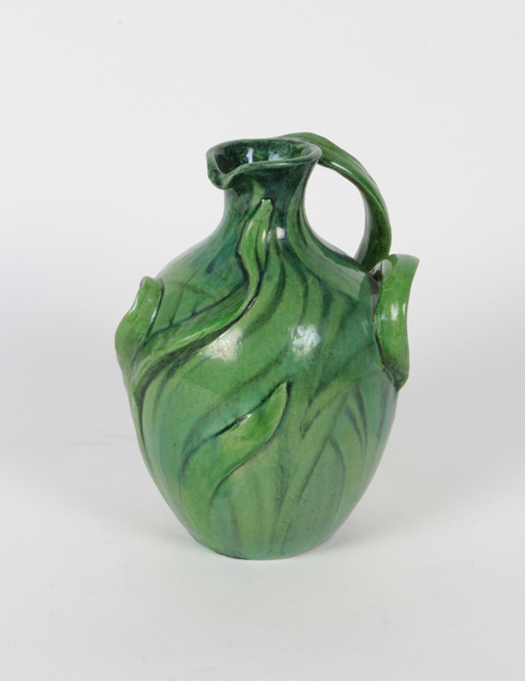
Edmond Lachenal French Art Nouveau Green glazed pitcher / vase form c. 1900
EDMOND LACHENAL (1855-1930) Paris, France
Green glazed pitcher / vase form c. 1900
Marks: E LACHENAL (impressed and glazed in a rectangle on base)
For information on Edmond Lachenal see:”Edmond Lachenal”, Fritz Minkus, Kunst und Kunsthandwerk, IV (1901) pp.390-98; La Céramique Art Nouveau, Edgar Pelichet and Michèle Duperrex (Lausanne: Les Éditions du Grand-Pont, Switzerland, 1976) pp. 66,71,74,78,83,112,115; “l’Atelier Lachenal à la galerie Georges Petit “ in Les Echoes d’Art” (1933), p. Vll; Art Nouveau: Belgium & France, exh. cat. Yvonne Brunhammer et al. (Houston, TX: Institute for the the Arts, Rice University, 1976), p. 48; Le Japonisme (Paris: Éditions de la Réunion des Musées Nationaux, 1988) cat no. 377, p. 321; Japonisme: the Japanese influence on western art in the 19th and 20th Centuries, Siegfried Wichmann (Parklane: New York, 1980) pp. 339, 349; cat. no. 920.
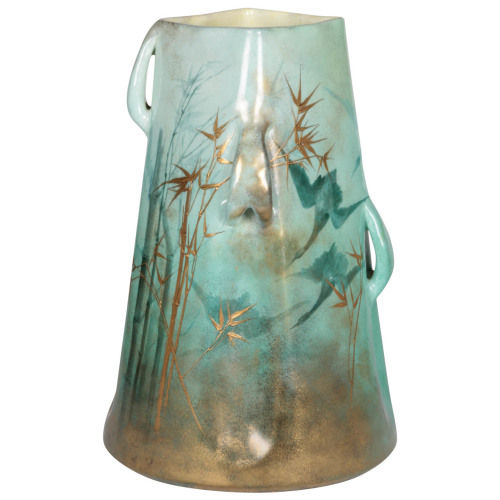
Clement Massier / French Art Nouveau “Bamboo and Flying Crane” Vase circa 1900
CLÉMENT MASSIER (1845-1917) France
MASSIER ART POTTERY Golfe Juan, France
“Bamboo and flying crane” vase c. 1900
Earthenware tapering form with applied handles, hand painted with bamboo and flying cranes with gilt motives and details
Marks: Clement Massier Golfe Juan (block impressed letters)
For more information and other works by the Massier family see: Lost Paradise: Symbolist Europe (Montreal, Quebec: The Montreal Museum of Fine Arts, 1995) p. 176, cat. 269; Jugendstil Art Nouveau, Floral and Functional Forms, Siegfried Wichmann (New York/Boston: Graphic Society/Little, Brown & Co., 1984) p. 45; Art Nouveau Belgium France. Exh. cat. Yvonne Brunhammer et al. (Houston, TX: Institute for the the Arts, Rice University, 1976); La Céramique Art Nouveau, Edgar Pélichet, Michèle Duperrex (Paris: La Bibliothèque des Arts, 1976) p. 89
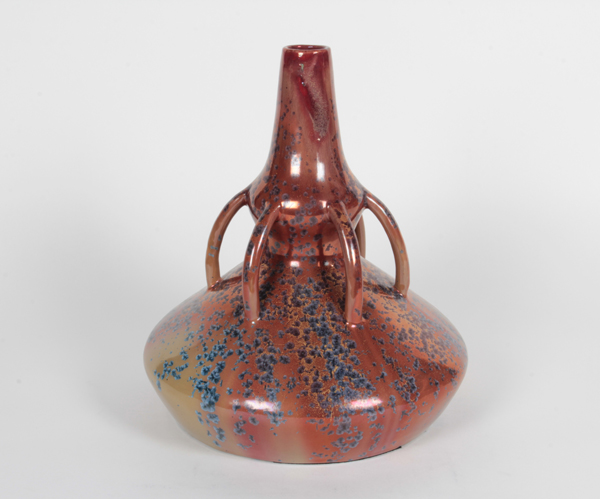
Olivier de Sorra / Pierrefonds (Count Hallez d’Arros) French Art Nouveau six branch vase c. 1900
OLIVIER DE SORRA
SOCIETE FAIENCIERE HERALDIQUE DE PIERREFONDS
Six-branch vase c. 1900
Copper color glaze with blue oxide flower crystallization
H: 11″ x Dia: 9″
Price: $7,250
The Societe Faienciere Heraldique de Pierrefonds pottery studio was founded in the village of Pierrefonds in 1903 by Count Hallez d’Arros and is renowned for it’s crystalline and flambe glazes
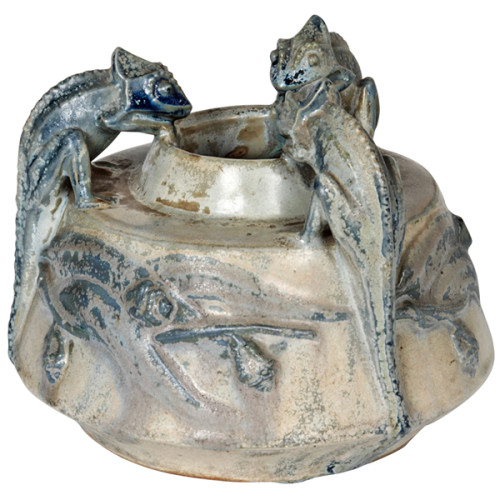
Charles Greber French Art Nouveau “Chameleons” vase c. 1905
CHARLES GREBER France
“Chameleons” vase c. 1905
Stoneware with crystalline-structure glaze in creamy white beige and blue tones with floral motifs and three full scale chameleons perched on the edge.
Marks: C. Greber (incised script)
H: 6 1/4″ x Dia: 7 1/2″
The potter-sculptor has awakened Darwin’s theory of evolution with this vase and has furthermore humanized these reptiles with an amusing sense of cameraderie.




 @hd_jewels