Product Description
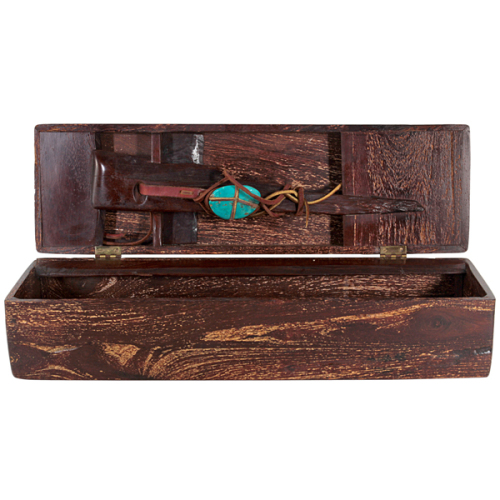
Giacinto Melillo, Naples “Etruscan Revival” 18K gold articulated pendant brooch, original fruit wood and velvet box c. 1870

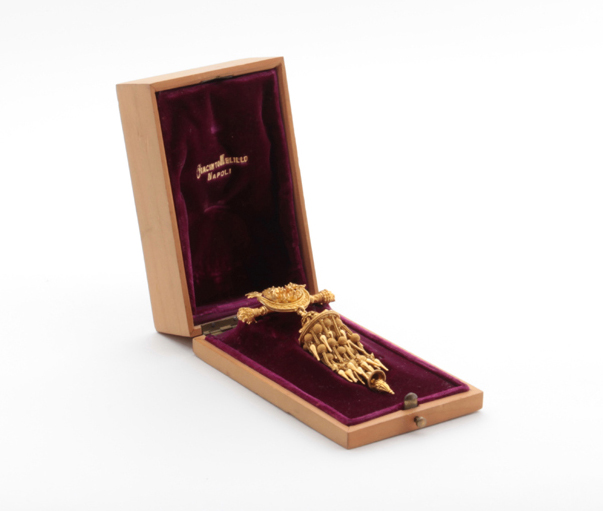
Giacinto Melillo, Naples “Etruscan Revival” 18K gold articulated pendant brooch, original fruit wood and velvet box c. 1870
HAYNO FOCKEN (1905-1968) Germany
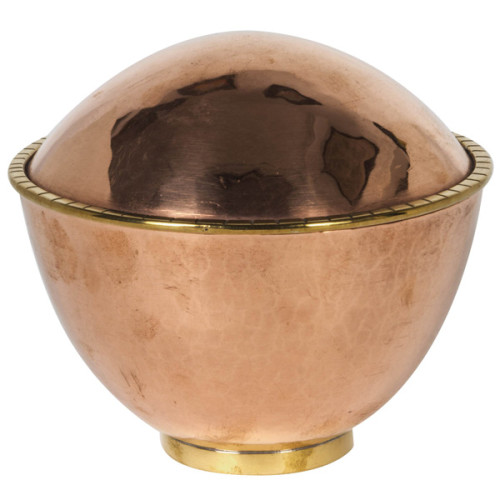
Round covered box c. 1935
Hand-wrought and hand-hammered copper with brass details
Marks under the foot: HF (conjoined monogram)
For other works by Hayno Focken see: Metallkunst: Vom Jugendstil zur Moderne (1889-1939), ed. Karl H. Bröhan (Berlin: Bröhan Museum, 1990), illus. 177, p. 183; Avantgarde Design 1880=1930,Torsten Bröhan & Thomas Berg (Köln, Benedict Taschen, 1994) p. 116; , (Berlin 1937) S. 43f, Abb. 37, Abb. S 128, S 146, Sl 243; Die Schaulade 15 Ausg. A (1939) Abb. S. 197, S. 204, S. 213; Die Schaulade 16 Ausg. A (1940) Abb. S. 44, S. 51., S. 54, S. 71, S. 83. S. 89; Die Kunst 84 (1941) S. 136, S. 139-39; Die Schaulade 17 (1941) Abb. S. 13, S. 41, S. 82, S. 229;
H: 4 ¼” x Dia: 4 7/8”
Hayno Focken (1905-1968) was an eminent German metal artist. He completed his training under Professor Karl Müller (1888-1972) at the design and arts school on Giebichenstein Castle in Halle (Saale), which was strongly tied to the ideals of the Deutsche Werkbund and the Bauhaus. In 1932 he established his own workshop in Lahr/Schwarzwald and continued his work until shortly before his death. His artistic work always stood out with a strong preference for large, organic forms, a similar manner of surface design and the same adherence to the principle of handicraft. Even his artist signet was modelled on the simple, square castle mark. In the 1950s he became one of those significant artists who had a major impact on contemporary metal design. The foundation of his creative work was a masterful understanding of proportions.
MELLERIO PARIS Italy/ France
Gyroscope cigarette box c.1930
French silver (950 silver standard) in a structural form of a gyroscope with a lever for an interior lifting mechanism, gilding
Marks: Mellerio Paris, 3776 D, head of Minerva French guarantee mark for 950/1000
H: 5 1/4″ x Dia: 4 1/4″
The renowned Mellerio family and their jewelry can be traced back to Lombardy, Italy as early as the 16th century. Some family members moved to Paris and became royal jewelers for Louis XIII. The revolutions of 1789 and 1848 interrupted their business and they moved to Madrid where they became the jewelers favored by Queen Isabel II. Later in the 19th century they returned to Paris where once again they prospered and participated in several international expositions including London (1862), Paris (1867, 1878 and 1900), and Vienna (1873). In the 20th century they exhibited at the renowned Paris 1925 Exposition des Arts Décoratifs in Paris and then in New York at the 1939 World’s Fair.
FRENCH ART DECO
LA MARQUISE DE SEVIGNE Paris
Covered chocolate box 1932
Black and red oil cloth, nickle plated brass
Illustrated in La Marquise de Sevigne Paris vintage ad (see pairing)
Dia: 10″ x H: 3″
CHINESE ART DECO
Covered Box c.1930
Cloisonne enamel in a fantasy archaic Chinese motif in red, yellow, black and white abstract designs on a bronze body with a blue enameled underside and a wood lined interior.
H: 1 5/8″ x D: 6 1/8″ x W: 6 1/8″