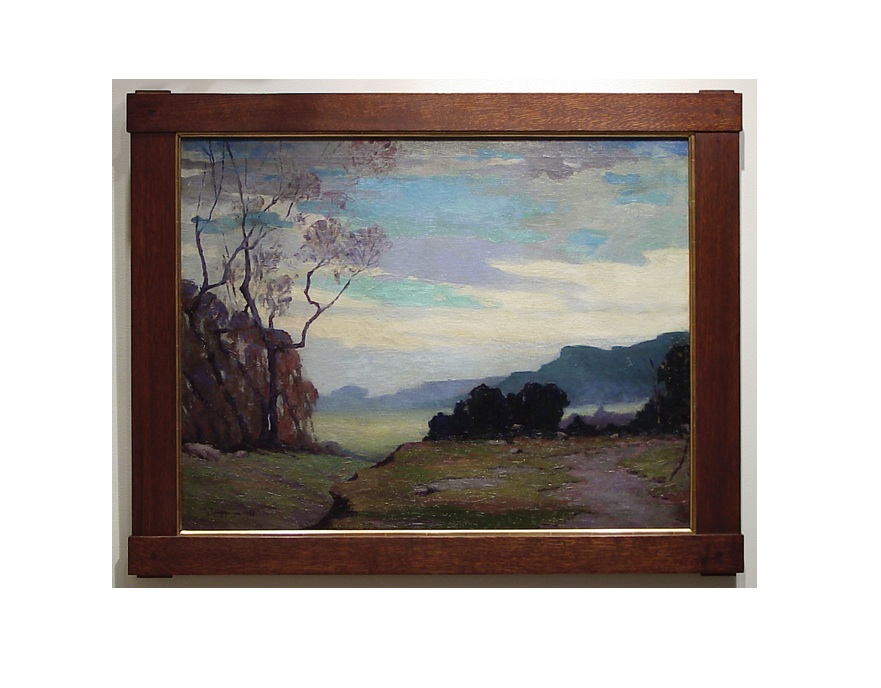
Gianni L. Cilfone “After the Rain” Oil on canvas 1928
GIANNI L. CILFONE (1908-1990) USA
“After the Rain” 1928
Oil on canvas, contemporary quarter sawn oak pegged frame with yellow gold filet.
Signed: Cilfone, 1928 (lower left corner)
Marks: Illinois Academy of Fine Arts, Second Annual Exhibition 1928, Gianni L. Clifone, 905 South Ashland Boulevard, “After the Rain,” $500 (paper label).
Exhibited: Illinois Academy of Fine Arts, Second Annual Exhibition 1928, Art Institute of Chicago 1928
For more information see: Who Was Who in American Art (Madison, Conn.: Sound View Press, 1985) p. 115.
Canvas: H: 30” x W: 40”
Framed: H: 38” x W: 48”
Gianni Cilfone emigrated with his family from San Marco, Italy to Chicago at the age of five. After studying at the Art Institute of Chicago, Cilfone took lessons from Hugh Breckenridge and John F. Carlson. His consistently won many prizes from the Chicago Gallery Association throughout the 1930s and 40s. He exhibited at the Hoosier Salon between 1949 and 1958, at the North Shore Arts Association, at the Association of Chicago Painters and Sculptors, and at the Art Institute of Chicago in 1919 and 1928.
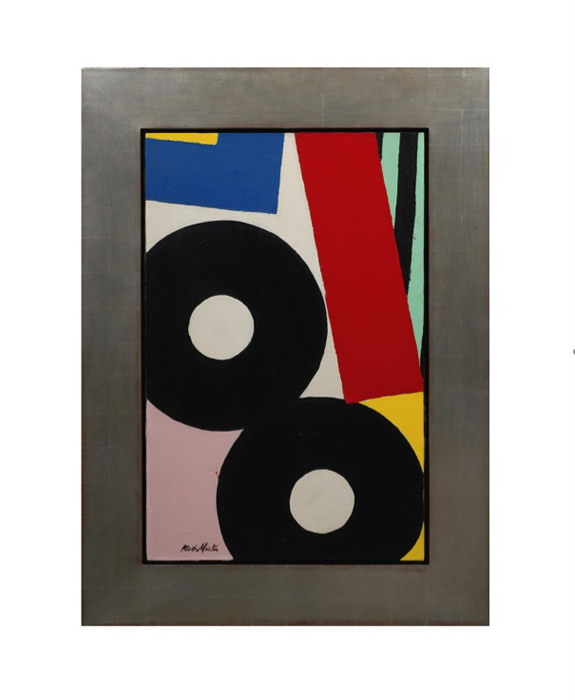
Knox Martin, “Eight”, Magna and oil on canvas 1958
KNOX MARTIN (1923-) USA
Eight 1958
Magna and oil on canvas
Signed: Knox Martin on lower left on front of canvas, Knox M on back of canvas
Marks: From: CORE, 38 Park Row, New York 38, NY, To: Martin, Knox, Eight, 1958, Magna/Oil, 30×40, 700. (paper label), Fischbach Gallery, 799 Madison Avenue, New York 21, Knox Martin, Eight, C.O.R.E., Price $700 (paper label), Mr. Ned L. Pines, 605 Park Ave., New York 21, NY (address label).
Exhibited: Fischbach Gallery, New York 1963; I. Jankowski Gallery, New York, 1975
Provenance: Personal Collection of the artist; Private Collection New York
Canvas: H: 40 1/4” x W: 26 1/4””
Framed: H: 52 3/8” x W: 38 3/8”
From 1957 to about 1964, the spirit of art in New York City was moving in directions for which Abstract Expressionism had not prepared us. By 1965, the strokes, swipes, drips, and splatters of New York painting had given way to cool, laconic representations of the most ordinary of ordinary objects. It was a transformation in artistic culture in which intellectual rewards replaced, or at least supplemented, visual ones, and the whole philosophical face of art was beginning to disclose itself in a particularly vivid way. I saw Knox Martin’s paintings as embodying this transformative moment. In them, I thought, the tension between the two rival philosophies of art could be felt. the way I saw them: they appeared at first glance to be collages, made of large, irregular, overlapping swatches of patterned cloth. Some of the swatches were striped, some appeared to be decorated with circles. It must be conceded that stripes and circles belong to the vocabulary of one kind of abstract art, while the irregular shapes, which felt as though they had been torn from bolts of material, belonged to another.
So one might properly claim that Martin was synthesizing an expressionist abstraction with a geometrical one. For me, however, Knox’s stripes and circles evoked the life of the circus: the striped tents, the loudly patterned costume of clowns. And Martin’s colors—pistachio, raspberry, banana—were festive and impudent. That is why I felt that the paintings referred to vernacular reality, as much so as Campbell Soup cans or Coca Cola bottles. The circus was a recurring theme in modernist art, and I thought it appropriate for late modernist painting to reduce the circus to patterned rags expressive of its raucous gaiety.
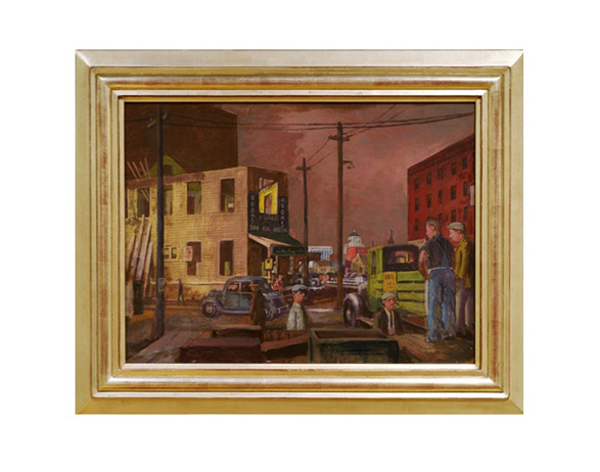
Gerrit V. Sinclair “Third Ward Milwaukee”, Oil on board, lemon gold frame c. 1940
GERRIT V. SINCLAIR (1890-1955) USA
Third Ward Milwaukee c. 1940
Oil on board, lemon gold frame
Signed: GV Sinclair (lower right corner on front of painting)
For more information see: Who Was Who in American Art (Madison, Conn.: Sound View Press, 1985) p. 571.
Painting H: 15” x W: 20”
Framed H: 20 7/16” x W: 25 7/16”
Price: $27,500
Gerrit V. Sinclair was born in Grand Haven, Michigan in 1890. He studied art at the School of the Art Institute of Chicago from 1910 to 1915. His most well known teachers at the Art Institute were John Vanderpoel and John Norton. In 1917 the artist enlisted in the Army Ambulance Corps and served in northern Italy and Austria. Scenes from his experience abroad are recorded in his works of the early 1920s. Following the war, Sinclair settled in Milwaukee, Wisconsin, where he became a member of the faculty of the Layton School of Art upon the school’s founding in 1920. He continued to teach at the Layton School and at the Oxbow Summer School of Art in Saugatuck, Michigan until his retirement in 1954. Sinclair is recognized both as an important artist and teacher from the Great Lakes region. During his lifetime Sinclair’s paintings were exhibited at the Salon d’Automne in Paris, the Salon Printemps in Paris, the Pennsylvania Academy of Fine Arts, the National Academy of Design, the Whitney Museum in New York, the New York Watercolor Club, the Brooklyn Museum, the Corcoran Gallery of Art in Washington D.C., the Carnegie Institute in Pittsburgh, the Art Institute of Chicago and in many other museums and galleries. He received numerous prizes and commissions for his work including a W.P.A. mural commission for the Federal Building in Wassau, Wisconsin. Sinclair was a member of Wisconsin Painters & Sculptors, Wisconsin Federation of the Arts and the Wisconsin Painting Museum. His style is a blend of realism and Impressionism but is clearly modern in its abstract concern for composition and color. Sinclair is best known for his regionalist paintings of rural and urban Wisconsin. His farm scene entitled ”Spring in Wisconsin” was exhibited at the 1939 World’s Fair in New York. Gerrit V. Sinclair died in Milwaukee, Wisconsin in 1955.
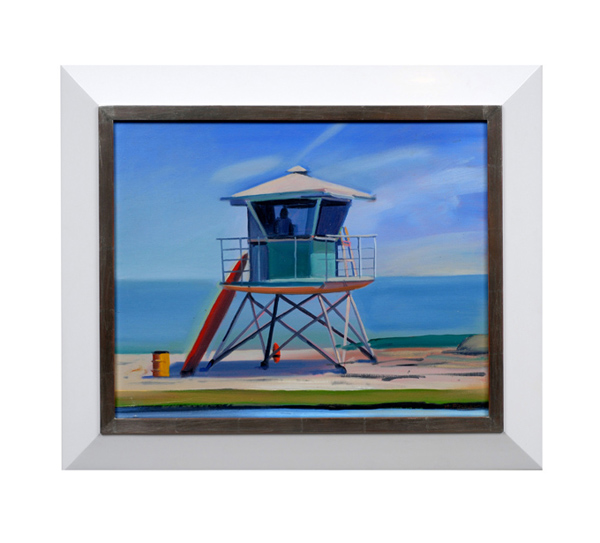
Hank Pitcher, “Life Guard Tower”, Oil on canvas c. 2002
HANK PITCHER (b. 1949) U.S.A.
“Life Guard Tower” c. 2002
Oil on canvas
Signed (on back)
For more information see: Hank Pitcher Surf, exhibit. cat. (Santa Barbara: Sullivan Goss Gallery, 2003); Surfboard Wax – A History, Jefferson “Zuma Jay” Wagner (Atglen, PA: Schiffer Publishing Ltd., 2005).
Canvas H: 15 7/8” x W: 19 7/8”
Framed: H: 21 3/8” x W: 25 3/8”
Pitcher’s surfboard paintings are the symbol of California beach culture…strong, definite, positive and euphoric statements about life in California. The surfboard’s power as totem is seen in its power to convey identity: surfer, Californian, Hank Pitcher. All are identifiable from this symbolic representation. Hank Pitcher is the voice of California culture. At the beach, in the surf, approaching the foothills, in the mountains, on the spit of Point Conception, in the crags of Big Sur, at a beach campfire in Santa Barbara, Pitcher paints the icons of California’s culture.
Hank Pitcher’s paintings are grounded in a particular sense of place. He was born in Pasadena, California on July 20, 1949, but his family moved to Isla Vista, near Santa Barbara, when he was two years old. When they came to Isla Vista it was an outpost on the beach, and Goleta was a farm town where kids rode their horses down the avenue to buy candy at the store. He was a football star at San Marcos High School and was recruited by big-name universities. Instead of football, he chose to attend the College of Creative Studies, an alternative program within the University of California at Santa Barbara (UCSB) where he now teaches painting. He splits his time between painting and surfing, pursuing each with the commitment and energy of a linebacker.


 @hd_jewels