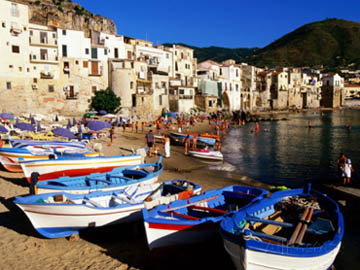
Joseph Raskin "Seaside scene" Oil on Canvas c. 1920 -1925
More Information
Joseph Raskin, Seaside scene, Oil on Canvas c. 1920 -1925
JOSEPH RASKIN (1897-1981) USA
Seaside scene c. 1920 -1925
Oil on canvas, gold leaf frame
Signed: Jos. Raskin (lower left)
For more information see: Who Was Who in American Art,
(Madison, Conn.: Sound View Press, 1985), p. 505
Canvas: 25 1/4” x 21 1/4”
Frame: 31 1/4” x 26 3/4”
Price: $35,000
Born in Nogaisk, Russia, Joseph Raskin made a name for himself as a painter in New York City, where he was also recognized as an etcher, teacher and writer. He studied at the National Academy of Design and, in 1921, received a fellowship from the Louis Comfort Tiffany Foundation. A member of the American Artists Congress, Raskin’s work was exhibited at the Schervee Gallery (Boston) in 1927, Tricker Gallery in 1939, the Schneider-Gabriel Gallery in 1941, Steinway Hall in 1942, and the American Artists Association in 1945. Raskin’s work may be found in several museum collections including the Carnegie Institute in Pittsburgh, the Pennsylvania Academy of Fine Arts in Philadelphia, the Virginia Museum of Fine Arts in Richmond, and the Corcoran Gallery of Art and National Academy of Design, both in Washington, D.C.
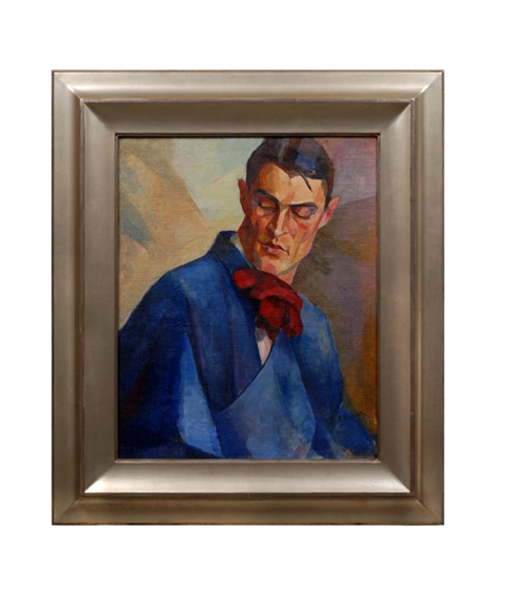
Zygmund Sazevich “Portrait of Victor Arnautoff” Oil on canvas 1925
ZYGMUND SAZEVICH (1899-1968)
Portrait of Victor Arnautoff 1925
Oil on canvas
Signed: Z. Sazevich 1925 (lower right)
Framed: H: 34 5/16” x W: 29 9/16”
Price: $65,000
Zygmund Sazevich was born in Russia in 1899, and studied briefly at the University in Kazan in 1917, before traveling to Manchuria where he lived and worked as an actor and stage scenery painter. He emigrated to the U.S. via Japan in the early 1920s and entered the School of Architecture at the University of California, Berkeley, supporting himself by working as a house painter and helping stage plays for a local Russian theater company. Sazevich met Russian artist Eugene Ivanoff, and together they shared living quarters and studied at the California School of Fine Arts in San Francisco. Sazevich was awarded two scholarships, one in painting and one in sculpture. During the 1920’s Sazevich exhibited with the San Francisco Art Association, and in 1929 won first prize at their annual exhibit, followed by several sculpture commissions. That same year Sazevich and Ivanoff traveled to live and work in Paris. Back in San Francisco in 1931, his work was included in a show of garden sculptures at the California Palace of the Legion of Honor, along with works by Adaline Kent, Ruth Cravath, and others. By 1935 he was working as a W.P.A. muralist. Sazevich and his wife Zena, a decorator, purchased a home in the City, which they filled with Sazevich’s sculptures, woodcarvings, and hand-made furniture. In 1939 Sazevich exhibited at San Francisco’s Golden Gate International Exposition. His cast terrazzo sculpture Mississippi won the 1940 purchase prize at the annual San Francisco Art Association exhibition, and he had a one-man show at the San Francisco Museum of Art in 1941. During World War II, Sazevich worked in a shipyard creating wood patterns, and in later years he designed and made hand-blocked Christmas cards that were in great demand. His clients included celebrities such as Greer Garson, Joan Fontaine, and Red Skelton. From the late 1940s until the 1960s, Sazevich taught art classes, both at the California School of Fine Arts and at Mills College in Oakland. He continued to exhibit at the San Francisco Museum of Art through the 1950s, and in 1953 was featured in the museum’s Four Sculptors of the West show. Sazevich also had two solo shows at Mills College in 1950 and 1954, and a show at Raymond & Raymond in San Francisco in 1951. Zygmund Sazevich passed away in San Francisco in 1968. In 1982 his work was included in The Oakland Museum’s seminal exhibition 100 Years of California Sculpture.
Though his works are rare today, Zygmund Sazevich was a prolific, versatile and highly-regarded San Francisco Bay Area artist and instructor whose passion for his medium was evident not only in his sculptures and carvings, but also in his drawings and paintings. Sazevich believed that the two-dimensional rendering of the subject was integral to the process of sculpture, along with the necessity for the artist to have a feeling for the material with which he worked. His convictions were reflected in the great variety of woods, metals, and stone he used to create his sculptures, as well as in his paintings.
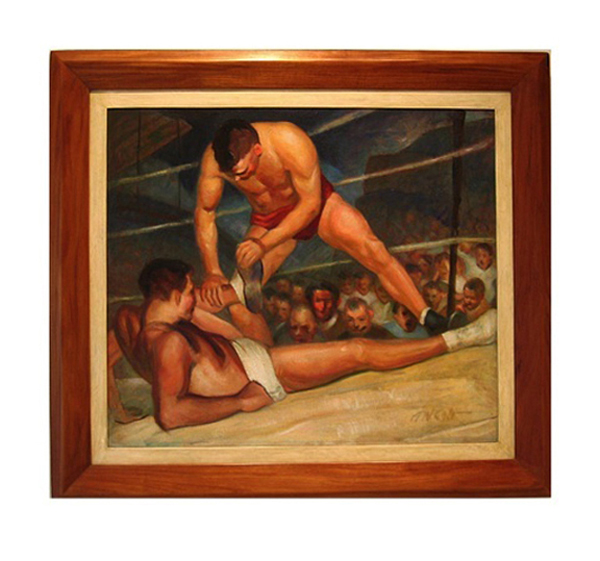
Arthur N. Colt, “The Wrestlers”, Oil on canvas c. 1938
ARTHUR N. COLT (1889-1972) USA
The Wrestlers c. 1938
Oil on canvas
Signed: A. N. Colt in lower right corner
For more information on Colt see: Who Was Who in American Art (Madison, Conn.: Sound View Press, 1985). p.125. Hove, Arthur, ed. Wisconsin Alumnus Vol. 61, No. 9 (January 1960), “Portrait Patterns” Art Digest v. 9 (December 15, 1934) p. 7
Canvas: H: 29 ½” x W: 34”
Framed: H: 38 ½” x W: 43”
Arthur Colt studied painting at the Art Institute of Chicago and in Paris. He was not only an important Wisconsin painter but also an influential teacher. He taught at the University of Wisconsin, Madison, founded a summer art colony at Black River and Devil’s Lake, WI and went on to form the Colt School of Art. Arthur Colt exhibited at the Madison Salon of Art Exhibition in 1934.
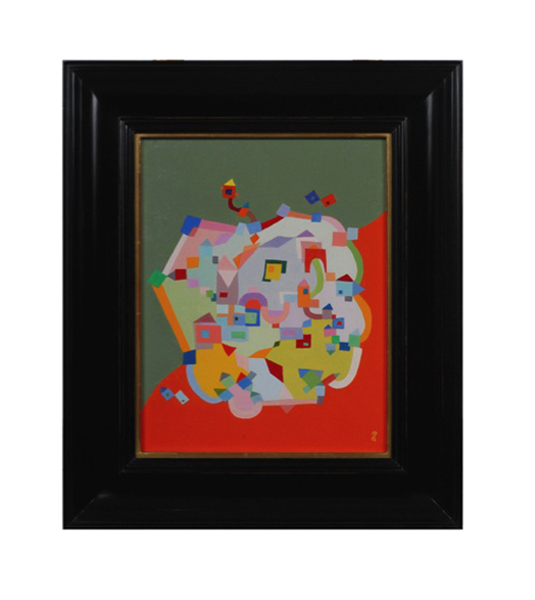
Michiel Gloeckner “Old Town No. 2”, Oil on Canvas 1960
MICHIEL GLOECKNER (1915-1989) Germany / USA
Old Town No. 2 1960
Oil on Canvas
Signed: MG (lower right corner)
Canvas: H: 14 1/16” x W: 11 1/16”
Framed: H: 19 9/16” x W: 16 9/16”
Price: 32,000
Michiel Gloeckner, known for his highly refined, balanced abstract, geometric style derived from natural forms, was the son of a well-known art collector. He graduated from the University of Dresden with a degree in mathematics and art history. He received a degree from the Royal Academy of Dresden where he studied under Otto Dix. Paul Klee also influenced Gloeckner’s work. After WWII Gloeckner moved to New York City. He continued to maintain a studio in New York at 115 East 70th Street, even after he moved to West Cornwall, Connecticut where he spent the later years of his life.
EXHIBITIONS
Gallery Seventy-Five, New York 1955, 1956, 1958
Jacques Seligman Galleries, New York 1960, 1961, 1962
Wadsworth Atheneum 1960
Wesleyan University 1961
Philadelphia Art Alliance 1962
Philadelphia Academy of Fine Arts 1963
World House Galleries, New York 1963, 1962, 1965, 1966
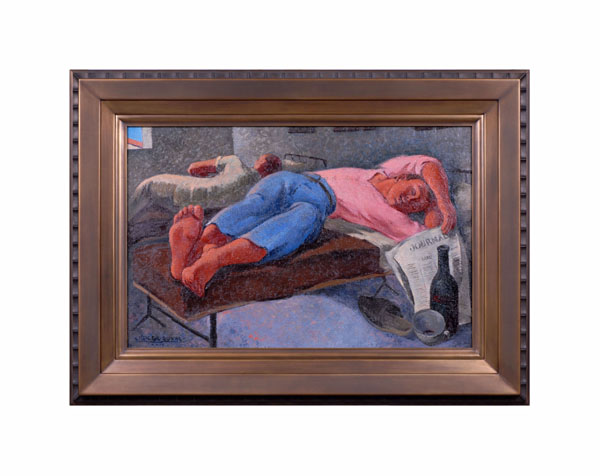
Roger Georges Andre Duval, “La Chambré” Oil on canvas 1924
ROGER GEORGES ANDRÈ DUVAL (1901-?) Meudon (Seine-et-Oise), France
La Chambré 1924
Oil on canvas
Signed and dated: ROGER DUVAL XXIV(lower left)
Exhbited: Paris, Salon des Indépendants, 1926, no. 1122
For more information see: Dictionnaire des Peintres, Sculpteurs, Dessinateurs et Graveurs, Vol. 4, E. Bénézit (Paris: Librairie Gründ, 1976).
Painting: H: 23 2/3” x W: 36 1/5”
Framed: H: 35” x 47 5/8”
Roger Duval painted in a modernist figurative style and beginning in 1920 regularly exhibited at the Salon d’Automne and the Salon des Indépendants in Paris. In 1925 he was awarded a prize by Paul Poiret for a painting entitled Conversation and again in 1926 for another painting entitled Bal Musette. Also in 1926, La Chambrée (1924) was exhibited in Paris at the Salon des Indépendants. By 1928 Duval’s technique had evolved into a moderninst/cubist style and a group of his paintings were featured in an Exposition of Painting and Sculpture in Boston, MA.
It is interesting to note Duval’s shared vision with Picasso in their depiction of peasant figures in repose. Their full-bodied, voluptuous and sensual forms illustrate both artists’ sculptural approach to painting in the early 1920s. However by the mid-1920s Duval and Picasso’s painting styles evolved from these softer, rounded shapes into more angular, abstracted forms.




 @hd_jewels
Reviews
There are no reviews yet, would you like to submit yours?