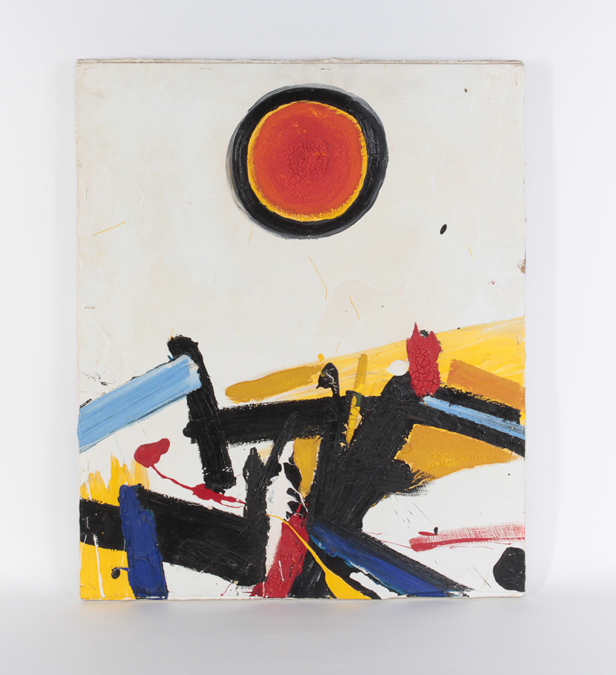
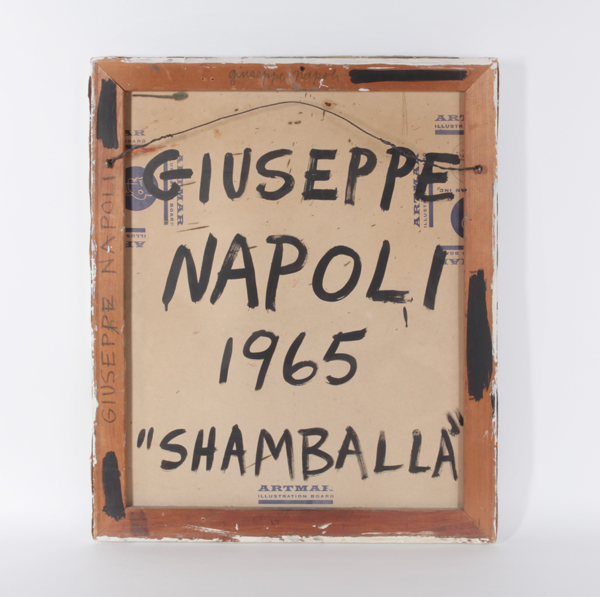
Signed: Napoli (scrafitto on front), Giuseppe Napoli 1965 “Shamballa”
(on back of board), Giuseppe Napoli (signed twice on stretcher)
H: 24” x W: 20”
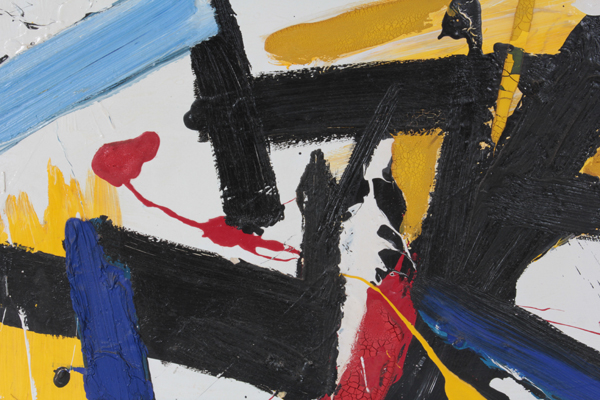
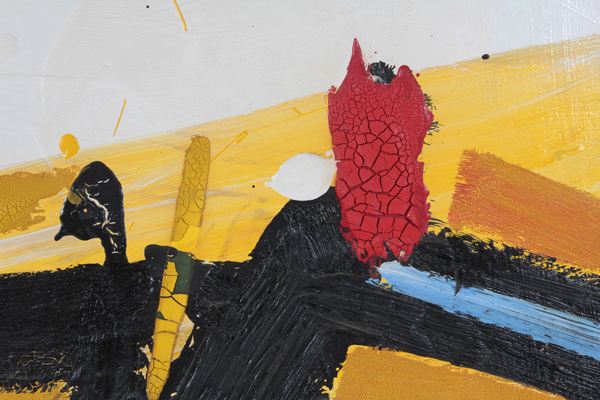
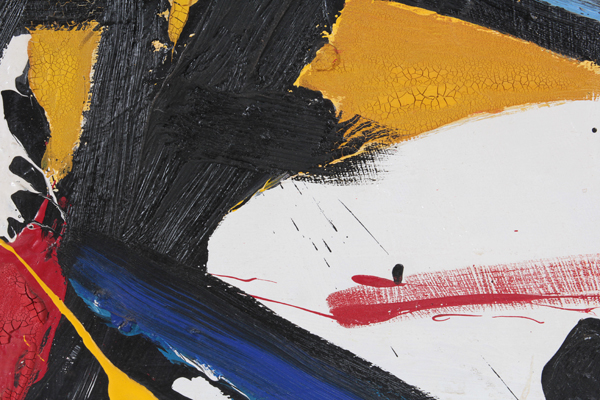
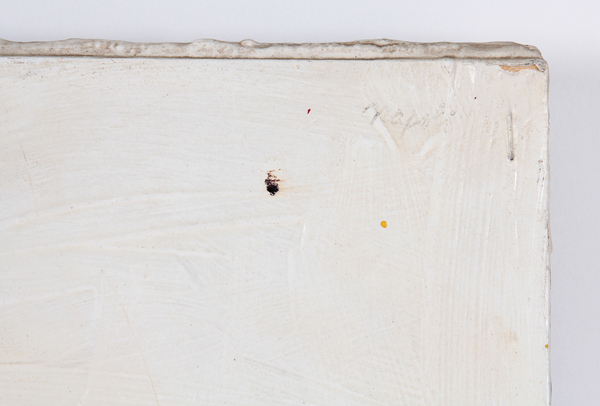
A profoundly dynamic Abstract Expressionist painting by New York artist, Giuseppe Napoli. The painting is painted on board which is affixed to stretcher bars by staples.
Giuseppe Napoli was part of the New York School of the 1950’s and 60’s working out of a small studio in Greenwich Village. Napoli participated in numerous exhibitions but unfortunately his career was cut short by his suicide in 1967 the result of suffering from periods of depression.
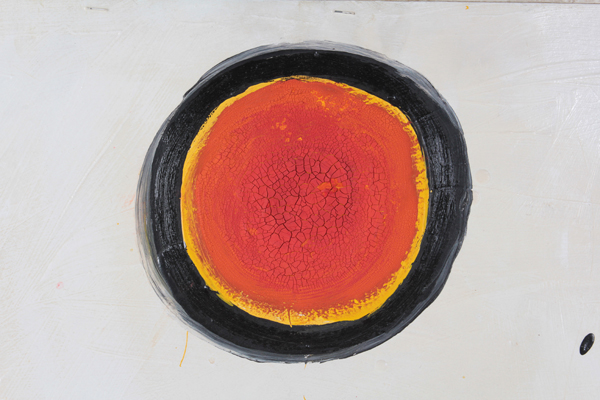
Just as “Starry Night” is widely considered to have reflected the mental state of Van Gogh shortly before his death; this painting may also have reflected the mental state of Giuseppe Napoli who ended his own life only two years after creating this remarkable painting. The vigorous, heavy impasto, the ominous sun made impotent by the bold black ring that surrounds it and the jumbled landscape below, could be symbolic of the hope-against-hope, that eventually prevailed.
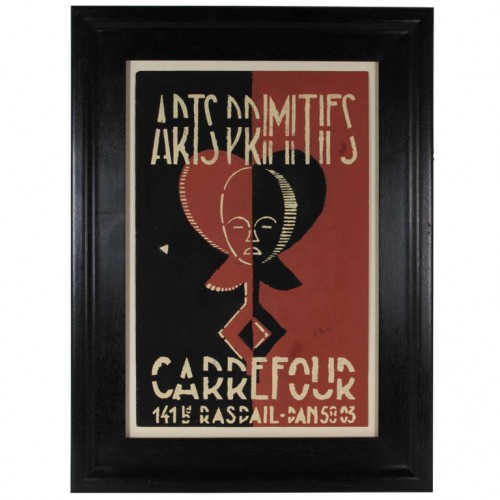
GALERIE CARREFOUR 141 Boulevard Raspail, Paris Vérité Collection Wood block print poster, ARTS PRIMITIFS, CARREFOUR, 141 BD RASPAIL, DAN 5803 c. 1948
GALERIE CARREFOUR 141Boulevard Raspail, Paris
Vérité Collection Wood block print poster “ARTS PRIMITIFS, CARREFOUR, 141 BD RASPAIL, DAN 5803″ c. 1948
Float mounted in a finely contoured oak frame.
Inscribed to: A Monsieur E Mme Breton, Vérité Image dimension:
H: 19 1/2″ x W: 12 3/4″
Framed dimension: H: 26 3/4″ x W: 19 3/4”
Price: $9,000
The Vérité Collection of primitive arts started after World War 1 in 1920. Pierre Vérité, a young artist started buying primitive art before anyone else. Vérité opened a small store selling exclusively tribal art in 1931 in conjunction with the Paris Colonial Exposition. Pierre Vérité regarded “primitive arts” as art, and it is the raw power of these primitive pieces that changed the history of 20th-century European culture. In 1936, he opened the Galerie Carrefour on the Boulevard Raspail, which was a hangout for artists and collectors such as Pablo Picasso, Helena Rubenstein, Nancy Cunard and Andre Breton. Tribal art was one of the key influences on Pablo Picasso and he often dropped into Pierre Vérité’s Galerie Carrefour in Paris to buy masks and carvings from Africa and Oceania. Henri Matisse was also a regular visitor, as were other artists such as Fernand Léger and Maurice de Vlaminck, while Vérité used to browse Parisian flea markets with André Breton, Surrealism’s chief theorist. In the decades that followed the opening of the gallery, the Vérité family’s client list grew to include Hollywood stars and leading museum curators, as well as some of the greatest names in 20th-century art. Vérité very quickly became the most important art dealer for primitive arts. In the 1948, Pierre’s son Claude became increasingly involved in the gallery. He went on African expeditions, collecting objects and information, and took photographs to document his travels, while his wife Jeannine was running the gallery operations. With Claude and Jeannine joining the gallery, Galerie Carrefour showed at all “Art Primitifs” exhibitions in Europe and the United States. The gallery established itself as the most important player in tribal arts in the world and exhibited until the 1990’s.
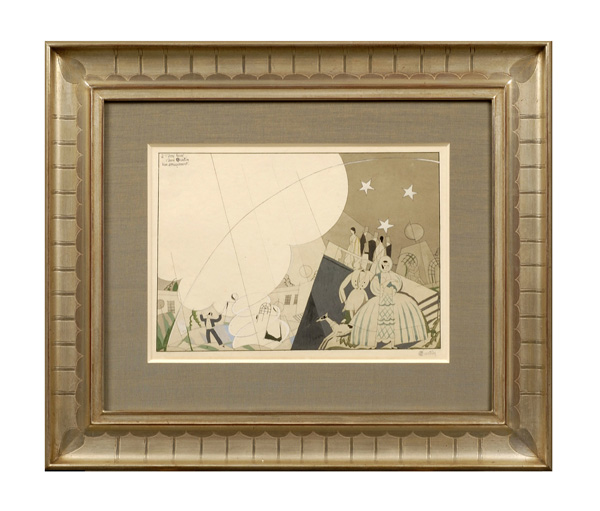
Charles Martin, “Bal Masque”, Pencil, ink, gouache and watercolor on paper 1927
CHARLES MARTIN (1884-1934) France
Bal Masque 1927
Pencil, ink, gouache and watercolor on paper.
Signed: Martin (lower right corner); A l’Ami Koval, l’Ami Martin, Bien Amicalement (upper left corner)
H: 8” x W: 11 7/16”
Price: $12,500
Charles Martin was a notable French illustrator, graphic artist, posterist, fashion and costume designer. His drawings are charming, amusing and sophisticated. The artist studied at the Montpelier Ecole des Beaux Arts, Academie Julian and Ecole Des Beaux Arts, Paris. Throughout his career, Martin was also a contributor to the French fashion journals Gazette du Bon Ton, Modes et Manieres d’Aujourd’hui, Journal Des Dames et Des Modes, and Vogue. His illustrated books include the hat catalogue “Les Modes en 1912,” the erotic “Mascarades et Amusettes” 1920, and “Sports et Divertissements” 1919, written in collaboration with composer Erik Satie.
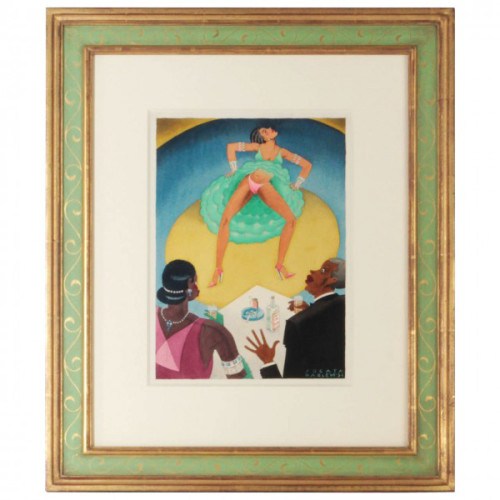
S O G A T A New York, NY “Harlem: Concert” Watercolor and pencil on paper 1931
S O G A T A New York, NY
“Harlem: Concert” 1931
Watercolor and pencil on paper
Signed: SOGATA · HARLEM 1931 (in pencil, lower left corner of image); HARLEM: CONCERT. (in pencil beneath image on left)
For contextual history and similar art see: Rhapsodies in black : art of the Harlem Renaissance, (Berkeley: University of California Press, 1997); Harlem Renaissance Artists. Jordan, Denise (Chicago: Heinemann Library, 2003).
Paper H: 14 7/8″ x W: 10 7/8″
Image H: 11″ x W: 7 1/2″
Frame H: 19 1/4” x W: 16”
*This SOGATA New York Watercolor and pencil on paper has been gifted to The Wolfsonian – FIU, Miami Beach, FL.


 @hd_jewels