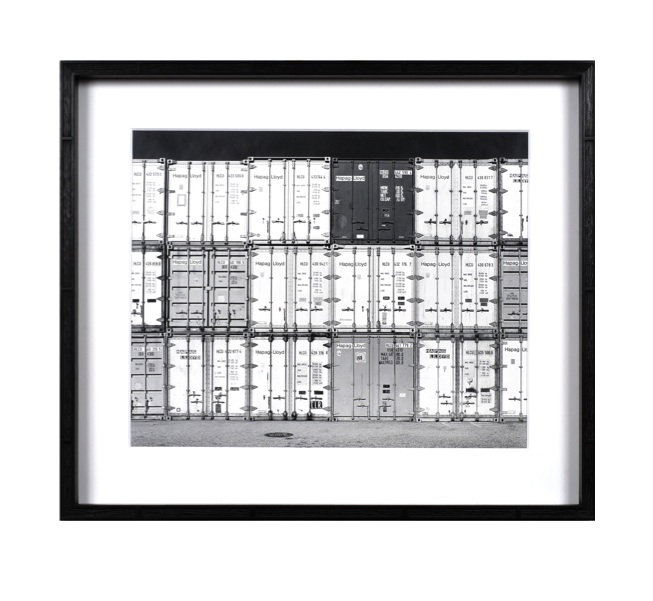
Grant Mudford, Containers, Gelatin silver print, 1979
GRANT MUDFORD (1944- ) Australia
Containers 1979
Gelatin silver print
Signed and dated on back
Framed size: H: 26 ½” x W: 30 ¾”
“Since he moved to Los Angeles from Australia in the late 1970s, Grant Mudford has composed photographs that crisply examine the streamlined geometries of West Coast architecture and landscape. Mudford has zeroed in on the abstract formal relationships lurking within the designs of gas stations, strip malls and apartment buildings. The geometrical arrangements highlighted in his photographs of the masterful modernist structures of Rudolf Schindler and Craig Ellwood have disclosed a link between their midcentury architecture and the contemporaneous hard-edge abstractions of L.A. painters John McLaughlin and Lorser Feitelson.” – Art in America, “Grand Mudford at Rosamund Felsen, September 2003
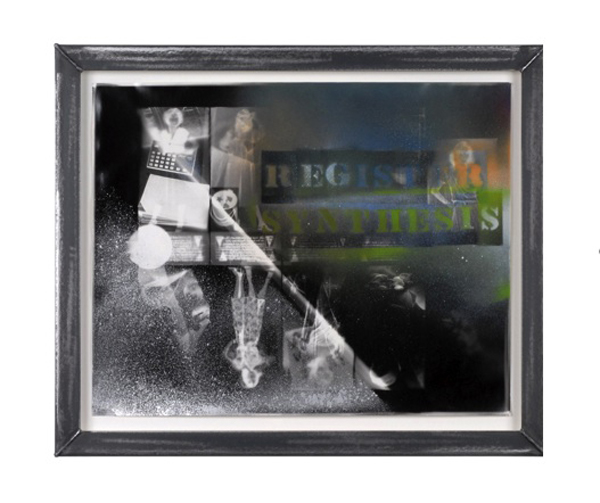
Thomas F. Barrow, Register Synthesis, Gelatin silver print photogram with applied spray paint, 1978
THOMAS F. BARROW (b. 1938) Kansas City, MO
Register Synthesis Photogram 1978
Gelatin silver print photogram with applied spray paint
Signed: Register Synthesis – 1978 – Thomas F. Barrow (in ink on back)
Exhibited: J.J. Brookings & Co. (San Jose, CA): Thomas F. Barrow: Inventories and Transformations, A Twenty Year Retrospective, Nov. 6 – Dec. 16, 1986. This exhibit occurred simultaneously with the following two museum shows: the San Francisco Museum of Modern Art (Nov. 6, 1986 – Jan 11, 1987) and the Los Angeles County Museum of Art (Feb. 26 – May 10, 1987).
Related photograph illustrated: Aperture: The New Vision: Forty Years of Photography, no. 87 (New York: Aperture Foundation, Inc., 1987), cover image.
Framed size: H: 19 5/8” x W: 23 7/16”
Thomas Barrow, American was born in Kansas City, Missouri. He studied at the Art Institute of Design in Chicago, Illinois and received his M.A. in 1967. At the George Eastman House, Barrow was the Assistant Director from 1971 to 1972 and served as the Associate Director of the University of New Mexico Art Museum from 1973 to 1976. Barrow started teaching photography in 1976 in the Art Department of the University of New Mexico and by 1985 he became the Acting Director of the University Art Museum. His Midwestern academic pedigree includes studying with Aaron Siskind at the Art Institute of Design in Chicago and with filmmaker Jack Ellis at Northwestern University in Evanston, IL. Barrow has received two NEA Photographers Fellowships in 1973 and 1978.
Barrow has produced a series of silver-gelatin photograms and then applied spray paint to the prints. These combine the feeling of a split-toned black and white print and at the same time appear as color-print photograms. He has produced a series of photograms entitled Disjunctive Forms. His images appear as surreal assemblages of various found and created objects superimposed with stencil text. Barrow works in the “academic” tradition—his pictures are deliberately and consistently experimental, highly intellectualized, scholarly in their concerns, and chock-full of references to the work of other artists.
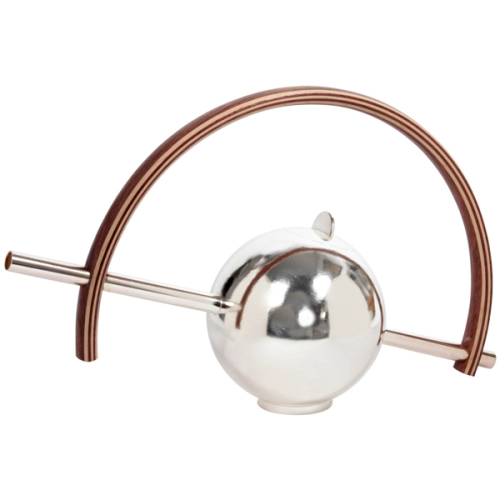
Wolfgang Gessl / Scandinavian Modern Sterling silver teapot with arching handle 1990
WOLFGANG GESSL (b. 1949) Austria / Sweden
Teapot 1990
Hand wrought and hand hammered spherical silver teapot with cylindrical handle and spout elements, maple and padouk wood layered arching handle
This is No. 2 out of the edition of 3 models.
Marks: Wolfgang Gessl (script impressed signature), 2/3, WO.GE (in a rectangle), Swedish assay mark for Stockholm, 925 (silver guarantee in a rectangle), E11 (in a rectangle), LF
Exhibited: Glänsande Geometri, Mettalum, Stockholm, Sweden
Illustrated: Gold and Silversmith Wolfgang Gessl: Exceeding Geometry, Kerstin Wickman, p. 16.
H: 10” x W: 16 ½” x D: 5 ½”
Price: $32,000
Wolfgang Gessl was born in 1949 in Vienna, Austria and trained as a goldsmith with Professor Hans Angerbauer. Upon moving to Sweden, Gessl studied under the eminent silversmith Sigurd Persson at Konstfack, the National University of Art, Craft and Design in Stockholm, Sweden.
Wolfgang Gessl has had fifteen solo exhibitions including shows at The National Museum, Stockholm and The Royal College of Art in London. His metalwork has been widely exhibited in Sweden, Europe and the U.S and his pieces can be found in many private collections throughout the world. He has taught at Konstfack for more than twenty-four years, and continues to live and work in Stockholm.
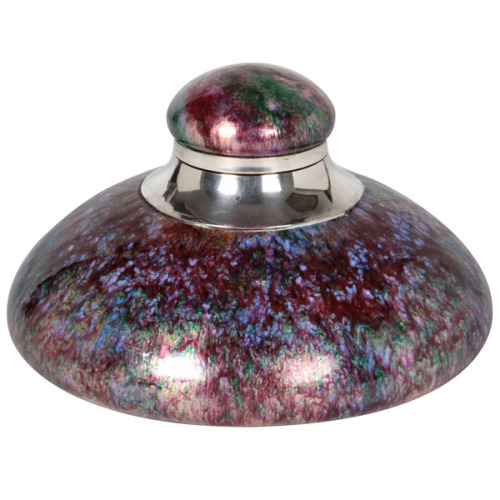
Paul Haustein Germany Rare Jugendstil enamel and silver inkwell c.1900
PAUL HAUSTEIN (1880-1944) Germany
HERMANN BEHRND (b. 1849) SILBERWARENFABRIK (silver) Dresden, Germany
JAKAB RAPOPORT (enamelist) Budapest, Hungary
Inkwell c. 1900
Multicolored burgundy, purple, blue and green enamel with silver mounts, glass insert
Marks: Moon, crown, 800, HB (Hermann Behrnd mark)
Same model with variant mount illustrated: Deutsche Goldschmiede-Zeitung, n.d. (circa 1903-05), p. 23
For related works and more information see: Art Nouveau in Munich: Masters of Jugendstil, ed. Kathryn Bloom Hiesinger (Philadelphia: Philadelphia Museum of Art, 1988) pp. 67-69; Jugendstil in Dresden, Aufbruch in die Moderne, Gisela Haase et al., exh. cat. (Dresden: Staatliche Kunstsammlungen Dresden; Wolfratshausen: Edition Minerva, 1999).
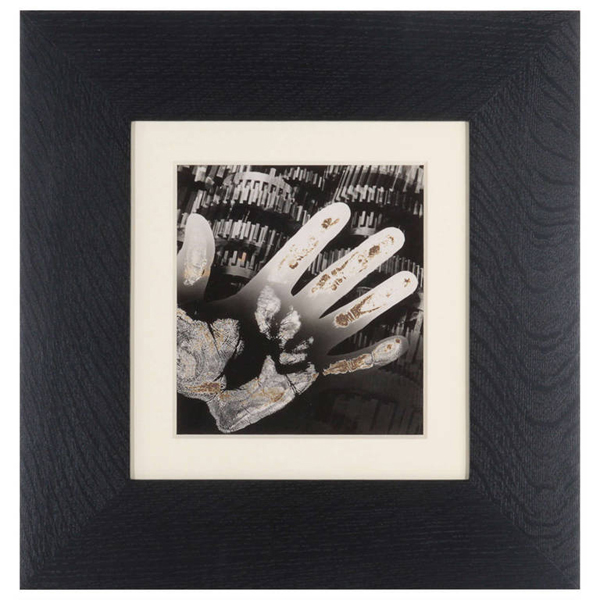
Edmund Kesting, Gears with hand, Photogram / Solarization c.1929
EDMUND KESTING (1882-1970) Germany
Gears with hand c.1929
Photogram / Solarization
Signed: Edmund Kesting 3644-280 (in pencil)
Provenance: Private Collection New York; Gene Prakapas Gallery New York 1970’s
Photogram: H: 7 9/16” x W: 6 15/16”
Frame: H: 15 9/16” x W: 14 15/16”
Price: $19,500
During the 1920s, Kesting was at the center of the avant-garde movement in Germany, where he befriended Kurt Schwitters and Laszlo Moholy-Nagy. He first trained as a painter at the Akademie der Kunst in Dresden from 1911 to 1916. In the early 1920s, after service in World War I, he turned to collage and photography. An exhibitor at Herwarth Walden's Der Sturm gallery (Berlin), which supported German expressionism and the Blue Rider group, Kesting also operated several private art schools. The last, Der Weg (The Way), was closed by the Nazis in 1933. Kesting’s interest in the photographic portrait began in 1930, and often resulted in bold experimentation (Photomontages, superimpositions and solarizations) that provided some of the strongest examples of German expressionist portraiture in photography. In contrast to the objective naturalism of August Sander, his work is informed by the “Sturm und Drang” of the period – the storm and stress of the political, economic, and social unrest in Germany. After the war in 1948, Kesting taught at the Kunsthochschule in Berlin-Weissensee. – (partially excerpted from James Borcoman, Magicians of Light, National Gallery of Canada, 1993)
Works by Edmund Kesting can be found in the collections of the Museum of Modern Art in New York and the Los Angeles County Museum of Art.
Solarization — is a phenomenon in photography in which the image recorded on a negative or on a photographic print is wholly or partially reversed in tone. Dark areas appear light or light areas appear dark. The term is synonymous with the Sabattier effect when referring to negatives, but is technically incorrect when used to refer to prints. In short, the mechanism is due to halogen ions released within the halide grain by exposure diffusing to the grain surface in amounts sufficient to destroy the latent image.


 @hd_jewels