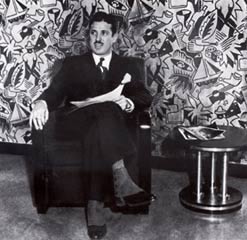
Donald Deskey was a native of Blue Earth, Minnesota. He studied architecture at the University of California, but did not follow that profession, becoming instead an artist and a pioneer in the field of Industrial design. In Paris he attended the 1925 Exposition Internationale des Arts Décoratifs et Industriels Modernes, which influenced his approach to design. He established a design consulting firm in New York City, and later the firm of Deskey-Vollmer (in partnership with Phillip Vollmer) which specialized in furniture and textile design. His designs in this era progressed from Art Deco to Streamline Moderne.
He first gained note as a designer when he created window displays for the Franklin Simon Department Store in Manhattan in 1926. In the 1930's, he won the competition to design the interiors for Radio City Music Hall. In the 1940's he started the graphic design firm Donald Deskey Associates and made some of the most recognizable icons of the day. He designed the Crest toothpaste packaging, as well as the Tide bullseye. His company is still in operation in Cincinnati. A collection of his work is held by the Cooper-Hewitt, National Design Museum. He is regarded the American pioneer of industrial design, and contemporary American graphic design.
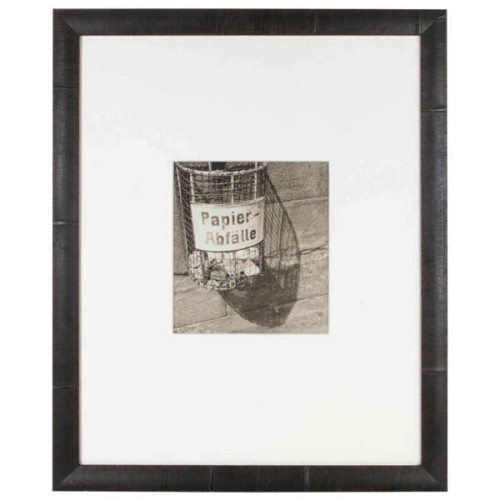
Donald Deskey, Papier-Abfälle, Gelatin silver print, c.1925-30
DONALD DESKEY (1894-1989) USA
Papier-Abfälle c.1925-30
Provenance: The Estate of Donald Deskey
H: 9 7/8” x W: 7 15/16”
Framed: H: 22” x W: 18”
Donald Deskey was a native of Blue Earth, Minnesota. He studied architecture at the University of California, but did not follow that profession, becoming instead an artist and a pioneer in the field of Industrial design. In Paris he attended the 1925 Exposition Internationale des Arts Décoratifs et Industriels Modernes, which influenced his approach to design. He established a design consulting firm in New York City, and later the firm of Deskey-Vollmer (in partnership with Phillip Vollmer) which specialized in furniture and textile design. His designs in this era progressed from Art Deco to Streamline Moderne.
He first gained note as a designer when he created window displays for the Franklin Simon Department Store in Manhattan in 1926. In the 1930's, he won the competition to design the interiors for Radio City Music Hall. In the 1940's he started the graphic design firm Donald Deskey Associates and made some of the most recognizable icons of the day. He designed the Crest toothpaste packaging, as well as the Tide bullseye. His company is still in operation in Cincinnati. A collection of his work is held by the Cooper-Hewitt, National Design Museum. He is regarded the American pioneer of industrial design, and contemporary American graphic design.
Illustrated: New Bauhaus, 50 Jahre: Bauhausnachfolge in Chicago (Berlin: Bauhaus-Archiv and Argon Verlag GmbH: 1987), p. 177
H: 18 5/8” x 22 ½” (framed)
Nathan Lerner’s long career was inextricably bound up in the history of visual culture in Chicago. Born in 1913 to immigrants from Ukraine, he began studying painting at the Art Institute of Chicago at the age of 16, taking up the camera to perfect his compositional skills. At 22 he began doing a kind of photojournalism, developing his well-known series on ”Maxwell Street,” an immigrant neighborhood hit hard by the Depression, and also photographing the southern Illinois mining area. In 1936 when the New Bauhaus was established in Chicago by Lazlo Moholy-Nagy, Lerner became one of its first scholarship students and turned increasingly to photographic experimentation. He began making semi-abstract, strongly Constructivist images involving luminous projections, solarization, photograms and other methods, and his interest in manipulating light led him to invent the first ”light box.” In 1939 he became the assistant of Gyorgy Kepes, head of the school’s light workshop; together, they wrote ”The Creative Use of Light” (1941). With Charles Niedringhaus in 1942 he developed a machine for forming plywood that was used in making most of the school’s furniture. After working as a civilian light expert for the Navy in New York during World War II, Lerner returned to the school, now called the Institute of Design, and was named education director after Moholy-Nagy’s death in 1946. He left in 1949, opening a design office that became nationally known for its furniture, building systems and glass and plastic containers (including bottles for Revlon and Neutrogena and the Honeybear honey container). In 1968 Lerner married Kiyoko Asia, a classical pianist from Japan, and over the next two decades made numerous trips to Japan, where he took his first color photographs, as well as Mexico. He had his first solo exhibition of photography in 1973 and thereafter exhibited regularly in galleries and museums in the United States, Europe and Japan. His work is included in photography and design collections around the world. (Roberta Smith, New York Times, February 15, 1997).
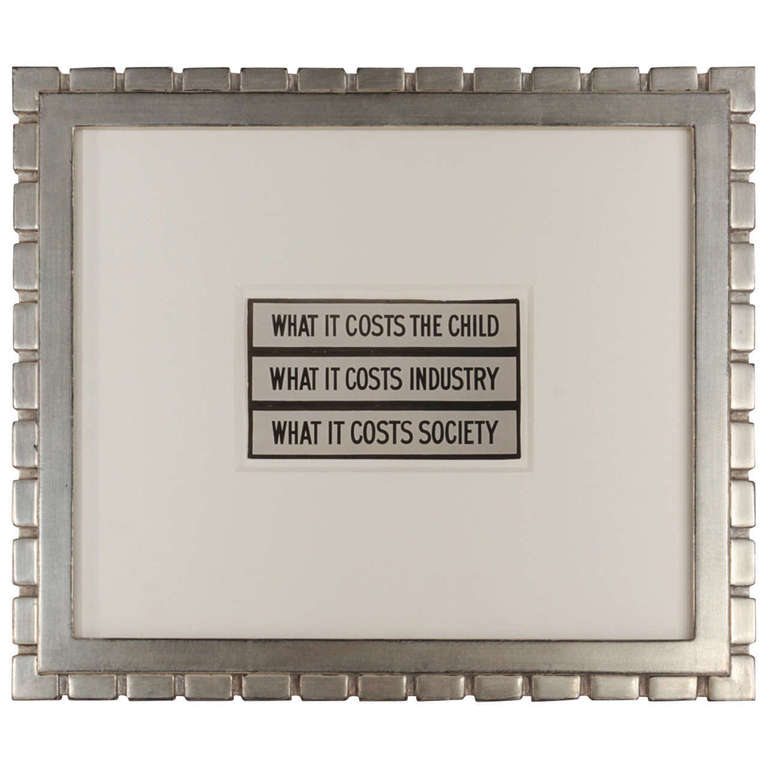
Lewis Hine, What It Costs The Child/Industry/Society, Silver gelatin print c. 1913-14
LEWIS HINE (1874-1940) USA
What It Costs The Child/Industry/Society c. 1913/14
Silver gelatin print
Signed in script on back
Framed size: H: 14 1/8” x W: 16 3/16”
Price: $20,000
***The same image is in the collection of the Metropolitan Museum of Art, New York.
Lewis Wickes Hine, photographer, sociologist and humanist, is best known for his insightful portraits of immigrants at Ellis Island and his unflinching views of housing and labor conditions in the United States. Studying and eventually teaching at the Ethical Culture School in New York City, Hine infused his humanist concerns into a style of documentary photography that set the standard for delivering a social message through his medium.
The Artist's Joke surveys the rich and diverse uses of satire by avant-garde and contemporary artists. The texts collected in this new reader from London's Whitechapel Gallery examine what Andre Breton called the “lightning bolt” of the unsettlingly comic, as seen in the anarchic wordplay of Duchamp, Picasso, the Dadaists, and Surrealists; Pop's fetish for kitsch and the comic strip; Bruce Nauman's sinister clowns and twisted puns; Richard Prince's joke paintings; art ambushed by feminist wit, from the Dadaism of Hannah Hoch in the 1920s to the politicized conceptualism of Jenny Holzer and Barbara Kruger in the 1980s; the serenely uncanny in Mike Kelley's installations and the risibly grotesque in Paul McCarthy's; and the strangely comic scenarios of artists as various as Maurizio Cattelan, Andrea Fraser, Raymond Pettibon, and David Shrigley. Artists' writings are accompanied and contextualized by the work of critics and thinkers including Freud, Bergson, Helene Cixous, Slavoj Zizek, Lewis Wickes Hine, Jorg Heiser, Jo Anna Isaak, and Ralph Rugoff.
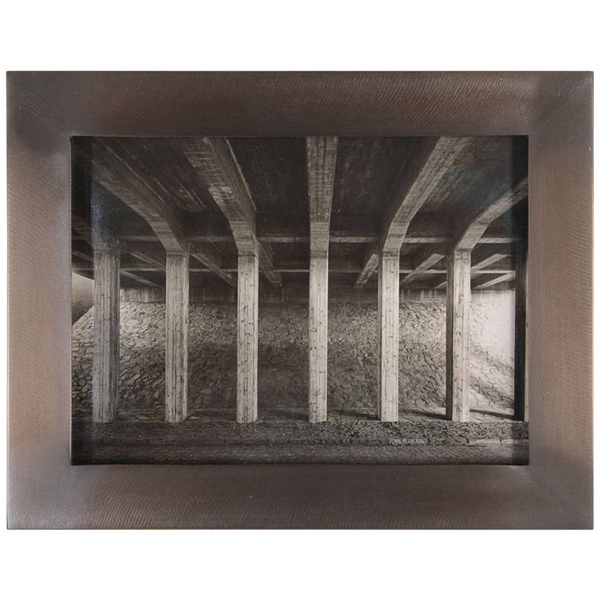
Werner Mantz is regarded as one of the most gifted architectural photographers of the twentieth century. His talent in this field we recognized early in his career and he received numerous commissions from a variety of prominent architects, first in Germany and later in the Netherlands. His work in Cologne especially, from the mid-1920s to the early 1930s, forms a definitive statement of the Neue Sachlichkeit movement in architecture.
Works by Werner Mantz can be found in the collections of the Metropolitan Museum of Art in New York, The Museum of Modern Art in New York, The Art Institute of Chicago, Tate London and many more.




 @hd_jewels