Product Description
Imperial topaz (26 carats) solitaire ring set in platinum with two elongated baguette diamonds, signed: L and M French maker’s mark in a diamond poincon, French Dog’s head assay mark for platinum, c.1950

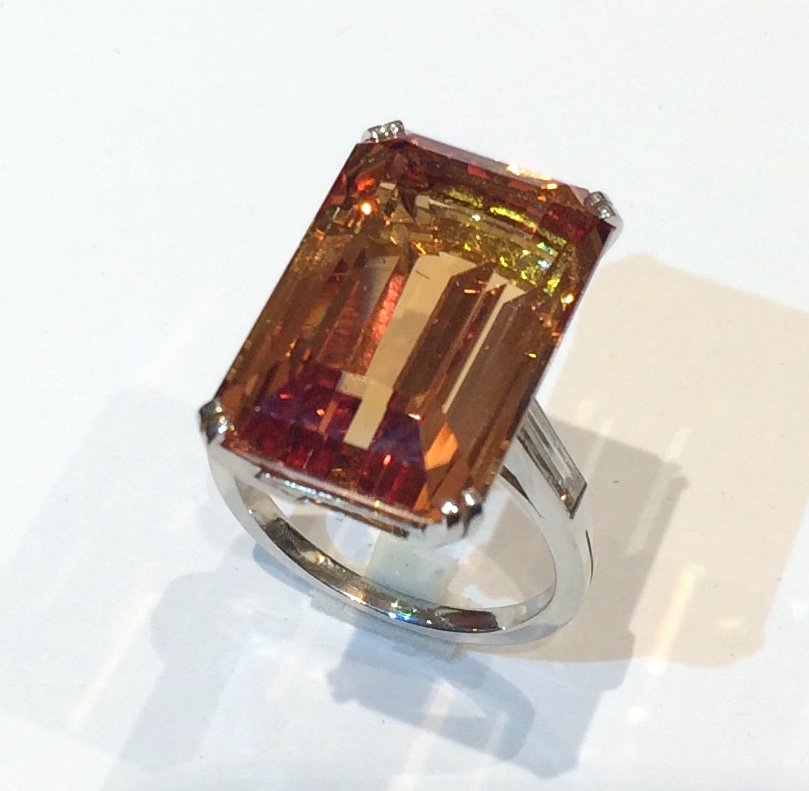
Imperial topaz (26 carats) solitaire ring set in platinum with two elongated baguette diamonds, signed: L and M French maker’s mark in a diamond poincon, French Dog’s head assay mark for platinum, c.1950

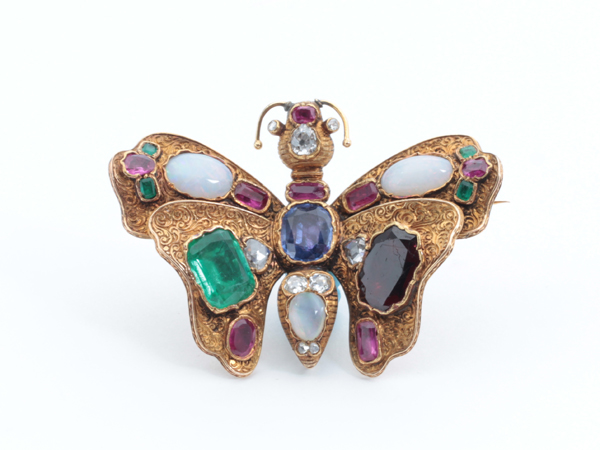
Charles Darwin published his theory of evolution with compelling evidence in his 1859 book “On the Origin of Species” overcoming scientific rejection of earlier concepts of transmutation of specie. By the 1870s both the scientific community and much of the general public had accepted evolution as a fact and awakening the public to the diversity of life. The frog emerging from Darwin’s Pond was a symbol of the times and a favorite theme for jewelry of the era.
PROF. MICHAEL POWOLNY (1871-1954) Austria
LÖTZ WITWE GLASWERKS Klostermuhle
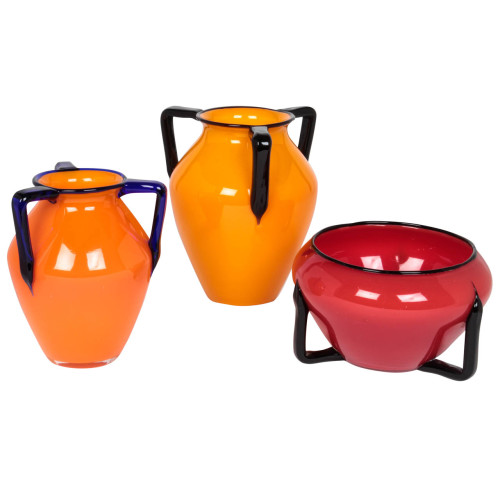
Set of three “Tango” glass vases c. 1920
Blown tall yellow glass with applied black handles, blown orange glass with applied cobalt blue handles, blown red glass with applied black handle-form feet
Marks: Cecho. Slovakia (acid etched in an oval) (red vase)
Yellow and black vase H: 6 1/2” x Dia: 6″
Orange and cobalt blue vase H: 5 1/2” x Dia: 6″
Red and black vase H: 3 1/2” x Dia: 6″
For more information see: Lötz: Böhmisches Glas 1880-1940, Band 1, Helmut Ricke and Ernst Ploil, (Munich: Prestel-Verlag, 1989) ; Glass of the Avant-Garde, From Vienna Secession to Bauhaus, The Torsten Bröhan Collection from the Museo Nacional de Artes Decorativas, Madrid, Torsten Bröhan, Martin Eidelberg (Munich, London, New York: Prestel Verlag, 2001).
Other Powolny works: Jugendstil Art Nouveau: floral und functional forms, Siegfried Wichmann (New York / Boston: Graphic Society, Little, Brown and Co., 1984), p. 226; Vienna 1900-1930: Art in the Home, Historical Design exhibition catalogue (New York: Historical Design, Inc., 1996), p. 45; Modernism:Modernist Design 1880-1940, The Norwest Collection, Norwest Corporation, Minneapolis, Alastair Duncan (Woodbridge, Suffolk, England: The Antique Collector’s Club, 1998).
SOLD
JAIPUR, MUGHAL INDIA
Enameled and gem set gold Cup and Saucer c. mid-19th Century
High carat yellow gold (22-24 carat) cup and saucer set with a fine emerald, ruby and diamonds, the cup with a high foot with rounded sides and handle formed of two snakes intersecting at three points and biting the rim. The exterior is decorated with red, green, blue and white enamels with roundels containing combatant animals on a ground of floral sprays, the saucer with gently rounded sides decorated with lobed cartouches containing warriors combating tigers and birds, the underside with a series of oval panels containing peacocks and hummingbirds.
Provenance: a gift from a European diplomat in the 1930’s-40’s, and thence by descent.
Saucer: Dia: 5 1/4;
Cup: H: 2 3/4″ (with handle) x Dia: 2 5/8″
Similar animal decoration can be found in an epaulette attributed to Rajesthan, probably Jaipur, in the Khalili Collection (Pedro Moura Carvalho, Gems and Jewels of Mughal India, London, 2010, p. 225, no. 120. A related cup and saucer with similar animal depictions was sold at Christie’s (Islamic Art, Indian Miniatures, Rugs and Carpets, London, 21st October 1993, lot 350.