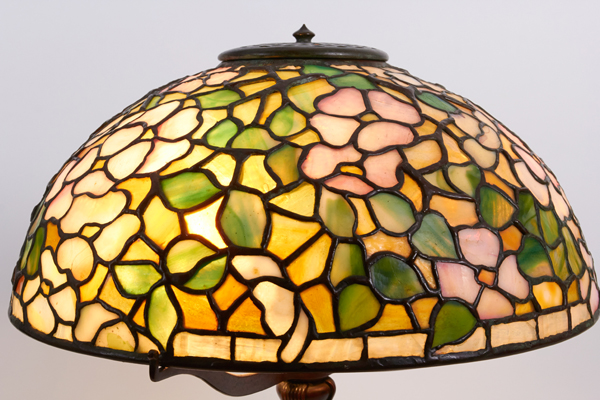
Louis C. Tiffany / Tiffany Studios Dogwood Blossom table lamp c. 1906
More Information
Louis C. Tiffany / Tiffany Studios Dogwood Blossom table lamp c. 1906
LOUIS C. TIFFANY (1848-1933) USA
TIFFANY STUDIOS New York
Dogwood Blossom table lamp c.1906
Stained glass shade in shades of pink, white, gold and green glass with rich brown/green patinated leading and a matching base with a rich brown/green patina.
Signed: TIFFANY STUDIOS NEW YORK (impressed bronze tag on shade); TIFFANY STUDIOS NEW YORK, 2588-1, Tiffany Glass & Decorating Company cipher (impressed on base)
Related model illustrated: Tiffany at Auction, Alastair Duncan (New York: Rizzoli, 1981), p. 98, illustration 268
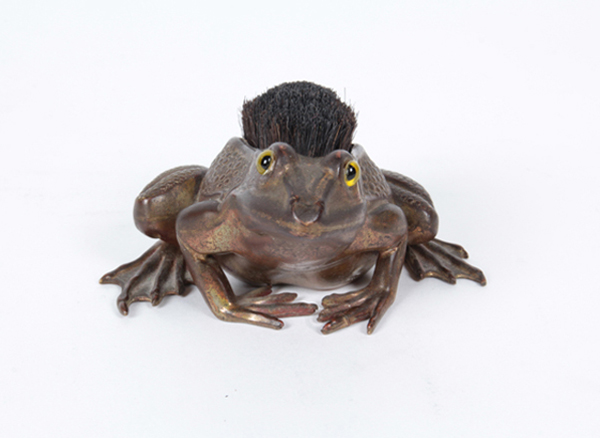
Franz Xaver Bergman Art Nouveau “Frog” pen wipe c. 1905-1910
FRANZ XAVER BERGMAN (1861-1936) Austria
“Frog” pen wipe c. 1905-1910
Cold-painted bronze, boar’s hair bristles
For information see: Art Bronzes, Mich. Forrest (Schiffer, 1988).
L: 3 1/2″ x W: 3 1/2″ x H: 2″
Price: $1,675
A well-known animalier at the turn-of-the century, the sculptor Franz Bergman created a number of small bronzes in a variety of subject matter. Other figurative works were informed by the Jugendstil / Art Nouveau style and the European taste for the exotic as is found in his figures of rug merchants and camels. His animal sculptures, however, capture the Viennese tradition of naturalistic bronzes. The quality of the bronze casting shows tremendous detail, which was carefully brought out through the applied patination process known as cold painting.
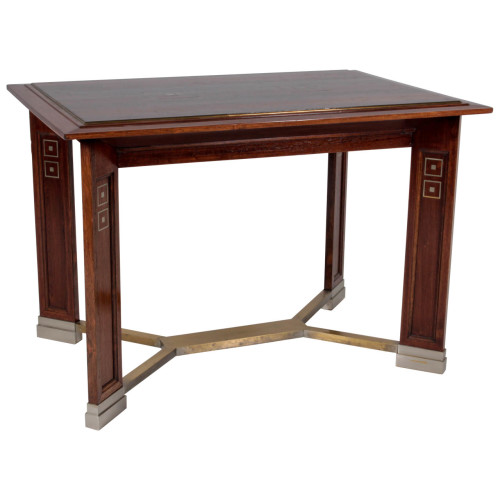
KOLOMAN MOSER attr. (1868-1918) Austria
PORTOIS & FIX Vienna, Austria
Secessionist center table c. 1902
Exotic wood with brass inlaid squares, brass stretcher and feet with nickel-plated sabots
Marks: No. 29378 (inventory paper label), oval metal plaque in Russian with No. 798
***This table was likely exhibited at the 1902 Moscow Exhibition of Architecture and Applied Art and that is perhaps the reason for the Russian metal plaque.
For more information see: Art in Vienna, Peter Vergo (London: Phaidon Press Ltd., 1975), p. 139, footnote 88, p. 247.
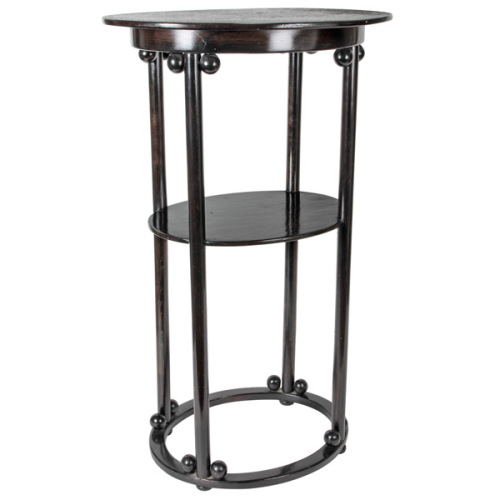
Josef Hoffmann Table for J & J Kohn, Vienna Secession c.1915
JOSEF HOFFMANN (1870-1956) Austria
JACOB & JOSEF KOHN Vienna, Austria
Oval occasional table c.1915
Model no. 960/4
Ebony stained beech
Marked: original Jacob & Josef Kohn paper label
Illustrated: Jacob & Josef Kohn: Bentwood Furniture, der Katalog von 1916 (München: Verlag Dry, 1985), p. 69;
Against the Grain: Bentwood Furniture from the Collection of Fern and Manfred Steinfeld, Ghenete Zelleke, Eva B. Ottilinger and Nina Stritzler (Chicago: The Art Institute of Chicago, 1993) p. 88.
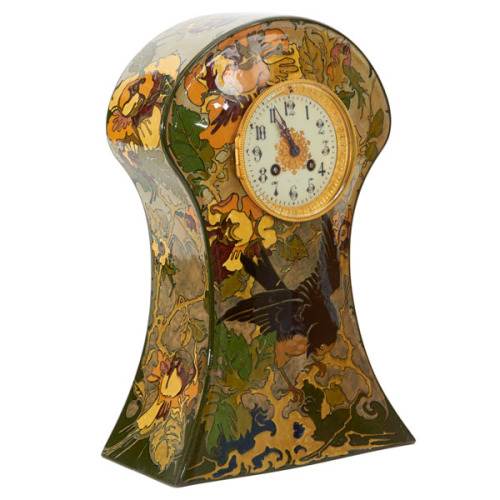
Rozenburg Pottery Holland, W.P. Hartgring Art Nouveau Mantle Clock, 1904
W. P. HARTGRING
ROZENBURG POTTERY The Hague, The Netherlands
Blackbird mantle clock 1904
Handpainted earthenware with exotic foliage and a bird, porcelain face, gilt bronze surround, original clock mechanism.
Marks: H (artist’s monogram) 534, Rozenburg den Haag trademark, date mark symbol for 1904
For more information see: Art et Décoration, vol. 8 (1900) 193, illus. p. 189 (A. Sandier, La ceramique à l’Exposition); Kunst und Kunsthandwerk, vol. 3. (1900) 395, illus. p. 392; Art et Décoration, vol. 9 (1901) 56 Abb. S. 54 (A. Sandier, La Ceramique à l’Exposition II); Der Moderne Stil, Julius Hoffmann, Vol. 3, (1901) Taf. 53.; La Kunstgewerbeblatt Neue Folge, Vol. 12. (1901) p. 95, Abb. S. 82,89; “The International Exhibition of Modern Decorative Art at Turin – The Dutch Section,” Enrico Thovez in The Studio, vol. 26 (1902), pp. 204-6; Kunst und Kunsthandwerk, Vol. 7 (1904), p. 568, Abb. S. 574-5, (K. Ruge, Kunst und Kunstgewerbe auf der Weltausstellung zu St. Louis); Art et Décoration, vol. 17 (1905) p.86 Abb. S. 77, 88 (G. Mourey, L’Art Decoratif Hollandais); Sprechsaal, Vol. 38, (1905) p. 517 (W.H. Zimmer, Die Weltausstellung in St. Louis; Rozenburg, Monographie einer Manufaktur 1883-1917, Marjan Boot et al. (Munich: Verlag Künst & Antiquitäten, 1984); Sammlung Bröhan: Kunsthandwerk 1-Jugendstil, Werkbund, Art Deco, Glas, Holz, Keramik, (Berlin: Karl H. Brohan, 1976) p. 367-380.






 @hd_jewels